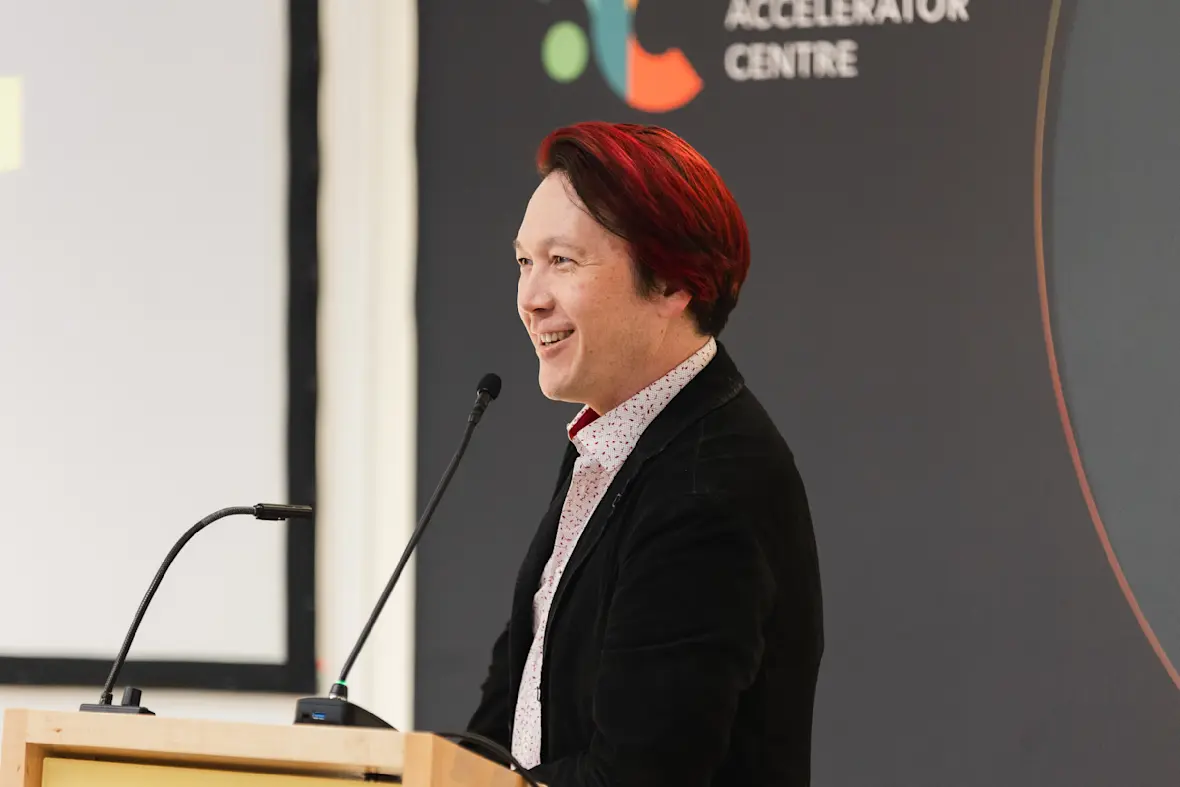
Mila Banerjee thought she knew who would pay. Her startup, Pronti AI, helps people assemble outfits from clothes they already own. Retailers seemed the obvious customer. Yet, as she explained at Accelerator Centre’s 2025 Studio showcase, charging users produced greater appreciation and engagement. The person opening the wardrobe turned out to be more interesting than the merchant hoping to fill it. A business model had acquired an inconvenient new fact.
That is a useful way into Accelerator Centre, or AC. Entrepreneurship has a weakness for immaculate plans. AC’s job is to put those plans within reach of people who can inspect them, customers who can contradict them, and specialists who can help rebuild them. The attraction is practical: founders keep their equity while getting help with the decisions that determine whether it becomes worth anything.
- Personalized mentoring for early-stage technology businesses.
- Sales training, product support and investor connections across different programs.
- No equity taken; fees and grant eligibility vary.
- Studio funding requires matching cash, with further selection before the full award.
01 / Waterloo built a bridge
AC opened in May 2006 in the University of Waterloo’s David Johnston Research and Technology Park. Johnston, then the university’s president, was a founding partner. Its origins were institutional and communal: universities, government and business had a shared interest in turning technical talent into companies that could survive beyond the laboratory.
The distinction mattered early. In a 2012 university interview, then-CEO Tim Ellis described companies spending 18 to 36 months in the program. Growth was expected; companies that stopped growing could leave. This was a place to work on commercial progress, with office space serving the purpose rather than defining it.
“The Accelerator Centre is not about office space.”
Tim Ellis / then CEO / 2012
Today, its startup directory includes ApplyBoard, Axonify and Clearpath Robotics. Those businesses solve quite different problems. The common thread is the work of company building: finding a customer, choosing a market, recruiting people and explaining why an invention deserves somebody else’s budget. AC sits between technical possibility and commercial credibility.
02 / Advice with somewhere to go
Consider the mentor roster. It includes intellectual property strategy, manufacturing and supply chains, finance, recruitment, product management and customer experience. A founder might need help with a patent question on Monday and a sales conversation on Thursday. Treating both as problems of motivation would be wonderfully economical and rather useless.
AC:Incubate supplies a structured route through early company development, with one-to-one mentoring and fundraising preparation. Its current investment readiness guidance suggests allowing four to six months. Founders are expected to spend at least 15 to 20 hours a week on their startup. That commitment makes the offer easier to understand: access to expertise is valuable when somebody has time to use it.
Studio adds a different ingredient. When designing it, AC drew on founders who had struggled to find talent to execute their milestones. Partners such as SnapPea and Conestoga College’s Gig Lab bring practical product and design help. Uvaro contributed sales training to the original model. Identifying the next task and finding someone capable of doing it are separate jobs; Studio attempts to connect them.

03 / Read the small print before the big cheque
Canada’s federal contribution record lists a CAD $10 million agreement for the venture studio innovation program, running from July 2021 through March 2025. This was money to deliver a program supporting new companies. Calling it a venture round in Accelerator Centre would give the wrong impression of both the recipient and the arrangement.
The current Studio offer is also more specific than the headline figure. Cohort 3 provides two nine-month phases. Twenty-three ventures receive $30,000 in matching funds; seven can progress to another $70,000 after evaluation. The money is non-repayable, but applicants must demonstrate matching cash. Eligibility includes a southern Ontario base and alignment with a UN Sustainable Development Goal.
$30,000 matched funding
+$70,000 matched funding
Up to $100,000 total. Matching cash required.
A cash match can help public money go further. For a founder without cash, it is also a real barrier. The same care applies to price: Incubate has a subsidized participation fee, while office memberships are separate. RevLab, Health and Incubate+ are described as free. “Equity-free” answers one financial question; founders still need to examine the others.
04 / A sale that can happen twice
AC:RevLab concentrates on the moment after early traction. Its five-month curriculum covers pricing, prospecting, sales funnels, customer retention and hiring a sales team. HubSpot supplies CRM expertise and discounted startup tools. The program is supported through Communitech’s FedDev Ontario Scale-Up Platform.
Here is something a reader can copy immediately: separate product validation from sales repeatability. Record where a lead came from, what qualified it, why a buyer agreed, and what happened after the purchase. An enthusiastic first customer is evidence worth examining. A repeatable process gives the next salesperson something more reliable than the founder’s charm.
05 / The customer has an operating system
Sector programs take the principle closer to the buyer. AC:Health is a nine-month program for digital health companies, connecting founders with healthcare advisers and organizations. Its first cohort, announced in August 2026, included 30 companies. Procurement, validation and clinical workflows enter the discussion alongside product development.
The Aerospace Accelerator works with the Region of Waterloo and Skywise. Previous participants pursued pilots at Waterloo’s international airport. Its third cohort was announced in September 2026. A real operating environment can expose questions a presentation leaves comfortably unanswered: integration, deployment and whether the intended customer can actually use the thing.
06 / Bring a problem, not a pedestal
AC is a nonprofit supported by government funding, corporate partners, sponsorships and paid services. That places it alongside Waterloo’s wider support network, including Velocity and Communitech. Some organizations are both alternatives and collaborators. The sensible comparison is the next obstacle: validation, sales, capital or industry access.
Participation rules matter. A founder seeking passive introductions, unable to attend required sessions or outside a program’s geography will have a harder time getting value. Mentoring also depends on willingness to revise a belief. Banerjee’s wardrobe example offers the transferable lesson: decide who might pay, ask them to, and pay attention when the answer surprises you. The plan can afford a little embarrassment. The company may benefit from it.