The price of admission to District 3 looks almost suspiciously good: no program fee, no equity surrendered, no claim on a founder’s intellectual property. Then comes the calendar. Its business-validation program asks roughly 25 hours a week from each co-founder. In a city full of startup events, this is a substantial amount of homework.
The Concordia University incubator helps people turn technical ability, research and ambitious ideas into businesses. Its territory spans biotechnology, healthcare, high technology and social innovation. Founders arrive needing different things: a plausible customer, a route out of the laboratory, an experienced person willing to question the plan. The common task is making a venture work beyond the presentation.
District 3’s appeal becomes clearer when the big language about innovation gives way to a small, consequential detail: a building manager who wants an explanation before approving a change. That is where one of its startups found a better direction.
180 conversations, and a different priority
Thermolio, founded by Amine El Kaouachi, develops technology for commercial buildings. Its system connects with existing building infrastructure and gives managers recommendations they can review, approve and trace. The product’s emphasis on explanation reflects something the team learned by speaking with more than 180 property managers.
In District 3’s account of the company, those conversations revealed how much visibility and trust mattered. Work through Systems Mapping and Validation also highlighted that maintenance costs could run to twice energy costs. That finding helped direct Thermolio toward preventive maintenance. The case study reports 18 active sites as the company works through Launch & Grow.
“People want to understand why changes are being made.”
Thermolio team, on interviewing property managers
That is a more useful lesson than a tidy tale of a failed first product. What changed was the founders’ understanding of the buyer’s priorities. For another team, the transferable exercise is straightforward: ask customers what they spend money on, what makes them hesitate, and whose permission they need. Let the answers influence the product.
The invoice is mostly hours
District 3 organizes its support around the work a founder needs to do next. Systems Mapping introduces people tackling social or environmental problems to the relationships surrounding a challenge. Validation concentrates on testing business assumptions. Launch & Grow serves ventures with traction. MentorConnect addresses the responsibilities of leading a growing company.
Calculated from D3’s published commitment. Includes individual work, coaching and workshops.
That schedule is an economic cost even when no money changes hands. A founder may be fitting the work around paid employment, family responsibilities or laboratory time. Free access removes one obstacle; it does not manufacture spare capacity. The sensible question is whether the next several months can accommodate sustained business-building work.
The application process tests fit. Teams submit their information, selected applicants pitch to a panel, and District 3 identifies the appropriate sector and program. Its current application guidance requires building or expanding in Quebec and participating in person. Cohort instruction is primarily in English. Openness extends beyond Concordia, but participation still comes with selection and commitments.
A chair, a shopping app and a shared vocabulary
District 3’s early history has the appealing untidiness of a student workshop. In June 2013, Concordia described a dozen teams working through the summer. One was developing a chair that could respond to its occupant’s posture. Another was exploring augmented-reality shopping. A third wanted to make rapid prototyping more accessible.
Flight-simulator entrepreneur Xavier-Henri Hervé helped guide the initiative alongside students including Sydney Swaine-Simon, Ali Talhouni and Charles Gedeon. Their disciplines ranged across computing, engineering and marketing. The basic challenge was sometimes language: Hervé observed that an engineer and a fine-arts student could mean different things by the word design.
That detail still earns its place in the story. Bringing specialists together creates possibilities, but first they need to understand one another. The practical work of an incubator starts well before a financing pitch, with people agreeing on the problem, the customer and what they are trying to build.
Someone pays for free
The model rests on institutional support, philanthropy and public funding. District 3 belongs to Concordia’s innovation network, where support for entrepreneurship serves a broader university purpose: helping ideas and research reach people who can use them. Its finances have consequently developed through gifts and partnerships.
In 2015, André Desmarais and France Chrétien Desmarais gave CAD $1 million to support District 3. The announced uses were concrete: prototype funding, makerspace equipment and additional staff, including coaches. That same announcement accompanied the opening of its collaborative space in Concordia’s Faubourg Building.
National Bank followed with a CAD $2 million gift to Concordia for MentorConnect in 2021. In April 2025, Desjardins announced CAD $2.575 million for several university initiatives, including District 3 programs. The latter was a shared university gift, so treating the whole amount as District 3’s own financing would inflate the picture.
Concordia has also reported multi-year Quebec ministry support. This mix explains how founders can receive services without handing over shares. It also makes partnerships part of the operating model: maintaining the people, facilities and programs requires resources from outside the participating startups.
A wet lab changes the conversation
For biotechnology founders, a desk and an introduction can only accomplish so much. District 3’s BioHub at Concordia’s Loyola campus supplies wet and dry laboratory space and equipment, including biosafety cabinets, centrifuges and qPCR systems. Those are practical tools for conducting experiments and developing a product.
Access has conditions. An incorporated bio startup must be active in Launch & Grow, discuss its needs with a coach, submit a project for committee review and complete Concordia’s environmental health and safety assessment. Training and approval are mandatory. Program membership alone does not amount to unrestricted laboratory access.

The biotech team supports fields including fermentation, therapeutics and biomaterials. Healthcare coaching addresses another set of questions, involving clinical need, product development and regulatory pathways. Sector knowledge matters because a researcher’s next obstacle may have little in common with an ordinary software company’s sales problem.
SWave3D illustrates the distance that scientific ideas can travel. The Concordia research venture is developing sound-based manufacturing technology with potential non-invasive medical applications. Its ambition is to reduce the need for surgery. That remains a proposed application, rather than proof of a routine clinical treatment. The commercialization challenge is turning promising research into something that can meet real-world requirements.
Three people allowed to ask difficult questions
A founder who has customers can still struggle to run a company. MentorConnect addresses that stage with teams of three experienced mentors, using a framework licensed from MIT’s Venture Mentoring Service. The arrangement supplies several perspectives on the same problem, instead of making one adviser’s judgment the only reference point.
The program’s rules matter. Mentoring is confidential, and mentors cannot invest in the startups they advise. That separation helps founders discuss difficult decisions without turning every meeting into a fundraising performance. Hiring, responsibilities and growth plans can receive attention on their own terms.
Precision Analytics co-founder Erika Braithwaite described the distinction in Concordia’s reporting on MentorConnect: the company already had clients and traction, but mentoring helped it evolve into a business. Early demand had not automatically supplied a management system. That is a recognizable gap for founders whose professional expertise lies elsewhere.
There are longer-running relationships, too. In June 2026, Concordia reported that MovingWaldo had acquired fellow District 3 alumnus MoveMate, alongside Gvota. MovingWaldo co-founder Guillaume Lahoud met MoveMate founder Lucas Francioli through the community. MoveMate had joined a 2019 cohort. Years later, two companies that shared an entrepreneurial setting ended up joining forces.
Space for people who need less noise
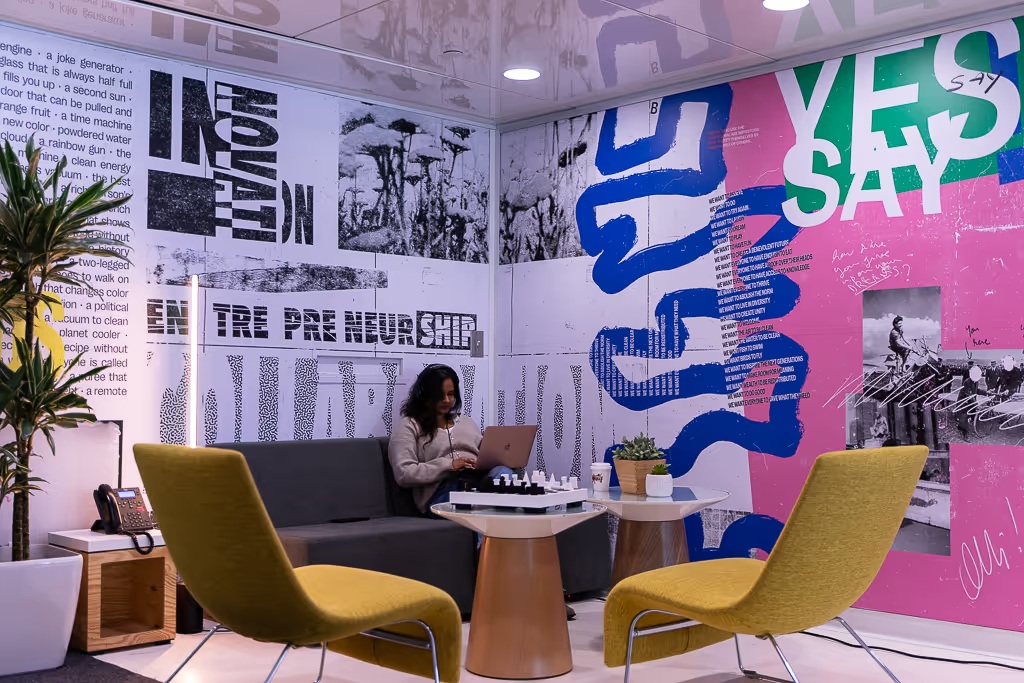
The downtown workplace has shared desks, meeting rooms and places to gather. It also has a dedicated sensory space, designed with neurodivergent founders in mind and available to anyone who needs to decompress. Ambient lighting, soft seating and calming soundscapes make inclusion a physical provision.
District 3 explicitly values multidisciplinary work and welcomes founders beyond the university. Those principles are easier to assess through such details than through a list of aspirations. A quiet room does not erase the pressure of building a company, but it recognizes that people do not all work comfortably in the same environment.
Leadership has changed as well. Concordia announced Hervé’s departure as executive director in October 2024; District 3’s current directory lists Aaron Johnson in the interim role. The organization’s continuing task is making its support useful across founders, sectors and successive teams of staff.
Choose the help, then do the work
Montreal founders have alternatives. Centech offers a free, equity-free acceleration program focused on deeptech, medtech and edtech. TandemLaunch operates as a venture fund and startup foundry. District 3’s price therefore cannot carry the whole argument. A founder should compare the relevant expertise, facilities and program stage.
The combination at District 3 is particularly relevant to someone with a technical or social problem to investigate and a willingness to revise the proposed business. It is less convenient for someone who cannot attend in Quebec or devote the necessary time. Fundraising support also needs to be understood as preparation and access, rather than a promised cheque.
The lesson a reader can borrow does not require admission. Write down the assumption that makes the business plausible. Find the people whose behavior would confirm or contradict it. Ask enough questions to discover what matters to them. Thermolio’s property managers wanted visibility and trust. Another founder’s customers will have their own answer. The work begins with listening long enough to hear it.