Most startup accelerators are built around a tidy fiction: for 12 or 13 weeks, a founder can become a pure instrument of company growth. The pitch gets sharper, the financial model acquires a second decimal place, and Demo Day arrives on cue. Real life, impolitely, keeps billing by the month. Rent is due. Children need care. A lawyer must read the contract. The laptop gives up. Build in Tulsa has made those annoyances central to its theory of venture creation.
Founded in 2020, the Tulsa organization helps Black entrepreneurs and other founders historically shut out of capital start, test and grow businesses. Its inventory is broad: pre-accelerators, longer accelerators, one-to-one coaching, pitch competitions, mentors, workspaces, investor introductions and direct financial assistance. The ambition is broader still. Build in Tulsa says it exists to close America's wealth gap by creating multigenerational wealth through technology and entrepreneurship. The location is not incidental. This work sits in the city of Greenwood, the prosperous Black business district destroyed in the 1921 Tulsa Race Massacre.
That history could make for a handsome annual gala and a thin grant deck. Build in Tulsa has chosen the more difficult job of building plumbing: a route by which a curious local founder can test an idea, earn a first check, find a peer group, meet an investor and, if the company warrants it, enter a national accelerator. It is a nonprofit doing work that falls somewhere between a business school, an economic-development agency and a very patient early-stage investor.
01 / The productA pipeline, not a pep talk
The organization serves people at several starting lines. BUILD UP Tech is the front porch: four weeks for would-be technology founders who have an idea but no evidence. Participants do not need a technical background, a finished product, a deck or investors. They validate the problem, test assumptions and work toward a clickable prototype or an MVP plan. This matters because the first thing to fail in young startup ecosystems is often not the company. It is the handoff between enthusiasm and proof.
Product Pitch Night does a similar job for physical goods, combining weeks of coaching with a public competition. Female Founders Pitch Night has become a repeating piece of civic theater with a useful balance sheet: by its 13th edition in 2026, nearly 80 contestants had appeared and more than $300,000 had gone to 32 winners. At the other end of the pipeline sits Build in Tulsa Techstars, a 13-week program for scalable companies led by founders the innovation economy routinely overlooks.
02 / The design choiceThe $25,000 check is only half the idea
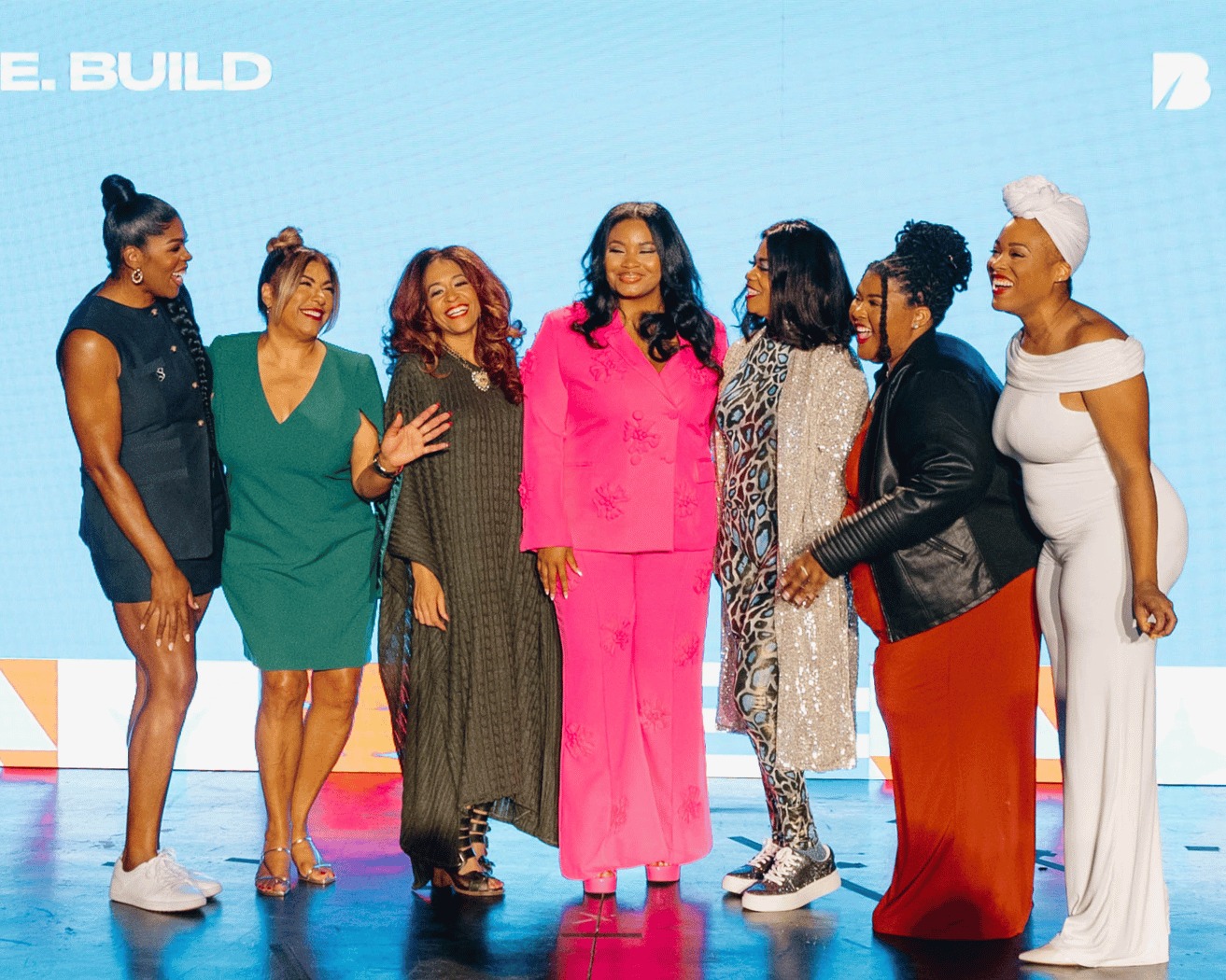
W.E. Build is the clearest expression of the model. The women-focused accelerator began after Build in Tulsa applied to Goldman Sachs' One Million Black Women initiative in 2021, received support in 2022 and launched its first cohort in 2023. Each selected founder receives a $25,000 non-dilutive business award. More interesting is what comes beside it: three months of sales, marketing, financial-modeling and operations work; mentorship; legal and accounting help; a laptop and connectivity; workspace; and living stipends for housing, childcare and health care. The 2024 cohort also received bi-weekly mental-health counseling.
“W.E. Build is the accelerator I wish I had.”Desiree Frieson, director of programming
Frieson has described herself as the founder who once built late at night without enough structure or community. Her conclusion is refreshingly operational: if a program wants women to scale companies, it cannot force them to choose between the company and the rest of life. That is what changed the design. Instead of treating personal constraints as evidence of insufficient hustle, W.E. Build budgets for them.
In accelerator language, this is “wraparound support.” In ordinary language, it is an admission that a spreadsheet does not cook dinner. The program's early record is specific enough to inspect. By early 2025, W.E. Build had supported 17 Black women-led startups, distributed more than $425,000 in business awards and supplied another $186,000 in founder support. Seven companies completed the 2024 cohort; reported outcomes included an MVP, two contracts with a Tulsa organization and a sales strategy that generated revenue during the program.
Public program materials list no participation fee, and W.E. Build's $25,000 award is non-dilutive. The practical price is eligibility, time and place: programs are selective, dates are fixed, and many require a Tulsa base or a commitment to build there.
03 / The scoreboardA nonprofit with an investor's dashboard
Build in Tulsa does not publish conventional company revenue or valuation, and those measures would be odd yardsticks for this enterprise. It raises philanthropic and institutional support, then turns that money into programs, awards, services and connections. George Kaiser Family Foundation and Charles and Lynn Schusterman Family Philanthropies have backed the ecosystem; Goldman Sachs supported W.E. Build; partners including ACT House, Lightship Foundation and Techstars extend the path toward investment.
Its 2024 report card counted nearly 2,500 event and program participants in addition to those 265 entrepreneurs. By June 2026, local reporting put Build in Tulsa's five-year investment in entrepreneurs near $20 million and said supported businesses had produced more than $14 million in revenue. The categories are not perfectly interchangeable - “invested” can include more than checks into company equity - but the direction is clear. This is no longer a handful of workshops with good refreshments.
The users range from middle-school students at Future CEO Camp to founders preparing investor data rooms. The 2024 camp alone drew more than 140 applicants, admitted 65 students and put their final pitches before more than 160 neighbors and family members. This long runway is Build in Tulsa's competitive difference. National organizations such as digitalundivided, Black Ambition and Black Girl Ventures also expand access for underrepresented founders. Tulsa's version is unusually concentrated in one place and deliberately staged across age, readiness and company type.
04 / The geographyTulsa is part of the product
The organization is national in its invitation but local in its mechanics. Some founders relocate. Others must demonstrate that they are building in Tulsa. That requirement makes the network denser: the mentor, investor, workspace and next program are more likely to be in the same room, or at least the same area code. The city gets companies and jobs; founders get lower operating costs and a community that can notice them before a coastal fund does.
It also gives the mission teeth. Black Wall Street is not used merely as a mood board. The 1921 Awards honor eight established Tulsa business owners based on business success, community impact and the resilient, inventive spirit associated with Greenwood. Accelerator alumni and previous pitch winners are excluded, preventing the same polished cohort from collecting every ribbon. The rule says something important: an ecosystem has to look beyond its own mailing list.
The place-based model has limits. It needs patient donors, credible local partners, enough founder density and a city where support dollars meaningfully reduce costs. Copying the surface - a pitch night, a historical reference, a cohort photograph - will not reproduce the result. Nor can free services rescue a company without a real customer problem. BUILD UP's insistence on validation before fundraising may be the least glamorous and most portable lesson in the entire portfolio.
“Talent is distributed equitably, but far too often opportunity is not.”Build in Tulsa
05 / The takeawaySteal the sequence, not the scenery
What can another city copy? Start earlier than the accelerator. Give founders small, public chances to test a claim. Separate idea validation from scale training. Make the next rung visible. Fund services that investors assume someone else already paid for. Measure coaching hours and company revenue, not just attendance and applause. Then repeat often enough that mentors, investors and alumni begin to recognize one another.
The harder pieces cannot be downloaded. Build in Tulsa benefits from major philanthropic partners, a national accelerator, an established coworking network and a history that places Black ownership at the center of the city's economic story. Without comparable trust and money, wraparound support turns into a brochure promise. Without employers, customers and follow-on investors, a well-trained cohort can still hit a wall after Demo Day. And without disciplined selection, direct grants can become disconnected acts of generosity rather than steps in a company-building process.
That is why Build in Tulsa is best understood as infrastructure. It does not promise that every founder will raise a round. It tries to repair the channels through which knowledge, introductions and money travel. Its sharpest observation is almost comically mundane: a founder's ability to build may depend on whether Thursday's childcare is covered. Venture capital likes to talk about seeing around corners. In Tulsa, somebody has finally looked down at the calendar.