A medical scan is an odd kind of achievement. The machine has done its work. The patient has held still. Somewhere on a screen, there is information that might matter enormously. Yet the person responsible for using it may still have a long afternoon ahead: aligning one image with another, tracing anatomy, retrieving an earlier study, preparing a report. The picture has arrived. The decision has not.
- The job: turn medical images into usable clinical workflows, from radiation planning to nuclear medicine.
- The appeal: combine image fusion, quantitative analysis and automation across equipment brands.
- The turning point: GE HealthCare acquired MIM in April 2024; a combined Encore release followed in 2025.
A picture is not yet a plan
MIM began in 2003 with a name almost suspiciously free of marketing: Medical Image Merge. Its first product registered, manipulated and displayed DICOM images, the standard format through which medical imaging data travels. The name describes a practical ambition. Different images of the same person should be useful together.
GE HealthCare’s account of the company’s beginnings places Dennis Nelson at the original problem. PET imaging had promise, but clinics struggled to put its information to work. Dennis developed the initial software, then brought in his son Andy Nelson and son-in-law Pete Simmelink to build the business. Andy’s early work included hospital implementation and customer support. The opportunity emerged through watching clinicians use the technology.
This origin matters because it explains the company’s later shape. MIM sells tools for the work surrounding interpretation and treatment: preparing images, combining studies, outlining structures, measuring activity and passing results to colleagues. Its customers include hospitals, cancer centers, imaging facilities and research organizations. The company reports more than 3,300 healthcare organizations using its software globally.
The handoff is the product
Consider radiation oncology. Before treatment begins, the team needs to identify the target and the surrounding anatomy that requires protection. There may be several imaging studies to reconcile. There may be movement to consider. There may also be a queue of patients waiting while specialists perform repetitive preparation.
MIM Maestro puts image registration, contouring and plan preparation in a shared working environment. A radiation oncologist can combine diagnostic information with planning images. A dosimetrist can prepare structures. A physicist can assess registrations and dose information. The useful unit here is the sequence of work across a team.
Contour ProtégéAI+ makes that argument unusually explicit. The software can begin segmenting anatomy when simulation data arrives and export contours into the planning workflow. MIM lists integrations with Eclipse, RayStation, Monaco and Pinnacle. The sales phrase is “zero-click.” The practical result is a set of contours ready for somebody to review.
“We focus our time on improving the plans”
Ben Mowbray, dosimetrist, Anne Arundel Medical Center, in a MIM customer testimonial
That distinction is consequential. Automatic preparation still leaves clinical judgment with the team. MIM’s product materials describe review, completion and quality assurance. A clinic considering the software should examine how well those steps fit its actual practice. A fast algorithm that leaves an awkward handoff can simply move the bottleneck down the corridor.
Automation helps with preparation. Clinical decisions still require people.
The machine has a brand. The workflow has several.
MIM’s position is easiest to understand in a hospital network with a mixed equipment estate. Each scanner may function perfectly well. The trouble appears when staff must use different processing tools and produce consistent results across facilities. A network does not become a single department merely because somebody drew one box around it on an organization chart.
In a testimonial published by MIM, Intermountain Healthcare’s Breece Perry describes replacing various manufacturers’ processing systems with MIM and working with its support team to standardize output across locations. This is a customer account, rather than an independently controlled comparison. It nevertheless identifies the buying problem precisely: consistency across cameras, technologists and sites.
MIM Encore addresses nuclear medicine processing, read preparation, interpretation and reporting in one platform. The company’s expertise extends into specialized applications: MIMneuro for brain image analysis, MIMcardiac for cardiac imaging, and MIM Symphony Dx for prostate multiparametric MRI. Each occupies a different clinical task, linked by the need to extract and communicate information from images.
Vendor neutrality is a competitive position, though MIM has company there. Hermes Medical Solutions’ Hermia also offers molecular imaging, lesion tracking and dosimetry across scanner types. A buyer’s comparison should follow the actual workload: supported data, analysis tools, integration, reporting and the effort needed to introduce the system. The nearest alternative changes with the department.
MIM earns its place through institutional software licensing, cloud services and enterprise deployments, supported by implementation and training. Public pages send prospective buyers to demonstrations and sales conversations. The sensible cost comparison therefore includes the work needed to configure and adopt the product, alongside the commercial quote.
When treatment becomes a measurement problem
Theranostics gives MIM’s old problem a new setting. Diagnostic imaging helps characterize disease and guide targeted radiopharmaceutical therapy. The images can also support measurement of treatment response and radiation absorbed by tissues. That creates a demand for information that goes beyond a visual impression.
MIM SurePlan MRT brings together reconstruction, segmentation, time-activity processing and dose calculation. It supports single-time-point and multiple-time-point dosimetry and produces reports. The challenge is operational: a clinic needs to fit these steps into its routine, using the people and equipment it has.
In October 2024, GE HealthCare announced FDA clearance for Monte Carlo dose calculation using the Dose Planning Method in SurePlan MRT. The method was developed at the University of Michigan. GE HealthCare says the implementation can calculate results in seconds on existing CPU hardware, without requiring a GPU. That is a manufacturer’s performance claim; its relevance is the possibility of adding a calculation method without adding another specialist computer.
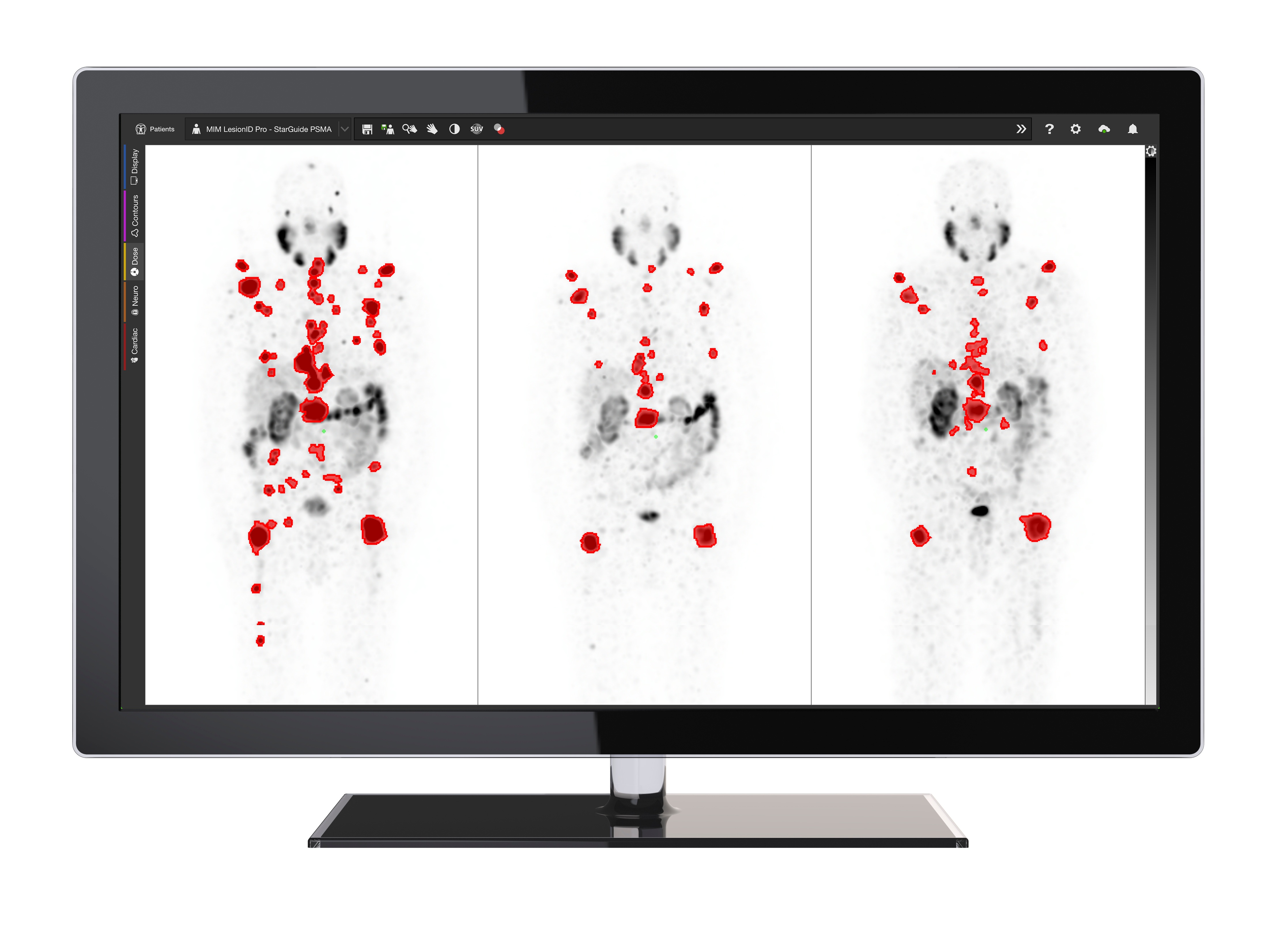
LesionID Pro tackles another demanding measurement: whole-body tumor burden in PSMA PET/CT and SPECT/CT studies. The January 2026 clearance announcement describes automated segmentation, removal of normal physiological uptake for review, and tracking over time. Users can review and edit results. The announcement also states that the product is not available for sale. Clearance and availability have separate calendars.
What $283 million bought
GE HealthCare completed its MIM acquisition on April 1, 2024. Its 2025 annual filing reports a total purchase price of $283 million: approximately $259 million net of acquired cash, $11 million of acquired cash and $13 million of valued milestone contingent payments. Up to $23 million of additional service-based contingent payments were described separately. These figures belong to the acquisition, not a clinic’s software bill.
Total purchase price reported in GE HealthCare’s 2025 annual filing.
Additional service-based contingent payments described separately.The strategic attraction was a business already working across imaging and treatment workflows. GE HealthCare bought tools that could connect its equipment and imaging portfolio to more of the tasks clinicians perform after acquisition. MIM gained access to a larger commercial organization and a broader set of technologies.
The first combined MIM Encore release, announced in June 2025, supplied a concrete example. It added GE HealthCare features and algorithms, including dedicated post-processing tools for GE systems, alongside automated read preparation and structured reporting. That raises an interesting product question: how does a platform preserve its usefulness across manufacturers while offering closer integration with its owner’s machines?
The Elekta collaboration, expanded in April 2024, illustrates why external relationships remain relevant. It combines Elekta’s dose-planning expertise with MIM’s imaging and automation capabilities. MIM’s wider partnership roster includes BK Medical for prostate biopsy fusion and Sirtex for Y-90 workflows. These connections put the software alongside devices and therapies where clinicians already work.

Copy the attention, not the acronym
MIM’s useful business lesson is to follow an output until it becomes useful to its customer. Where does the customer stop, repeat a task, switch programs or wait for somebody else? The answer can reveal a product opportunity that a tour of technical features will miss.
The same approach requires discipline in deployment. Imaging automation depends on suitable input data, supported workflows and review by qualified staff. MIM notes regional restrictions on some capabilities. Its October 2025 reirradiation workflow announcement, for example, specifies MIM 7.4 or later and US-only availability at the time. Compatibility and clinical fit deserve examination before a procurement decision.
For a patient returning for treatment, even an earlier radiation plan can become a data handoff problem: the old dose must be considered against current anatomy. MIM’s new workflow addresses that process through registration and composite dose assessment. It is a fitting continuation of Medical Image Merge. The company keeps returning to the space between having information and being able to use it.