A heart does not pose for its portrait. It beats behind ribs and lungs while a clinician slides a small probe across the chest, searching for a view that will make sense to somebody else. To a practiced sonographer, a slight rotation is obvious. To a beginner, the same movement can feel like trying to find a door in a dark room with a flashlight. The machine may be portable. The skill rarely is.
That gap became Caption Health’s business. Founded in 2013 as Bay Labs by Charles Cadieu and Kilian Koepsell, the company first worked on software that could read an existing echocardiogram and calculate ejection fraction, a measure of how much blood the heart pumps with each contraction. The more consequential question sat one step earlier: what if the useful image had never been captured? An algorithm waiting politely at the end of a bad scan cannot rescue it.
- What it built: AI that gives real-time probe instructions, judges image quality, saves usable clips, and estimates ejection fraction.
- Who bought it: Hospitals and care organizations, beginning with a publicly announced Northwestern Memorial Hospital purchase in 2020.
- What it took: Clinical studies, FDA authorization, a $53 million Series B, and partnerships across devices and care delivery.
- Where it went: GE HealthCare acquired the company in 2023 and put its technology on Venue systems and the Vscan Air SL handheld.
The first problem was the picture
Bay Labs’ EchoMD AutoEF could select promising digital clips and calculate ejection fraction. In 2018 the company reported that the software had been trained on more than four million images from roughly 9,000 patients. It was the familiar medical AI proposition: let software handle a repetitive measurement. But an echo requires a trained operator to create the image in the first place. Portable machines had made the hardware easier to move; they had not made a heart easier to find.
Caption Guidance changed the order of operations. During a scan, the software watches the live image and tells the operator how to move the probe. It assesses whether a view is good enough and can automatically save a clip when it reaches its quality threshold. Caption Interpretation then estimates ejection fraction from standard heart views. The system’s advertised vocabulary included more than 90 forms of real-time feedback. Some instructions are gloriously ordinary: slide, tilt, rotate. The difficult part is knowing when to say which one.
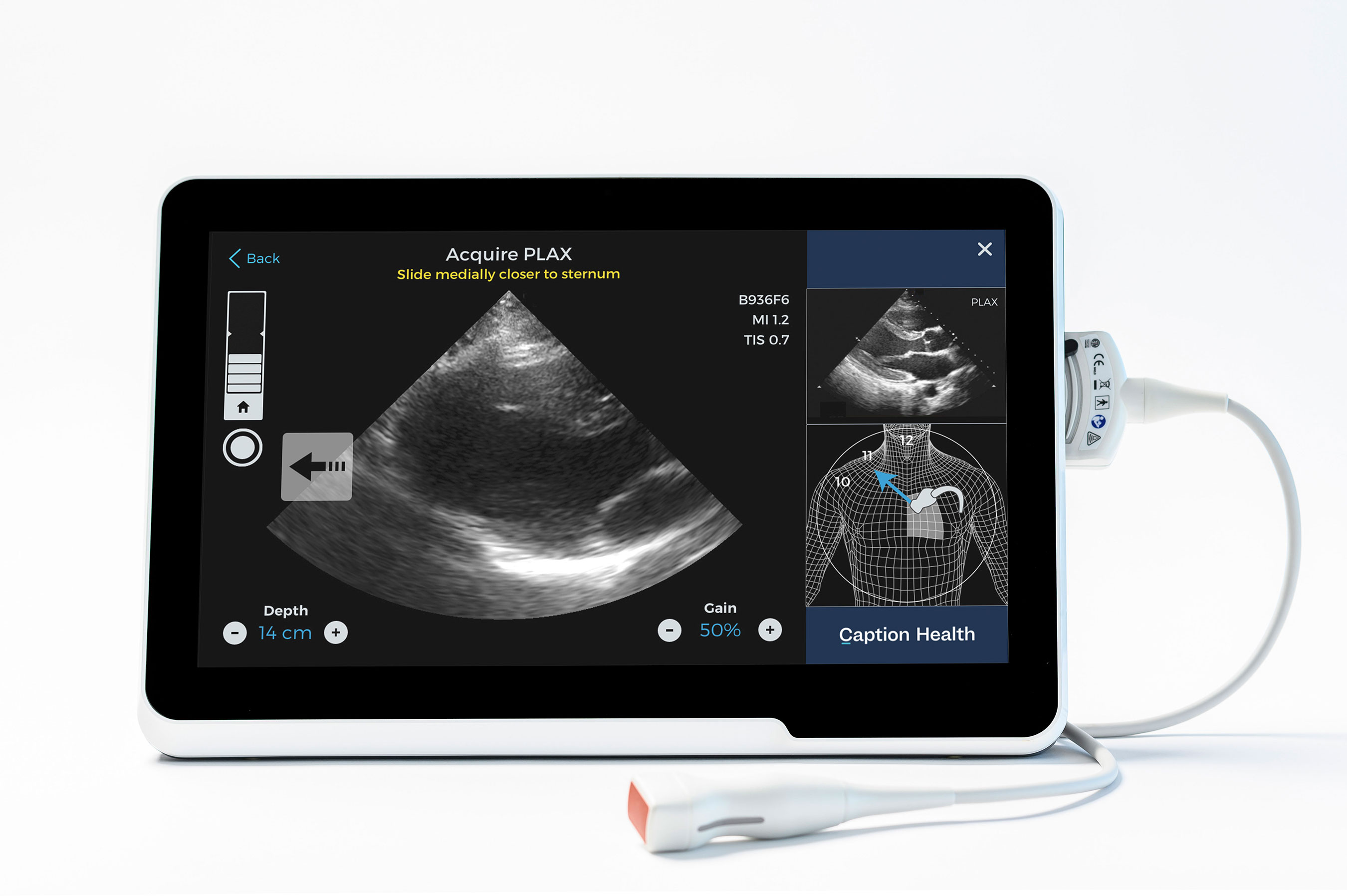
Find the view
On-screen prompts guide the hand holding the probe.
Judge the image
Quality assessment helps save a useful clip.
Read a signal
Automated ejection fraction supports cardiac assessment.
This is how Caption Health differed from software focused mainly on interpreting scans after they were taken. It tried to move scarce expertise to the moment of acquisition. Its alternative was still the skilled sonographer, whose work remains essential for comprehensive studies. Caption’s claim was narrower and more practical: certain useful views could be obtained closer to the patient by clinicians who were not ultrasound specialists.
Eight nurses and 240 patients
Medical devices do not earn their place by making a good demo. Caption’s decisive test put eight nurses with no prior echocardiography experience in front of 240 patients. Each nurse used the guidance system to collect ten standard views; trained sonographers examined the same patients separately. Experienced reviewers then judged whether the nurses’ images were sufficient for defined clinical questions. The study was later published in JAMA Cardiology.
Useful for which question?
Proportion of nurse-acquired scans judged sufficient for the study’s selected assessments.
The numbers are impressive precisely because their boundaries are visible. Median acquisition time for the ten views was 30 minutes, with a range from nine to 82. Less than half of the nurse-acquired clips were saved by the automatic capture function; the rest used a “save best clip” option. The study also involved training. Guidance lowered a skill barrier, but it did not abolish training, time, clinical judgment, or the need for an appropriate follow-up scan.
The FDA authorized Caption Guidance through its De Novo pathway in February 2020. Later that year, as hospitals tried to assess patients with COVID-19 while limiting personnel exposure, the agency cleared an update on an expedited timetable. Caption raised $53 million in a Series B led by DCVC, with Atlantic Bridge, Edwards Lifesciences, and Khosla Ventures participating. What did it cost? At least that much investor capital to commercialize the platform, plus an announced $4.95 million Gates Foundation grant to explore lung ultrasound. A product price or acquisition price was not publicly stated.
“We are looking to democratize the echocardiogram.”Patrick McCarthy, Northwestern Medicine, on its Caption Health partnership
A hospital purchase became a route to the home
Northwestern Medicine had helped develop and validate the technology. In October 2020, Northwestern Memorial became Caption’s first announced hospital purchaser, placing systems in emergency medicine, intensive care, cardio-oncology, and hospital medicine. That is a more demanding customer list than a trade-show booth. A scan must fit a department’s pace, its staff, its records, and the clinical decision waiting at the other end.
Caption’s commercial offer was software integrated with ultrasound equipment. In 2020 Caption AI was available with a Terason portable system. The buyer was a hospital or provider organization; the user might be a nurse or another clinician with limited sonography experience. By 2022 the company had stretched that model into a service called Caption Care. Working with Portamedic’s mobile clinician network, it proposed heart ultrasound in homes and other convenient locations for health plans, providers, and value-based care groups.
That was a change in the question. A hospital asks whether a clinician can get a useful scan beside a bed. A health plan asks whether imaging can reach someone who may otherwise miss an appointment altogether. The same guidance software supported both bets, but home delivery added scheduling, mobile labor, and referral pathways. Public announcements describe the launch and partner network; they do not establish its eventual patient volume or economics.
Caption also partnered with Ultromics, whose EchoGo software analyzes cardiac ultrasound images. The pairing made strategic sense: one company helped obtain the picture, the other concentrated on what a clinician could learn from it. The Bill & Melinda Gates Foundation grant asked whether the acquisition idea could extend to lung ultrasound for pneumonia in places short of trained specialists. The grant was for development, not proof that a finished lung product had arrived.
The buyer had a place for the software
GE HealthCare announced its acquisition of Caption Health in February 2023 and completed it on February 17. The attraction was plain. GE already sold ultrasound machines and had a worldwide distribution system. Caption had software that could make some cardiac scanning tasks easier for people newer to ultrasound. Within six months, GE said Caption Guidance had joined its Venue point-of-care family. In April 2024 it launched Caption AI on the Vscan Air SL handheld, pairing real-time capture guidance with automatic ejection-fraction estimation.
There is a useful lesson here for anyone building a tool around expert work. Start where the workflow actually fails. For Caption, the early answer was not a grand claim that AI could diagnose heart disease by itself. The obstruction was a human hand trying to produce a readable image. The company gathered examples of that motion, tested novice operators against defined clinical endpoints, secured permission to sell, and found partners with machines and access to patients. A smaller, well-placed piece of intelligence could travel further than a larger claim.
It also has conditions. A busy emergency department can benefit from a rapid, limited cardiac look; a complex valve question still calls for comprehensive echocardiography and specialist interpretation. A home service needs a working network of clinicians and a clear path from scan to treatment. And an image-guidance product succeeds only if its instructions are usable while the operator is doing something physically awkward, in real time, on a real patient. Caption Health’s achievement was to make that mundane moment the center of the invention.