The most revealing object in PhonePe’s business may be a little speaker on a shop counter. A customer pays. The device announces the payment. The merchant keeps working. There is no grand speech about financial inclusion, just one less reason to stop serving the next person in line. For a company now stretching into investments, app distribution and business intelligence, that small exchange is a useful place to begin.
PhonePe’s newsroom reported 718 million lifetime registered users and more than 50 million lifetime registered merchants as of July 2026. It also recorded 11 billion customer transactions that month. Those are different measures: registrations accumulate; transactions repeat. Neither is a count of paying subscribers. The distinction matters because PhonePe’s central business question is what it can earn from all that activity.
The answer increasingly lies around the payment. The group sells merchant services, distributes financial products and operates a stock-broking platform. In July 2026, it added PulsePro, a paid service that turns aggregated transaction patterns into market intelligence. Once you help people move money, you can try helping businesses understand where it moves.
Customer transactions in one month.
Activity is the starting point. Revenue is a separate calculation.
A public network, a private habit
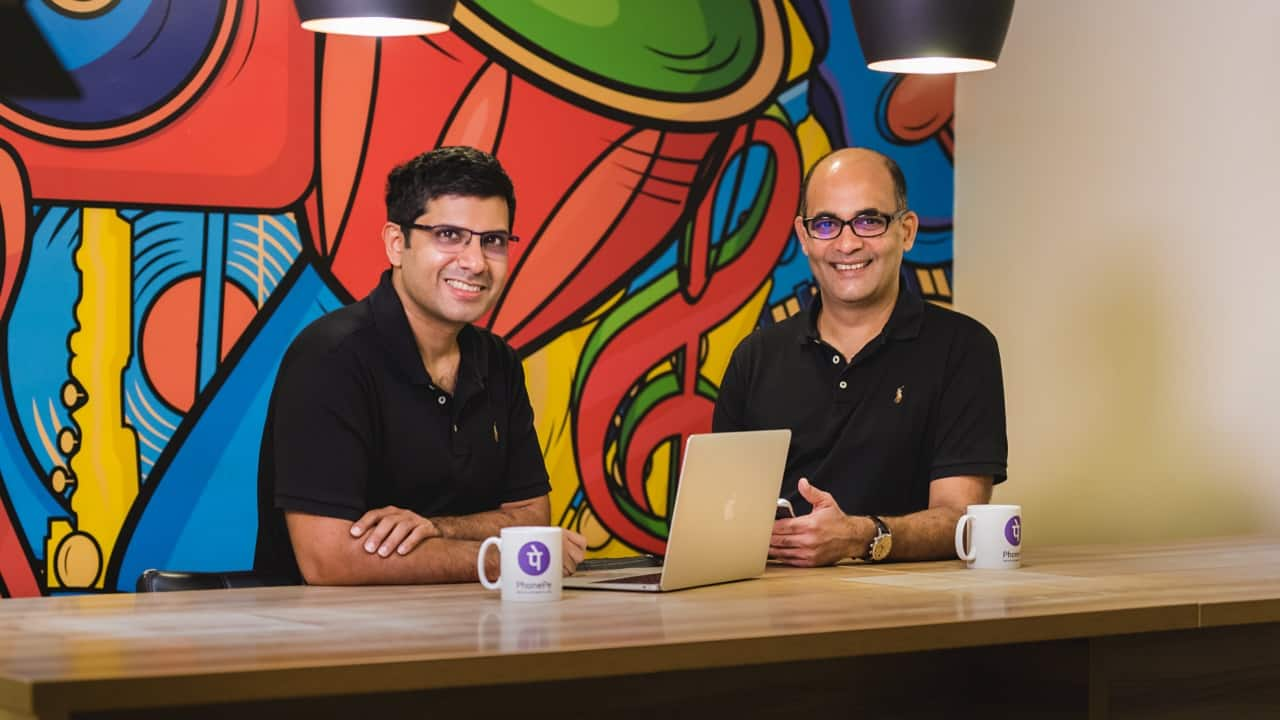
Sameer Nigam, Rahul Chari and Burzin Engineer founded PhonePe in December 2015. Its UPI app went live in August 2016, the same year Flipkart acquired the company. Nigam is CEO, Chari is CTO and Engineer holds the unusually explicit title of chief reliability officer. At a payments company, reliability is part of what the customer buys, even when the transfer itself costs nothing.
PhonePe built on the Unified Payments Interface, India’s interoperable payments system. For consumers, the attraction is practical: send money, scan a merchant’s QR code, pay a bill or recharge a phone from a familiar app. The company sits between the user and a wider network of banks and payment infrastructure. It does not need to become the customer’s bank to become part of the customer’s day.
That position also explains the competition. Google Pay and Paytm offer alternative ways into the same payment ecosystem. PhonePe must compete on familiarity, acceptance, service and the usefulness of surrounding features. A customer can keep more than one app. A merchant can accept payments from people who prefer a different one. Interoperability helps adoption while limiting the exclusivity any individual app can claim.
The free payment has a bill attached
Ordinary bank-account UPI merchant payments operate with zero merchant discount rate, the charge normally collected for accepting a payment. PhonePe’s annual report identifies government payment subsidies as one revenue stream. But a company cannot read its transaction counter as a cash register. Processing, equipment, staff and support still cost money.
For the financial year ended March 31, 2025, PhonePe reported approximately ₹7,115 crore in revenue from operations, up from ₹5,064 crore a year earlier. Its reported net loss narrowed to about ₹1,727 crore. Total expenses were approximately ₹9,394 crore, including ₹1,688 crore in payment processing charges. These figures describe a growing business with a substantial bill, not a finished profit story.
The adjacent products have recognizable jobs. A merchant can use payment links to collect remotely, a gateway to accept online checkout payments, and devices to confirm or accept payments in person. Advertising and financial distribution create other revenue opportunities. Share.Market, launched in 2023, adds broking and mutual fund distribution, including research-based WealthBaskets. Each service has to persuade someone that it is worth using beyond the original payment habit.
Nor was the expansion financed with pocket change. Documented 2023 tranches included $350 million from General Atlantic, $100 million from Ribbit Capital, Tiger Global and TVS Capital Funds, and $200 million from Walmart. They were announced at a $12 billion pre-money valuation. That historical fundraising price is a dated financing fact, not today’s stock-market price.
The bank stopped. So did the app.
One of PhonePe’s clearest stress tests arrived in March 2020. A moratorium on Yes Bank, its banking partner, was followed by a service outage lasting nearly 24 hours. The app was only one part of the system; a problem in a partner institution could interrupt the experience at the counter.
PhonePe worked with NPCI and ICICI Bank to restore service. Merchant settlements returned first, followed by other payment methods and then UPI by Friday night, according to the company’s account. Users retained their existing @ybl handles. In June, PhonePe announced a multi-bank arrangement offering ICICI’s @ibl handle alongside Yes Bank’s @ybl.
The practical lesson is specific: trace dependencies beyond your own software, and make recovery work for existing customers. Asking millions of people to learn a new identity during an outage would add another problem. The sequence also shows why a reliability chief belongs near the center of a payments company’s organization chart.
The shopping trip PhonePe abandoned
Pincode tested a more ambitious assumption: perhaps the payment company could help organize the shopping itself. Launched in April 2023 on the ONDC network, the consumer app connected buyers with local stores, restaurants and other businesses. It placed the neighborhood shop inside a digital ordering experience.
By December 4, 2025, the company had chosen a different direction. Pincode announced it would wind down the B2C app and concentrate exclusively on B2B services for offline businesses. Nigam said that “operating yet another B2C quick commerce app ourselves was distracting us from our core mission”.
Owning a moment at checkout does not mean owning the shopping trip.THE PINCODE LESSON
The announced focus was inventory management, order management, ERP tools and selected sourcing and replenishment services. The explanation was a conflict of priorities: building another consumer shopping destination consumed attention that management wanted to devote to shopkeepers. The lesson travels well. Before expanding into a neighboring market, identify whose job you are improving and whether the new product competes with that customer.
A speaker, an app store, a map
PhonePe’s portfolio makes more sense when viewed through distribution. The SmartSpeaker is close to the original merchant relationship: it helps a shopkeeper confirm money received. Indus Appstore is further away. Launched for consumers in February 2024, it offers an Android app marketplace with English and 12 Indian languages. Its December 2025 Motorola partnership aimed to put the store on devices in India.
That partnership matters because an alternative app store needs more than a catalog. It needs a route onto the phone and a reason to be opened. Google Play is a formidable alternative already embedded in many users’ routines. PhonePe’s payment reach may make its name familiar, but app discovery is a separate habit to win.
Help the merchant finish a sale.
Help the user find an app.
Help a business choose where to grow.
PulsePro takes a third route. Announced on July 30, 2026, it sells enterprise intelligence based on aggregated and anonymized transaction trends. The proposed uses include site selection, distribution planning and understanding category growth. A retailer considering its next location is a very different customer from someone paying for lunch, even if the underlying activity helps inform the analysis.
PhonePe says the free Pulse platform, launched in 2021, will remain available. Its GitHub repository already lets researchers and developers work with aggregated JSON data. PulsePro adds a commercial layer. The analytical caution is straightforward: payment observations describe the network that collected them. A business should test how well those observations represent its own customers, including cash spending and activity elsewhere.
Purple ink and people with keypads
Some of the most useful details in PhonePe’s story resist the usual technology vocabulary. A company designer described struggling to reproduce its signature purple in print, experimenting with printers and combinations of magenta and cyan. The logo might appear on a screen, but the merchant relationship also lives on physical counters. Consistency had to survive the printing press.
The company’s accounts of working life are similarly concrete when they describe activities rather than values: a Pincode hackathon built around seller problems, and accessibility initiatives covering employees with disabilities. These are employer accounts, not an independent culture audit. They nevertheless show the kinds of problems PhonePe chooses to put in front of its teams.
On August 31, 2026, PhonePe announced UPI 123Pay for supported feature phones, using an SMS-based architecture without an internet connection. Named handset partners included Nokia, HMD, Lava and Itel. The launch also included a voice-led setup helpline in English and 12 Indian languages. It is another version of the same design decision: work with the equipment and language a person already has.
What is worth copying
PhonePe offers a sequence other businesses can study: solve a frequent task, earn repeated use, then build paid products around neighboring needs. The merchant speaker is an especially legible example. It improves the work immediately surrounding a payment. Pincode supplies the counterexample: frequency in one task does not automatically produce demand for another.
There are conditions attached. This approach needs dependable partners, patient financing and customers who find the adjacent service useful on its own. PhonePe’s 2022 move from Singapore to India illustrates the financial commitment: investors led by Walmart paid close to $1 billion in taxes associated with the domicile shift. In March 2026, the company announced a pause in its IPO process, citing geopolitical uncertainty. Funding and public-market timing remain separate from product adoption.
The next test is therefore more demanding than another registration milestone. A merchant must value the tools. An investor must choose the broking service. A business must find the intelligence useful enough to pay for it. PhonePe has earned a place in the payment routine. Now its newer businesses have to earn places of their own.
Keep following the money
PhonePe website ↗Company news ↗Company blog ↗Engineering blog ↗Explore Pulse ↗Pulse on GitHub ↗LinkedIn ↗Twitter / X ↗Instagram ↗Facebook ↗