A well-designed payment interface is a vanishing act. A thumb moves, a screen blinks, money changes owners. The machinery stays out of sight, which is precisely where Raj Jain has spent much of his working life. Long before a QR code became part of the furniture of Indian commerce, Jain was building a company around the less photogenic questions: How fast can a transaction travel? What happens when volume multiplies? How do you test a system whose bad day can become everybody’s bad day?
His answer began with an unfashionable plane ticket. Jain had studied in India at Bishop Cotton School in Simla and St. Xavier’s College in Calcutta, then continued his education in the United States, earning BS and MBA degrees. He began his professional career there and worked as a software systems analyst in Los Angeles. In 1987, he left that job and returned to India to start R S Software.
Kolkata was not the obvious launchpad for an export software business. That was part of the point. Jain believed the convergence of computing and telecommunications would allow software expertise to cross borders. The city could be a base rather than a boundary. RS Software began by serving international markets and gradually found the hard, narrow field that would give it an identity: electronic payments.
“Our mission is to transform the lives of consumers, businesses, and nations with the power of digital payments.”Raj Jain, founder’s statement
The useful education of 50,000
Payments made the company grow up in public, even when the company itself remained largely invisible. RS Software’s long work with Visa became a technical apprenticeship in high-volume systems. In a 2024 interview, Jain described the journey from handling 500 transactions per second to 50,000. The clean headline is a hundredfold increase. The more interesting story is what a number like that does to a team.
A hundredfold lesson in payment scale
Transaction throughput Jain discussed from RS Software’s work with Visa. TPS means transactions per second.At 500 transactions per second, an edge case can remain politely at the edge. At 50,000, it is sprinting toward the middle. Performance testing becomes architecture. Reliability stops being a back-office virtue and becomes the product. Every bottleneck acquires a queue of impatient customers. Years spent learning these constraints gave RS Software something more valuable than a trophy client: judgment that could be transferred.
Jain also became part of the institutions growing around India’s technology industry. He served on NASSCOM’s executive council and chaired the association in 1998-99. Ernst & Young recognized him among 20 Outstanding Entrepreneurs of the Year in 1999. He helped establish TiE’s Kolkata chapter and co-founded a Silicon Valley chapter of the Young Presidents’ Organization. These connections were practical infrastructure of another kind - places to exchange operating knowledge, find talent and help an industry learn itself.
When the rails became a public habit
By 2015, India was preparing a different kind of payments leap. The National Payments Corporation of India selected RS Software through an RFP to work on the Unified Payments Interface. UPI’s public elegance was an audacious promise: any-to-any payments across banks, identifiers and authentication methods, delivered in real time. Behind that ease sat requirements, APIs, migration, testing, security, deployment and support. The user saw a handle. Engineers saw a national system.
RS Software’s role did not end with UPI. The company also worked on the Bharat Bill Payment System and, in 2019, delivered an enterprise fraud and risk management platform. Together, the projects tell a more complete story than instant transfer alone. A payment ecosystem needs a rail, a common place to present and pay bills, and a way to recognize danger while the money is still moving.
Jain’s public language around these systems is expansive - financial inclusion, economic participation, the effect of digital commerce on everyday lives. His method is stubbornly concrete. Open technologies. Standardized APIs. Low latency. Testing. Fraud controls. A grand social ambition is allowed, provided someone has checked what happens when the database is under pressure at 2 a.m.
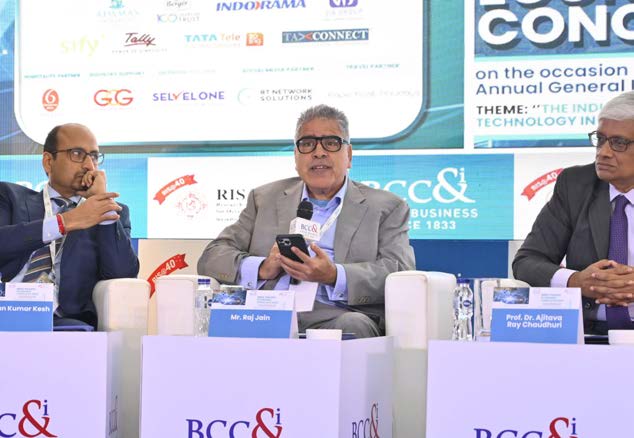
A founder who stayed with the hard layer
There is an unfussy consistency to Jain’s career. He did not begin with a consumer payments brand and retreat into infrastructure. He started beneath the surface and kept digging. RS Software moved from general software exports toward deep payments specialization, then from service work toward reusable products and platforms. The route was not straight. Client concentration, changing technology and the economics of project revenue all required adjustment. In 2015, Jain was already talking publicly about reducing dependence on a large client and moving toward recurring revenue.
That willingness to alter the business model while protecting domain knowledge is the useful distinction. Specialization can become a cage if it means doing the same assignment forever. It becomes leverage when each assignment leaves behind better tools, stronger patterns and a clearer view of the market. RS Software’s current portfolio speaks the dialect of modern infrastructure - cloud-ready, API-first, ISO 20022-native, modular - but its credibility rests on older scars.
Colleagues have publicly described Jain’s style as leading from the front. One long-time associate remembered him as analytically sharp, accessible and generous with his team. A 2007 profile found a chief executive who read business magazines, followed technology online, exercised regularly and occasionally played golf. None of this makes payment orchestration sound romantic. It does make the builder legible: curious about the next system, social enough to maintain a wide network, and patient enough to remain in a technically unforgiving market.
A Los Angeles systems analyst starts an international software venture from eastern India.
RS Software wins the NPCI assignment that puts its payments experience inside a new national rail.
The company works on connections between India’s real-time architecture and payment systems in other countries.
The border is the new bottleneck
Domestic instant payments solved one kind of distance. Borders preserve another. A small international transfer can still be slowed by fees, opaque routing and settlement steps that feel antique beside a real-time domestic payment. Jain now frames this gap as the next infrastructure problem.
RS Software says it has worked with NPCI on bilateral links connecting India’s payment architecture with systems in more than ten countries, including Singapore, France, Nepal, the UAE, Qatar and Bhutan. The India-Singapore UPI-PayNow linkage is a useful illustration: two national systems learning to exchange value without pretending they were designed as one.
“This is where the opportunity is huge to help connect digital payment networks to facilitate global trade flows.”Raj Jain on cross-border payments, 2025
The challenge contains more committees than glamour. National systems operate under different rules. Fraud controls, message standards, liquidity, identity and compliance must agree well enough for the customer to experience a simple transfer. Jain’s company has been preparing for that kind of complexity all along. Payment plumbing is mostly the art of persuading many forms of disagreement to resolve in milliseconds.
Artificial intelligence now appears in the company’s fraud analysis, testing, code review and risk-assistance work. Jain has spoken at industry forums about AI in payments, but the emphasis remains applied rather than theatrical. In a system that moves money instantly, intelligence earns its keep by finding a suspicious pattern before the transaction becomes a regret.
The lesson beneath the interface
Founders are often advised to find a wedge. Jain found a basement. Payment infrastructure offered few applause lines and plenty of ways to fail, but depth compounded. Visa-scale performance work prepared a team for national systems. National systems prepared it for links between sovereign rails. The same questions kept returning at larger scales: Can it move quickly? Can it survive? Can institutions trust it?
His career also offers a counterpoint to the idea that ambition requires leaving one’s city behind. Jain went abroad, learned, returned and kept Kolkata inside the company’s global story. The geography did not shrink the market. It gave the venture a point of view and a pool of relationships it could keep building over decades.
There is a second lesson in the length of the journey. Infrastructure companies rarely get to declare victory and go home. Standards change, fraud adapts, hardware improves and yesterday’s extraordinary speed becomes tomorrow’s minimum expectation. Jain’s aspiration has therefore stayed in motion: widen access, harden the system, then connect it to the next one. The work resembles city maintenance more than monument building. Every improvement invites more traffic, and more traffic reveals the next improvement.
The next time a payment vanishes successfully from thought, there will be no reason to thank the infrastructure. That is the arrangement. The engineer’s reward is a public that becomes impatient with anything slower. Jain has spent nearly four decades helping to create that impatience, first across card networks, then across India, and now at the borders between payment systems. Invisible work, once adopted, changes what the visible world considers normal.