A sale has two endings. One is the pleasant little moment when the customer is told the payment has gone through. The other arrives when the business can use the money. Between them sits a collection of systems, conversions and waiting. Alice Liu chose that unglamorous interval as the starting point for a company. There are easier things to put on a business card than settlement infrastructure. There are few things a merchant would rather have working properly.
Liu is the co-founder and chief executive of Singapore-based dtcpay. Its work connects stablecoins with traditional currencies so businesses and individuals can pay, receive and move money. Behind the digital vocabulary is a recognisable ambition: finish the transaction. Her route to it ran through corporate banking, a return to education and a classmate who became a business partner.
By September 2026, dtcpay had announced the completion of a US$25 million Series A. That is the conspicuous number in the story. The more revealing detail is where Liu began: with the time and cost involved in getting paid. She approached digital assets as something a business might use, then built toward the licences, partnerships and everyday settings that could make that use possible.
A banker goes back to class
Before Singapore, there was Hong Kong. Liu worked at China Minsheng Bank, becoming a managing director, and later took a managing director role at a listed company. Corporate finance was familiar territory. The work gave her experience inside the institutions through which businesses move money, well before she started designing another route for it.
In 2019, she relocated to Singapore and enrolled in the National University of Singapore’s Executive MBA programme in Chinese. Going back to class after holding a senior title has a pleasing reversal to it. The person accustomed to making decisions becomes a student again. In Liu’s case, the move also placed her inside the city’s fintech community.
She attended the Singapore FinTech Festival, met people working in the sector and encountered the country’s initiatives around financial technology. At NUS, she met Band Zhao. They founded Digital Treasures Center in 2019, the business later known as dtcpay. A university programme had supplied something rather more consequential than another line under “Education”. It had supplied a co-founder.
Liu’s August 2026 account of the programme gives special weight to learning from classmates. “The most undervalued part of an EMBA is peer learning,” she said. That is a useful detail about her formation as a founder: experienced people from other industries could bring questions that her own professional background would not necessarily produce.
Permission before expansion
Digital Treasures Center set out to reduce payment costs and settlement times through blockchain technology. Its early promise needed an institutional foundation. In March 2022, the company received in-principle approval from the Monetary Authority of Singapore. In August, it received its Major Payment Institution licence. The interval matters. An initial approval and a licence are separate stages, and the company had work to complete between them.
Account issuance, money transfers and merchant acquisition were among the services within the licensed business. These are the everyday workings of a financial company. Liu’s venture would have to meet the expectations that come with handling payments, even as its technology introduced a different way to move value.
The business took the dtcpay name in 2023. That June, it announced US$16.5 million in pre-Series A funding led by Kwee Liong Tek, chairman of Pontiac Land Group. The connection brought a hospitality business into the story, alongside the payment technology. Hotels, like shops, eventually need a settled bill. A novel payment method still has to accommodate that familiar requirement.
A shorter menu at the checkout
Liu had been making the case for utility early. In 2022, she described cryptocurrencies as having potential beyond investment. Her concern was the merchant’s experience: a long wait for settlement and the expense of existing payment methods. The appeal of the technology lay in what it could change about that transaction.
“crypto doesn’t have to be just an investment asset”
Alice Liu · 2022
By the end of 2024, dtcpay was narrowing its digital currency offer. It announced that its digital payment token services would support stablecoins from January 2025, phasing out Bitcoin and Ether payments. Fiat payments would continue. The company described the decision as a response to customer demand, with payments already moving toward stablecoins.
Stablecoins are designed to track a reference value, commonly a conventional currency. For a checkout business, the intended predictability has a practical purpose. A transaction should be easy for both sides to understand. Removing options can be a fairly sober kind of product development, especially in an industry fond of adding them.
Seen alongside Liu’s original payment question, the decision has a clear logic. The company was choosing which digital assets fitted the job it wanted to do. Its advertised purpose was becoming more specific: connect those assets with commerce through a service people could use.
A rooftop party, a familiar card
On 18 September 2024, dtcpay and Visa announced a partnership. The first phase involved a Visa Infinite card: customers could convert digital currencies such as stablecoins into fiat, then use the fiat to fund the card. The merchant would encounter an established payment network while the customer gained another route for spending digital value.
The distinction is useful. A card transaction does not require every shop to adopt a new digital currency system. Conversion can happen before the purchase reaches the familiar card network. It is an approach that gives Liu’s company a role between two financial worlds without asking the checkout to become a seminar.
The partnership also supplied an occasion for a party. Dtcpay’s fifth anniversary was celebrated with the launch at Lantern Rooftop Bar during TOKEN2049. Liu thanked guests afterward and said she had missed those the event could not accommodate. Even a company working on global payments must occasionally contend with the capacity of a room.
In February 2025, dtcpay announced the official launch of the Digital Treasures Card. A partnership agreement had become an available product. The card gave the payments ambition a familiar physical form, something that could travel in a wallet rather than remain on a presentation slide.
The department store test
In 2025, Metro brought stablecoin payments into its Singapore department store business through dtcpay. The setting has a useful ordinariness. Fashion, home essentials and electronics provide a different test of digital finance from a conference demonstration. Customers are there to buy something. The payment service has to fit around that purpose.
The Metro arrangement included currencies such as USDT, USDC and WUSD. Here was another expression of Liu’s early argument about use: digital value could be brought into an established retail environment. The store did not need a new reason to exist. It needed a payment option that could join the existing business.
Other work reached beyond the till. In April 2025, dtcpay announced its role as a design partner for Circle Payments Network, intended to support cross-border payments using stablecoins. Supplier payments, payroll and remittances were among the proposed uses. Liu’s founding problem could recur wherever money needed to cross from one organisation or country to another.
Her international connections also reached the office. She hosted Luxembourg’s finance minister Gilles Roth and his delegation during the 2024 Singapore FinTech Festival. By 2026, dtcpay had secured an Electronic Money Institution licence in Luxembourg, supporting its European plans. The conversations and permissions gave geographical substance to an ambition that could otherwise sound rather abstract.
The company returns to the classroom
Liu’s association with NUS continued after graduation. In 2024, Digital Treasures Center agreed to a S$48,000 gift establishing the dtcpay Award. The university’s rules allocate S$4,000 prizes to top performers in three fintech courses, spanning undergraduate, MBA and MSc in Finance study, beginning in academic year 2025/26.
The detail makes this a tangible educational commitment. There is an amount, a set of courses and an arrangement for recognising students. The institution where a business relationship began would now have support for people learning about the same field. A classroom can produce a company; a company can help sustain the next classroom.
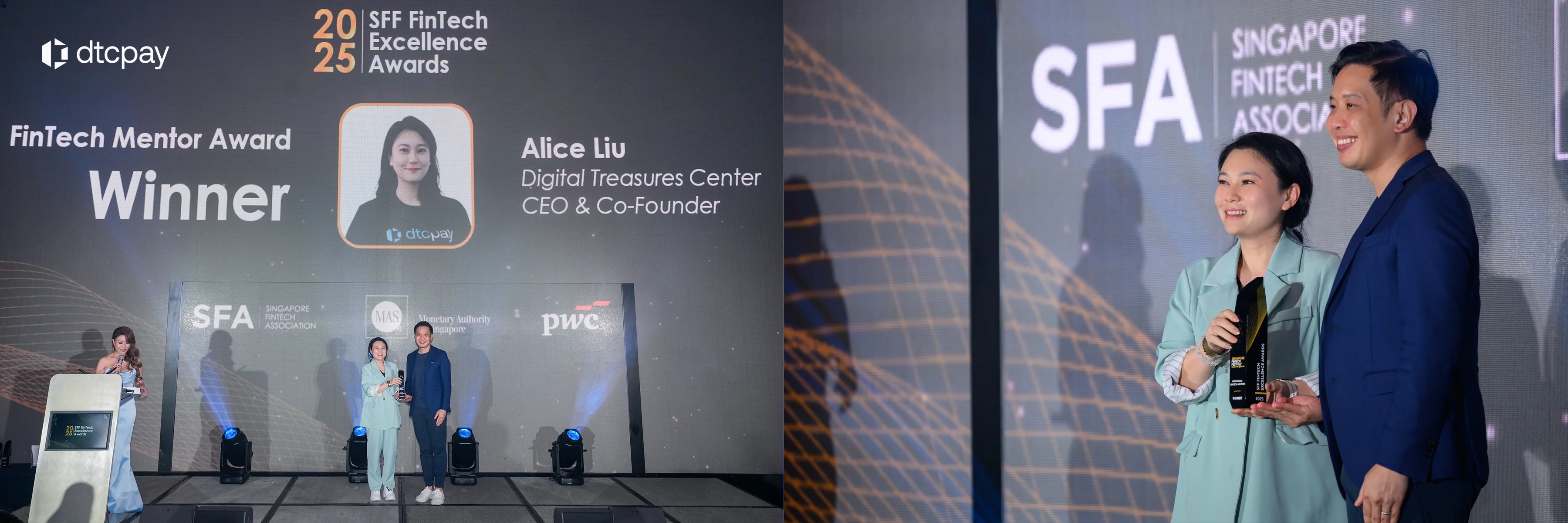
At the Singapore FinTech Festival in November 2025, Liu received a FinTech Mentor Award, one of three individual recipients recognised that year. The award was jointly organised by MAS and the Singapore FinTech Association. Her response credited the dtcpay team and its partners. She also spoke about passing on what her career had taught her.
There were smaller settings for that exchange, too. Dtcpay hosted NUS Executive MBA students for a coffee conversation with Liu in March 2025 about moving from banking into Web3 payments. In 2026, the company sponsored the Rising Star of the Year category at the Asia FinTech Awards. Mentoring appeared in the diary as well as on the stage.
More capital, the same destination
In March 2026, Vertex Ventures Southeast Asia & India announced its leadership of a US$10 million Series A for dtcpay. European entry, product development and stronger infrastructure were among the planned uses. Liu’s company was expanding through jurisdictions where it had built regulatory permissions, with Luxembourg central to the European effort.
Total completed round, with SBI Group joining as a strategic investor.
On 18 September, dtcpay announced that the expanded round had reached US$25 million, with SBI Group participating alongside other investors. The stated next work included a revamped business portal, new consumer app features and a broader merchant network. Larger capital came with a fairly specific list of things to build.
Liu’s international plans retain Singapore as the company’s headquarters. The venture has moved far beyond the university connection that helped form it, but its purpose remains recognisable. Somewhere, a customer pays. Somewhere else, a business waits for usable money. Alice Liu has made a career of attending to the distance between those two moments.