A payment takes a moment. Explaining everything that must cooperate before it takes that moment can occupy a chief executive for years. Peng Yang has chosen the latter occupation. As CEO of Singapore-based Ant International, he works on the connections between wallets, merchants, accounts and financial institutions that allow a purchase to cross a border without turning the checkout into a geography examination.
His favourite unit of economic ambition, judging by his public remarks, is the small business. The shopkeeper who wants to accept a visitor’s payment. The merchant who wants to sell overseas. The enterprise with a promising order and an inconvenient shortage of working capital. Yang keeps returning to these businesses when he explains what an international financial technology company should accomplish.
At the 2024 INCLUSION Conference in Shanghai, he described an ambition to keep people and businesses from being excluded as commerce becomes digital. It is an expansive intention with a rather practical consequence. Someone must connect systems that developed in different places, under different rules, for customers with different habits. The customer gets the brief, pleasant part. Yang’s organisation gets the plumbing.
“We don’t want anyone or any company to be left out”
Peng Yang · Shanghai, 2024
Before the wallet, the computer
Yang’s career crossed markets before his work centred on moving money between them. At Dell Technologies, he became a global vice president, with executive responsibilities spanning product development, strategy and business development. His work covered Greater China, Asia Pacific and global emerging markets. Those are broad territories to fit into a business card; they are also territories where a single approach seldom travels intact.
His education paired international business and finance at Lingnan College, Sun Yat-sen University, with an MBA at the University of Minnesota’s Carlson School of Management. His publicly listed study periods are 1994 to 1998 and 2003 to 2005. The subjects matter to the story: business across countries and the financial arrangements that make that business possible have been part of his training as well as his later responsibilities.
After Dell, he held management positions at Alipay under Ant Group. The progression runs from a company selling the equipment of the digital economy to one handling its transactions. Yang now lives in Singapore with his family. His professional map has widened, but the public account of his working life has a consistent feature: products, customers and organisations meeting across markets.
Singapore becomes the starting point
In 2023, Yang was introduced as the newly appointed president of Ant International when Ant Group expanded its Singapore presence and launched the Ant International Foundation. The location gave his international responsibilities a physical address and a public stage. In his remarks, he described a journey “From Singapore” built with policymakers, financial partners and customers in Asia and beyond.
The operation already had several kinds of connection to manage. Alipay+ linked mobile payment partners and merchants. WorldFirst provided cross-border payment, foreign-exchange and funds-management services to smaller enterprises. A global merchant-service operation brought its own institutional channels, licences and compliance requirements. Even at this stage, making commerce easier involved more than the moment when a shopper pressed pay.
Public career listings date Yang’s CEO role to December 2023. Ant Group’s reorganisation in March 2024 then made Ant International an independently managed unit. Yang’s responsibility was therefore taking shape while the organisation itself was changing. A global business needed both an operating structure and a reason for its different businesses to belong together. Small merchants supplied a recurring answer.
The shop is small. Its financial errands are not.
By December 2024, Ant International organised its work around Alipay+, Antom, WorldFirst and Embedded Finance. Think of these as different entrances to the same commercial problem. Alipay+ connected wallet users and merchants. Antom served merchant payments. WorldFirst handled global business accounts. Embedded Finance added services including foreign exchange, treasury management and credit technology.
For a small enterprise, these distinctions become errands. Accept the customer’s preferred payment. Receive the proceeds. Pay a supplier. Deal with another currency. Find financing when the timing of money coming in and money going out refuses to cooperate. The sale may be uncomplicated; the sequence behind it has an unfortunate talent for multiplying.
Yang’s public case for SMEs gives this sequence a political and economic meaning. In November 2025, he argued that smaller businesses face particular difficulties with financing and keeping pace with new technologies when they cross borders. He wanted them to have “the same global reach once reserved for multinationals”. That is a useful standard because it names the advantage he wants to distribute, rather than merely celebrating a new tool.
He also made room for trade travelling in the other direction: international consumers arriving at local stores. A neighbourhood merchant need not become an exporter to encounter the global economy. A visitor with a familiar wallet can bring it to the counter. Yang’s version of international commerce includes that modest encounter alongside the online seller pursuing customers overseas.
A management chart with a purpose
Yang’s emphasis on smaller merchants also appears in how the company has organised innovation. He announced organisational and strategic upgrades in December 2024 aimed at expanding AI-powered financial technology services. In February 2025, Ant International appointed Jiang-Ming Yang as chief innovation officer and created an organisation to bring product and technology work together.
This is the less photogenic side of a technology strategy. New products require decisions about who builds them, who talks to customers and how the teams work together. The appointment connected an internal management choice to the external promise of easier payments and financial services. A clever idea still needs an organisation capable of delivering it.
Peng Yang has also urged that technology, financial infrastructure and policy be designed with SMEs in mind. In a public post discussing small-business innovation, he pointed to partners including KeaBabies and the SME community around ANEXT Bank. His emphasis was on giving businesses usable tools and expanding shared infrastructure through cooperation between public and private organisations. The beneficiary in this account remains the business trying to get on with its day.
The people behind the international map
Ant International’s first independent sustainability report, published in 2025, grouped its approach into six areas: travel, trade, thrive, technology, talent and trust. The alliteration does useful administrative work. It places people and confidence in the same frame as payment products. Yang and company president Douglas Feagin signed the leadership letter together, connecting the company’s commercial ambitions with its inclusion commitments.
The report’s figures made that ambition more concrete. It said more than 90 percent of offline Alipay+ merchants were SMEs. WorldFirst had enabled more than 1.2 million SMEs to sell across over 200 markets. These were company-reported measures of reach, describing different services and populations. They show why the small-business argument occupies so much space in Yang’s public account of the organisation.
There was a human investment behind the network, too. The report described the 10x1000 Tech for Inclusion programme’s training of 7,157 people across 110 countries and regions. Such a number belongs beside the transaction totals: financial technology requires people who understand it, can adapt it locally and can explain it to the next customer. A payment network has to recruit understanding as well as participants.
By February 2026, Yang was discussing AI adoption, tourism, trade and talent development with Malaysia’s prime minister, Anwar Ibrahim. On July 1, the company opened its Global Development Centre at The Exchange 106 in Kuala Lumpur. Ant International had created around 1,500 fintech roles in Malaysia, more than half focused on technology. Yang’s international map was filling with colleagues, not just markets.
More than half focused on technology at the opening of the Kuala Lumpur development centre in July 2026.
A forehand finds its way into finance
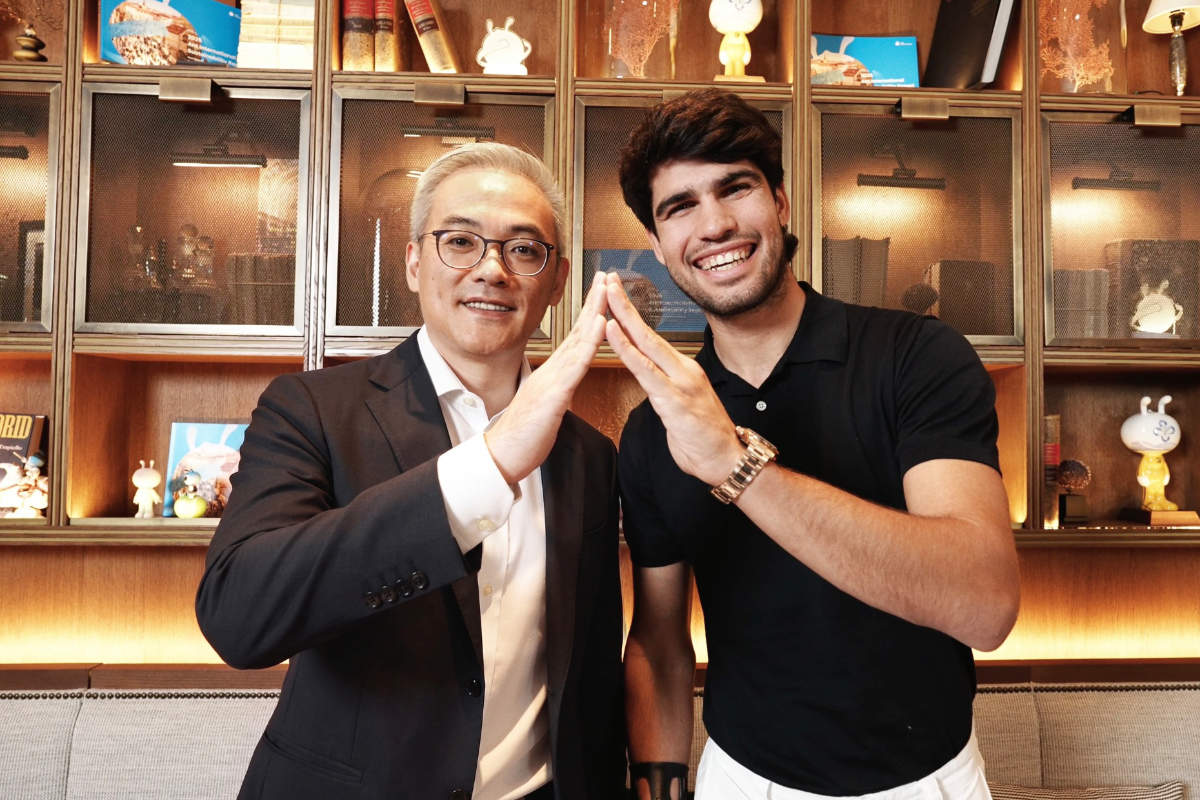
For a lighter view of Yang, follow his tennis commentary. When Carlos Alcaraz became Ant International’s global brand ambassador in May 2026, Yang recalled watching him play the previous year. His account lingered on the forehands, the speed of movement and the moment defence turned into attack. Here was a financial executive happily abandoning treasury vocabulary for a few sentences.
He brought the match back to work, linking the player’s intensity and pleasure in the game to his hopes for the company’s partnerships. The enthusiasm is public and specific. It gives the profile a detail more memorable than another executive adjective: Yang has watched Alcaraz, and he remembers the movement.
Football offers him another route into the same argument. Ahead of the 2026 World Cup, he connected teamwork and precision on the pitch with Ant International’s expansion in Latin America. His post discussed a wallet initiative in Mexico and Alipay+ payment services beginning in Chile and Argentina. Ant International also sponsored Argentina’s national football team. Sport supplied the shared language; financial connections supplied the work underneath.
These partnerships sit naturally beside a business built through other organisations. A payment company needs customers to recognise it, and partners to make its services available. Yang’s sporting analogies let him talk about both in terms people can picture. Even the most elaborate financial network occasionally benefits from a good forehand.
The next checkout may have an agent
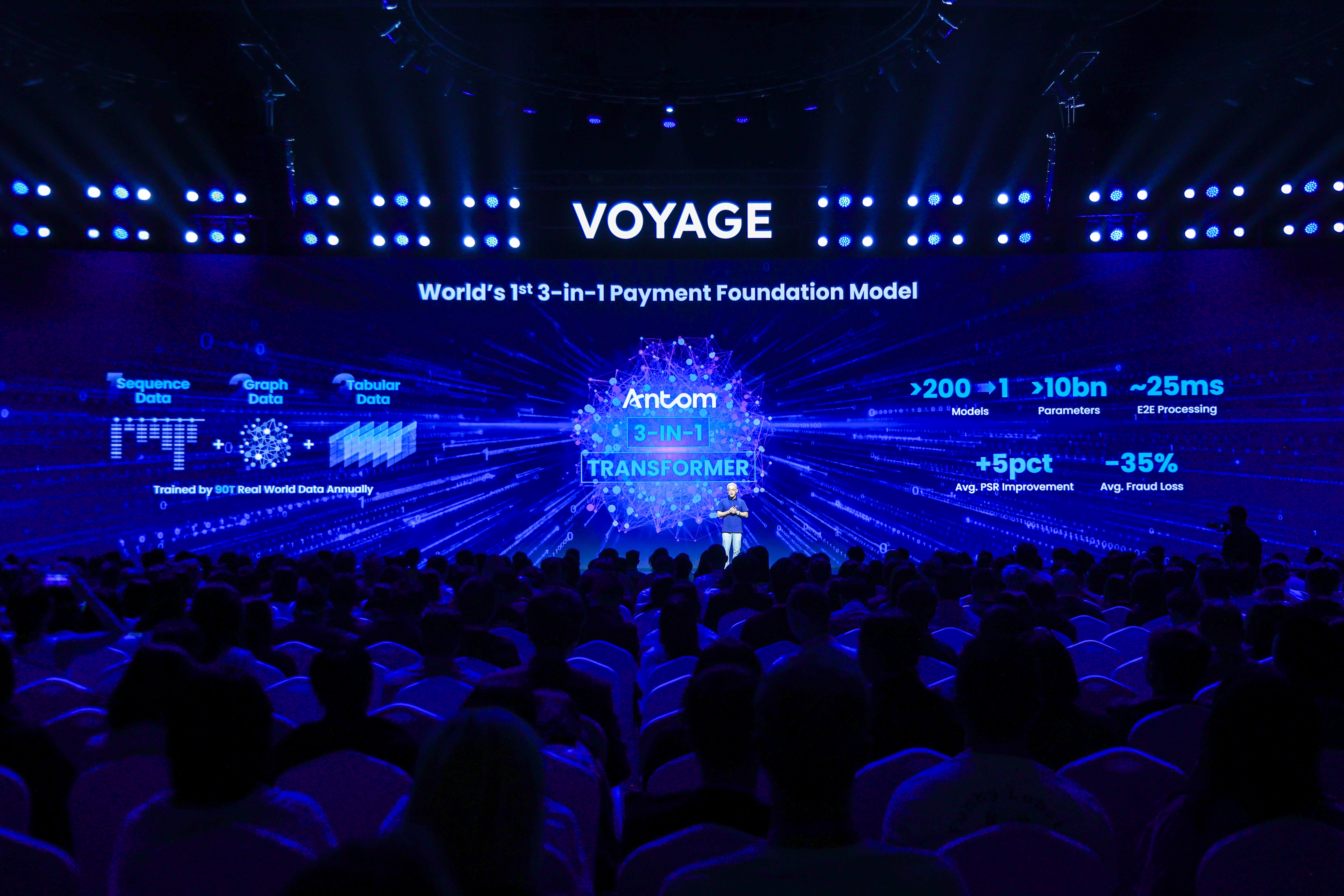
In September 2026, Yang presented Ant International’s latest product programme at VOYAGE in Shanghai, addressing more than 1,100 executives. The company announced AI-based services spanning payments, accounts, foreign exchange, treasury and growth operations. Its proposed future included software agents taking on more financial tasks, supported by payment and forecasting models and additional security controls.
The announcement made the scale of the existing business visible: Ant International said its network linked 150 million merchants with more than two billion consumer accounts through 53 digital wallets and ten national QR schemes. Those are network figures, not a census of individual customers. They describe the many connections on which the company wants to build its next set of services.
For Yang, the agent era extends a familiar assignment. More tasks can be automated, while permissions, trust and coordination need to keep pace. The vocabulary has changed since the Singapore expansion; the intended customer remains recognisable. It is still the business trying to accept an order, receive its money and make the next decision with fewer complications.
That gives his career a clear through-line without requiring a grand personal legend. He moved through international technology management, Alipay and the leadership of a reorganised global financial business. He talks about SMEs, builds partnerships and occasionally reaches for a tennis match to explain his ambition. The finished product he keeps describing is almost deliberately unremarkable: a small business able to do its work. For the customer at the counter, a payment should remain a moment.
Follow the connections
More from Yang, his organisation and the conversations around his work.