A childhood encounter with the business of moving money left Daniel Vogel holding a check his father had to cash. As a child, he built a website devoted to videos of radio-controlled cars. Payments began arriving in the mail. He was too young to take them to the bank himself. The internet had delivered an audience, a little income, and an administrative problem for Dad. Even in this early experiment, the money required someone to help it across the final stretch.
Years later, a similar problem would occupy him on a much larger scale. Vogel became interested in Bitcoin, tried to build a remittance business, and discovered that a digital transfer still needed somewhere useful to land. The transfer depended on Mexican pesos, local connections, and the people waiting at the other end. Bitso, where he is co-founder and CEO, grew around those connections.
His career offers an unusually practical route through a subject that often invites extravagant language. The interesting moments tend to involve a check, a loan, a signup form, or somebody wanting to buy a video game. Money becomes easier to understand when it has an errand.
The check before the blockchain
Vogel was born in Mexico City on January 28, 1986. At Stanford, he studied economics and computer systems engineering, graduating in 2009. The combination would later give him two ways to approach the same puzzle: how a system works, and why people choose to use it. A robotics class had helped turn his fascination with motors toward programming. Software gave the machinery instructions.
His next stop was Quantcast, the advertising technology company in San Francisco. There, his work included developing a real-time bidding system. It was a professional education in building software for a working business, with decisions happening at a speed no human auctioneer could reasonably manage. An engineer could see a direct line between a technical design and a commercial result.
A colleague introduced him to Bitcoin around 2010. Vogel did not immediately possess the convenient certainty sometimes supplied to founders in hindsight. His recollection begins with confusion and skepticism. The technical questions drew him in: how could a decentralized currency function, and how could a public transaction system maintain its integrity? Before there was a company to run, there was something to understand.
“I wanted to do something but I didn't know what to do.”
Daniel Vogel, recalling his early Bitcoin interest
That admission is more revealing than a polished origin myth. Curiosity can arrive well ahead of a business model. An engineer may spend years with a technology before finding the task it should perform. Vogel’s task eventually had a familiar geographical shape: the distance between earning money in the United States and spending it in Mexico.
A transfer with nowhere to land
At Quantcast, a Mexican colleague named Julio asked Vogel to lend him $200. He wanted to send money home, and sending a larger amount would spread the transfer cost. He would repay the loan after his next salary. Vogel has recalled this request as an inspiration for his interest in remittances. The fee had reached backward into the sender’s finances before the money even left.
It is a small incident with a large implication. A transfer price can change when someone sends, how much they send, and whether they need to borrow first. For the recipient, the relevant number is the amount available at the end. Every clever step in between has to justify itself against that outcome.
During his Harvard MBA, which ran from 2013 to 2015, Vogel explored using Bitcoin for remittances. His venture, Swaply, did not last. The obstacle was the infrastructure on the Mexican side: converting Bitcoin into pesos easily enough for the proposed service to work. A digital asset could travel; the receiving economy still needed a reliable connection to it.
The last conversion was central to Vogel’s early remittance problem. Schematic, not a depiction of every Bitso payment.
A failed venture is often treated as a prelude to the successful one, its significance limited to proving that the founder persevered. Swaply did something more specific. It exposed a missing service. Building a remittance application required a place to exchange the money underneath it. That made an exchange a practical piece of the wider project.
Three people, different beginnings
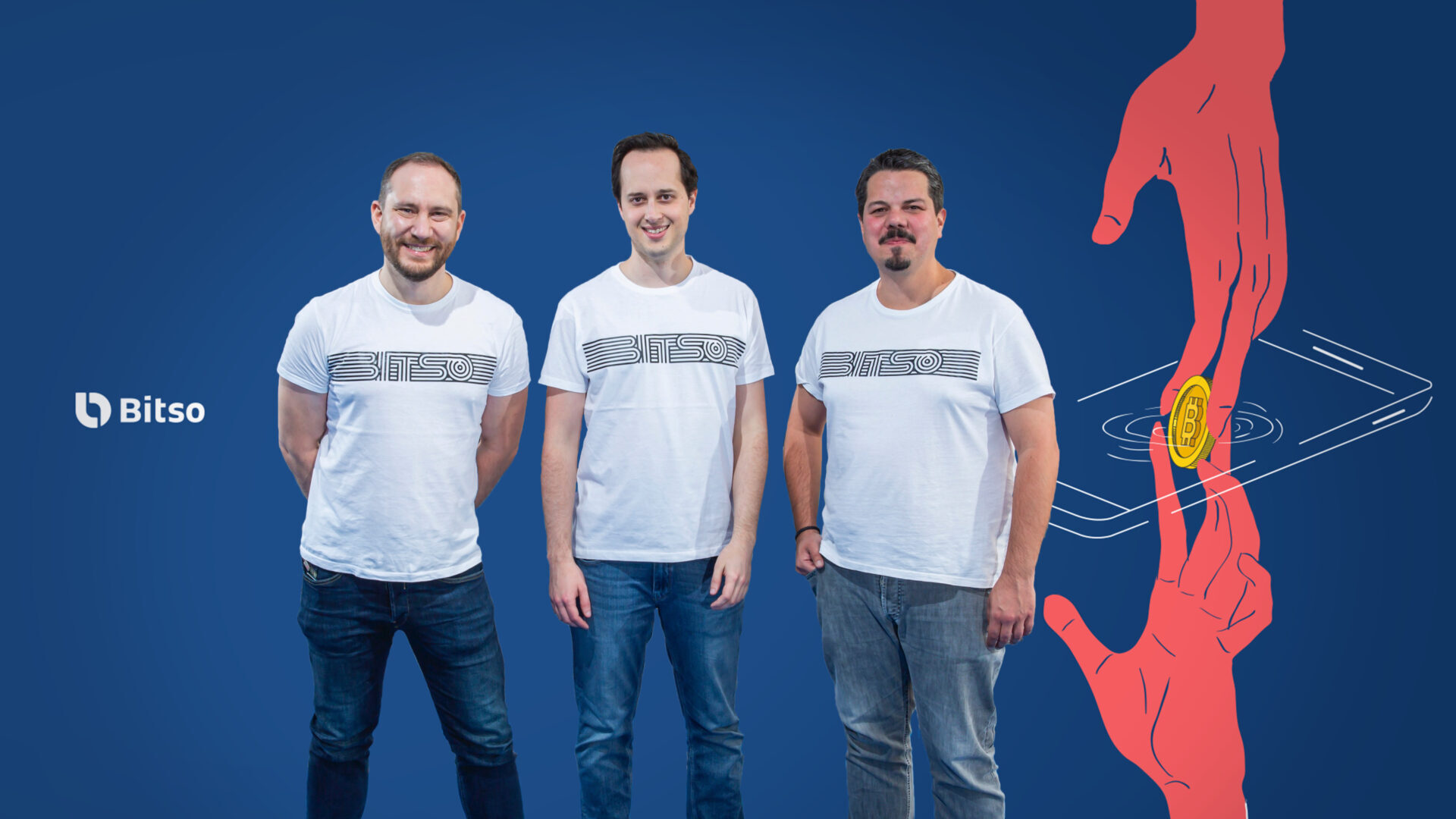
Pablo González and Ben Peters were already building Bitso, which began operating in 2014. A mutual friend connected Vogel and González through their shared interest in Bitcoin. Swaply became a corporate customer. An advisory relationship followed, then a full-time commitment. After finishing Harvard in 2015, Vogel returned to Mexico and became Bitso’s president and co-founder.
The dates give the partnership some texture. They show a business developing through overlapping projects and work already underway. González and Peters had their own experiments behind them. Vogel brought the experience of trying to send money across a border. Their meeting joined an exchange to a problem that needed one.
Returning to Mexico was also a career choice. Near the end of his MBA, an adviser questioned his decision to pass up an American technology-company opportunity for a Bitcoin business back home. By September 2026, Vogel was still describing his interest in terms of the way money could move. The ambition had outlived the first version of the product.
Some early uses were delightfully concrete. Young Mexicans without credit cards used the platform to buy video games online. There is no requirement that the first customer of a financial experiment arrive carrying a grand economic theory. Sometimes the customer wants a game, encounters a payment barrier, and finds a route around it. That is a service a person can explain to a friend.
The surname problem
Vogel became CEO in 2017. As Bitso expanded beyond Mexico, the work acquired a new set of details. In Brazil, the company initially asked for names using the paternal and maternal surname structure familiar in Mexico. Some Brazilian customers found the questions confusing. Vogel later recounted the mistake as a lesson in entering another market.
It is an excellent detail because a name field seems too ordinary to deserve a strategy meeting. Yet it sits at the entrance to the product. A company can spend months preparing financial infrastructure and still greet a customer with a question that makes little sense. The ambition crosses a border; the assumptions in the form quietly stay home.
Vogel has also emphasized customer education, including programs and media that explain cryptocurrency. Access involves several kinds of work at once. Someone must be able to open an account, understand the product, connect their local money, and judge whether the service fits their purpose. Removing one obstacle leaves the others available to spoil the afternoon.
In 2016, MIT Technology Review’s Innovators Under 35 Mexico recognized Vogel’s effort to connect mobile technology with financial access. The recognition located the opportunity in an everyday object: a phone. A device already in somebody’s pocket could become an entrance to services that had previously required a different kind of access.
A valuation, then a different measurement
In May 2021, Bitso raised $250 million at a valuation of $2.2 billion. The funding gave the company a number large enough to become its own headline. It also belongs to a particular moment. A financing valuation describes what investors agreed to then. It leaves the customer’s experience to be measured separately.
Raised by Bitso at a $2.2 billion valuation.
The later payment figures describe another dimension. In December 2025, Bitso Business announced approximately $82 billion in annualized total payment volume and $15.6 billion in annualized Mexican payment flows. These are measures of money moving through infrastructure. They are distinct from revenue, company value, and the amount of cryptocurrency held by customers.
For Vogel’s story, the change in measurement is meaningful. An exchange helps customers enter and exit digital assets. Infrastructure lets other businesses build services on those connections. A person receiving a payment may encounter the company offering that service rather than Bitso itself. Useful machinery has a habit of disappearing from view once people can rely on it.
The dollars inside the data
Bitso’s analysis of its retail users’ 2025 behavior offers another view of that evolution. Dollar-linked stablecoins accounted for 40 percent of purchases, with USDC at 24 percent and USDT at 16 percent. Bitcoin accounted for 18 percent of purchases while remaining the largest portfolio holding, at 52 percent. The analysis covered users in Argentina, Brazil, Colombia, and Mexico.
Share of purchases in Bitso’s four-market sample. Other assets omitted. Purchases and portfolio holdings measure different things.
Those differences resist a tidy verdict about what everyone wants from crypto. Purchases record activity over a period; holdings describe the accumulated portfolio. Digital dollars and Bitcoin can occupy different places in the same financial life. The builder has to accommodate the distinction, even when the public conversation prefers a single winner.
Vogel’s original fascination was with Bitcoin. The work now includes assets designed to track the dollar and connections to established local payment systems. Following the use case has broadened the technical picture. The recurring task remains recognizable: help value move into a form useful at its destination.
An ambition with a receiving end
There are interests beyond the office. Vogel is an avid pilot, and his Harvard activities included the Aviation and Aerospace Club as well as the Bitcoin Club. His professional life also extends into investing and Fintech Mexico. These connections place him among people building companies, discussing financial access, and working out how the industry should develop.
In September 2026, he joined Moris Dieck for a long conversation covering Bitso’s origins, regulation, stablecoin remittances, and artificial intelligence. The range suggests how far the questions have spread since his early Bitcoin reading. A payment company has to think about the environment around its technology as well as the technology itself.
In 2022, Vogel said crypto was “going to be a requirement and not a novelty.” His aspiration is easier to assess in the ordinary situations that recur throughout his career. A young gamer wants to pay. A sender wants the transfer cost to make sense. A recipient wants spendable money. A Brazilian customer wants a form that recognizes their name.
The childhood check is a fitting place to return. Building on the internet produced something of value; using that value required another connection. Years later, Vogel’s work keeps circling the space between the two. The destination gives the journey its purpose. For all the complexity of digital finance, someone is still waiting for the money to arrive.