An entrepreneur can have a company abroad and still have a problem at home: how to get paid. The incorporation documents look reassuring. The company exists. Yet the bank account, the payment arrangements and the means of moving money remain separate jobs. Nezih Sipahioglu encountered that gap while helping Turkish entrepreneurs establish businesses overseas. It became the starting point for a second business, Sipay, and for a career spent trying to gather scattered financial tasks into one place.
There is something pleasingly unromantic about this origin. No customer wakes up longing for payment infrastructure. Customers want the sale to go through, the money to arrive and the accounts to make sense. Sipahioglu built his argument around those ordinary demands. His chosen image was a marketplace: a place where different financial services could sit together, and where the customer could choose without having to reconstruct the entire arrangement.
By April 2025, Sipay had announced a $78 million Series B at a $877 million valuation. The sum made a striking headline. The more revealing question is how a consultant who helped other people go abroad came to build a payments company that wanted to follow them. His story begins well before the investment announcement, with an education in London and an appetite for the practical business of crossing borders.
A company is only the beginning
Sipahioglu studied business management at Regent’s College in London, then completed a bachelor’s degree in Business and Financial Management at City University of London. The sequence matters because his public career first took shape around business organization and international expansion. Before Sipay, his customers needed help establishing a presence in unfamiliar markets, understanding local practices and putting a corporate structure around their ambitions.
He founded Global Trust in 2013. Its work put him in contact with entrepreneurs for whom “international” was an administrative challenge as much as an aspiration. A business might need advice, an introduction or continuing management support. There were different countries and different arrangements, but a recurring customer desire: fewer places to go for an answer.
In 2021, while describing Global Trust’s approach, he emphasized giving international entrepreneurs a single point of contact for business solutions and global resources. That is a useful early clue to his later work. The service was consultation, yet the organizing principle was already recognizable. Gather the expertise. Make it accessible. Let a customer get on with running a business.
The lesson carries a modest sting for anyone who likes a tidy startup origin. A successful company formation does not finish the customer’s task. It merely creates the entity that must now operate. Sipahioglu’s next opportunity lay in that continuation. An adviser who keeps listening after the original assignment is complete may find that the customer has just begun explaining the more difficult problem.
One counter, many transactions
Sipay’s corporate registration dates to November 2018; its operating story is generally dated to 2019. Sipahioglu described the first service as virtual POS, allowing businesses to accept online payments. The product range subsequently widened. The direction was consistent: keep adding the financial functions a customer might otherwise obtain from separate providers.
At Money20/20 Europe in 2024, he explained a business that combined online and in-person payment services, digital wallets, prepaid cards, transfers and open banking. A merchant could use payment tools; another brand could use financial infrastructure under its own identity. That second arrangement made room for Sipay to work behind the scenes, rather than insist on being the name customers saw.
His language was disarmingly direct: “you can come to us and you’ll have everything in one place.” The attraction is easy to understand. A merchant’s day already contains suppliers, staff, deliveries and customers. Adding another financial interface is rarely a festive occasion. A platform that brings services together has to justify itself through the work it removes.
The tradeoff sits inside the promise. Every extra product makes the offer broader and the organization more complicated. Someone still has to maintain the connections, reconcile the transactions and understand which service belongs where. Sipahioglu’s marketplace idea moves much of that coordination toward the provider. The customer-facing simplicity therefore sets a demanding assignment for the people building it.
The customer sees one interface. Someone still has to make the pieces work together.The marketplace proposition
Banks invited to the party
In April 2024, Sipahioglu appeared at Swipeline Summit alongside Figopara founder Koray Bahar, with Debite founder Tayga Baltacıoğlu moderating. Their discussion included the shifting relationship between banks and fintech companies. He described an environment in which regulation, collaboration and competition could all operate at once. His stated priority was to keep adapting Sipay’s strategy as conditions changed.
That is an interesting setting for a founder selling convenience. A bank can be a supplier, a partner and a competitor in different parts of the same arrangement. Such relationships resist the easy storytelling of a newcomer marching in to replace everyone. They require a more patient question: which part of the customer’s experience can this company improve while working with the institutions already there?
By May 2025, Sipahioglu was describing three parts of the business: Sipay Business for companies, Sipay Personal for individuals and Sipay-as-a-Service for financial infrastructure. The last of these gave other fintechs and financial institutions a place in the model. He also described plans for emerging-market expansion, with regional activity centered on the UAE, Azerbaijan and South Africa.
The structure gives the founder several kinds of customer to think about. A person managing money wants an understandable experience. A business accepting payments wants transactions to work. A financial institution buying infrastructure wants dependable integration. Placing them within one organization makes the marketplace idea more concrete, while leaving each audience with its own standards for whether the arrangement is useful.
Capital arrives with company
Sipay’s first institutional funding round brought in $15 million in 2024, led by Anfa. The following April, Elephant led the $78 million Series B, with QuantumLight participating. QuantumLight was founded by Revolut co-founder Nik Storonsky. For Sipahioglu, the names attached to the investment were part of its appeal: international experience and introductions could help a company planning to enter new markets.
The two rounds amount to $93 million in announced funding. The later round was 5.2 times the size of the earlier one. Those are measures of capital raised. They tell a reader how much larger the investment commitment became, while leaving the harder operating questions open: where to expand, which customers to serve and how to make the additional products work together.
His public discussion of fundraising offered a particular sequence. Build products, reach a certain stage, then bring in outside investment. On his LinkedIn profile, he celebrated the rounds and thanked the team and partners. In the Series B announcement he reported a $600 million revenue run-rate. A run-rate annualizes a pace of business; it should be read with that meaning, rather than treated as a completed year’s accounts.
There is an appealingly practical side to this view of money. Capital can buy time, hire people and support market entry. It also adds expectations. Sipahioglu’s international plans gave the financing a destination, but an investment announcement could only mark the start of that next assignment. The marketplace would have to earn its place in each country, customer by customer.
A second chair on the stage
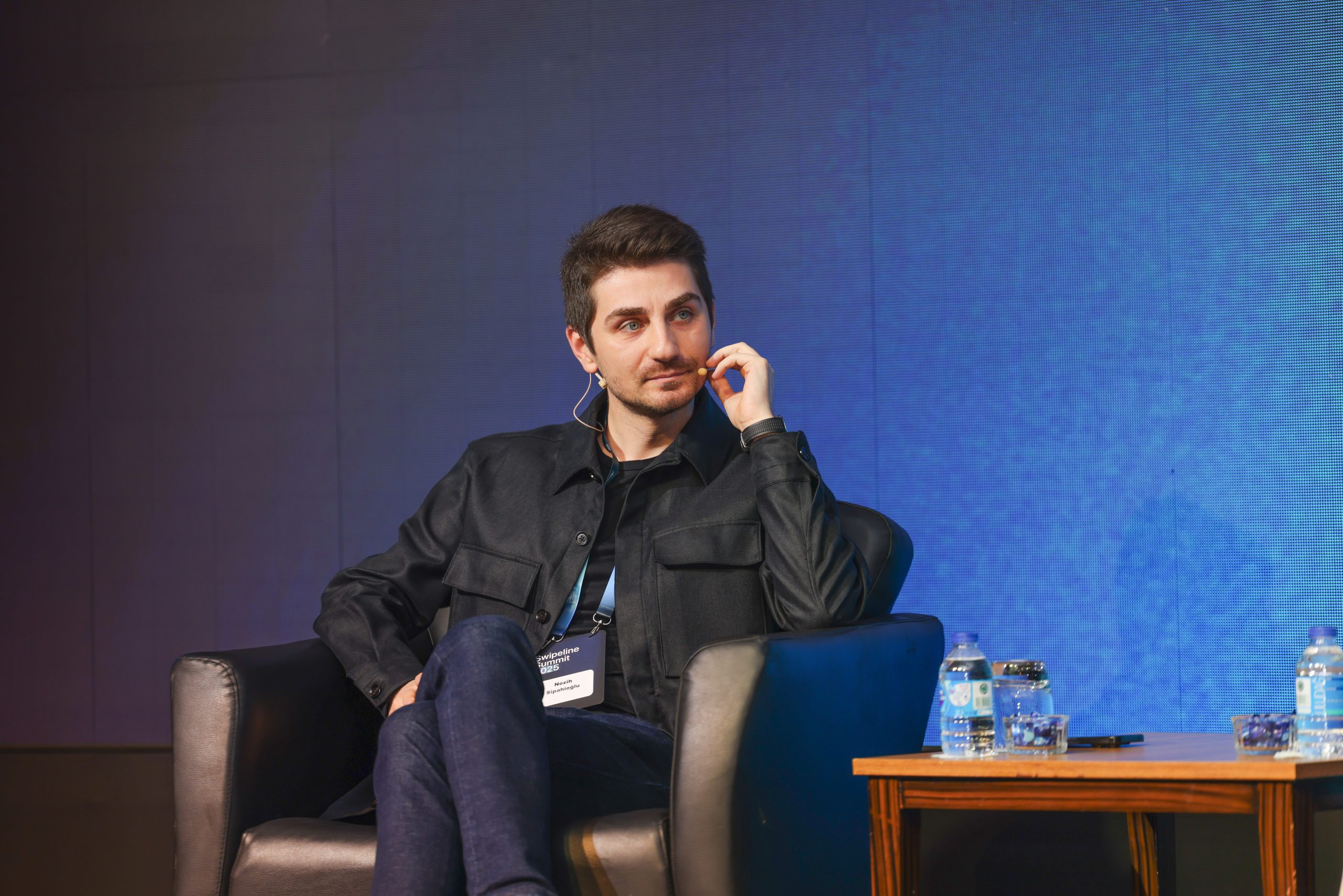
At Swipeline Summit 2025, Sipahioglu invited Sipay CEO Semih Muşabak onto the stage while crediting the team. It is a small action, and a useful one to retain in a founder profile. The investment figure was large enough to command the conversation. He made room for the colleague helping run the organization behind it.
Muşabak’s own account supplies the earlier connection. A mutual friend introduced them while Sipay was still taking shape. Conversations revealed shared values and a compatible outlook. At the end of 2020, Muşabak left KPMG Türkiye, where he had spent roughly nine years in information systems audit and consulting, and joined Sipay as CEO. Their partnership brought a different professional background into the founder’s enterprise.
Technology leadership had another existing connection. CTO Onur Akçınar said he knew Sipahioglu through projects in his earlier working life. In a June 2025 interview, Akçınar described an architecture built around APIs and software serving multiple customers, with attention to regulation, security and changing product needs. The person promising a marketplace needed colleagues who could make its many moving parts coexist.
These accounts make the business less abstract. An introduction, a set of conversations, previous projects: the organization grew through relationships as well as products. Sipahioglu is now listed as founder, Global CEO and chairman; Muşabak as general manager and a board member. Behind the neat titles are different jobs, and a shared obligation to turn the founder’s broad promise into daily service.
The permission to keep going
The expansion story met a more difficult chapter in late 2025. Certain Sipay payment and electronic-money permissions were temporarily suspended. A court stay allowed activity to continue after the October decision; a further temporary suspension was reported in November. Sipay said other specified permission categories remained in operation. These were material interruptions to a business whose products depended on authorization.
As checked on October 7, 2026, the central bank’s public register lists Sipay among active electronic-money institutions and shows permissions for electronic-money issuance and several payment-service categories. That current entry belongs beside the earlier setbacks. A company’s regulatory position has dates, just as its funding rounds do, and a portrait of its founder should keep both in view.
Sipahioglu’s November 2025 discussion of Azerbaijan returned to collaboration with local regulators and financial institutions. He said there were advanced discussions with potential partners and presented wallet infrastructure as one possible route into the market. He described partnerships under discussion, rather than a completed rollout. The distinction leaves room for the work between announcing an intention and providing a service.
Crossing a border changes the assignment. A useful product at home still has to fit another market’s institutions, customer habits and permissions. This is familiar territory in the broad sense for a former international business adviser. It is also where his old profession and his newer company meet: the business can be established, the ambition can be clear, and a substantial amount of work can remain.
The unfinished assignment
Sipahioglu has said that a US public listing is an ambition for Sipay. In 2024 he also described success in terms of drawing investors to Türkiye and building a Turkish brand recognized abroad. These aims sit beyond the next product release. They connect his company’s prospects to his long-standing interest in helping businesses operate internationally.
A founder who starts with incorporation advice and ends up planning a financial marketplace has followed the customer beyond the first transaction. That continuity is the most persuasive part of Sipahioglu’s story. Different company, different tools, larger sums of money, but the same irritation: a customer must keep assembling the pieces before ordinary business can proceed.
The marketplace has grown around that irritation. Its future depends on how much of the promised convenience survives the additional countries, products and responsibilities. Somewhere in that practical test is the point of the original discovery. A certificate can confirm that a business exists. Getting it paid is another matter. Sipahioglu has made a career out of staying for the next question.