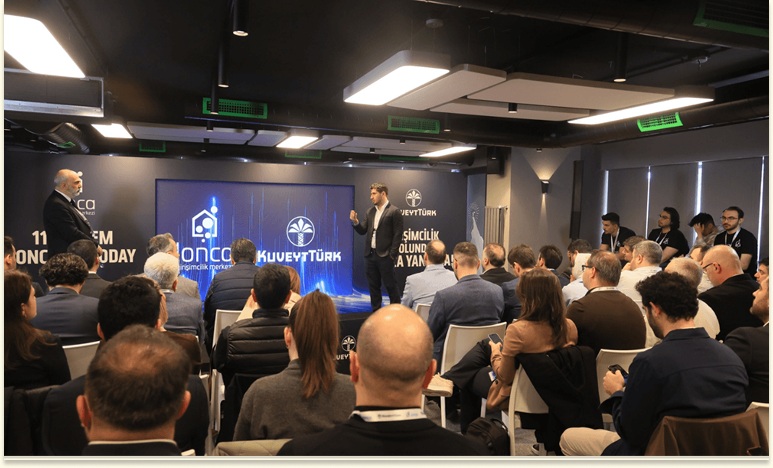
A startup can spend months trying to get a large company to answer an email. Lonca Girişimcilik Merkezi offers a more direct opening: an accelerator established by a bank that may have a use for what the startup is building. In April 2026, Kuveyt Türk reported that it had begun collaborations with six of the 12 ventures graduating from Lonca’s 11th cohort. For a program built around introductions, that is a useful number to put beside the graduation photograph.
It is also a carefully bounded one. A collaboration can mean work toward a pilot or a commercial relationship; it does not, by itself, establish a recurring revenue stream. Still, the announcement makes Lonca’s proposition unusually easy to understand. The bank supplies money, expertise and a route toward testing technology in an operating business. Founders bring products that might solve a problem the institution actually has.
Lonca’s latest accelerator offer includes up to TRY 400,000 in grants. Its published terms say the grants and support require no participation fee, shares or options. Those terms will draw applications. The more consequential question is what happens when the grant-funded product meets a potential customer.
A bank opens its doors, then changes the guest list
Kuveyt Türk established Lonca in September 2017 with coworking operator Workinton. The founding arrangement combined banking experience with places for young businesses to work. Applications were divided between general technology and fintech, leaving room for companies whose products had little to do with a payment screen.
By the second cohort, the emphasis had sharpened. The bank’s June 2018 account explicitly said Lonca was prioritizing entrepreneurs with ready products or products approaching customers, unlike the first term. Nine teams were selected from more than 400 applications. Participants could work from 14 Workinton centers and receive help from bank staff and outside specialists.
That early selection change remains revealing. A corporate partner can inspect a functioning product, describe where it falls short and explore whether it belongs in a business process. An idea alone leaves more of that conversation hypothetical. The shift put Lonca closer to the point where technical work could meet commercial feedback.
The current accelerator criteria retain that emphasis: a capable team, an identifiable market need and a working prototype or product. They also ask for willingness to collaborate and participate. Founders arriving with only a concept should read that distinction closely. The program’s appeal depends on having something concrete for its network to work with.
The grant is the easy part to explain
The support package reaches beyond a transfer into a bank account. Lonca advertises shared office space in Istanbul, technical and legal advice, fiscal consulting, cloud support, mentoring and help attending domestic and international events. Financial technology teams can work with Kuveyt Türk’s APIs in a test environment under the guidance of its API team.
For a founder, those services address several ordinary expenses and delays at once: somewhere to work, advice on unfamiliar business decisions and help connecting a product to financial infrastructure. Test access is particularly practical. It gives developers a place to investigate an integration before asking a prospective customer to depend on it.
The program also has a recurring working rhythm. Its published process describes monthly meetings with the Lonca Management Committee to track performance indicators, discuss targets and hear what teams need. The promise of tailored support comes with an expectation of participation. A founder needs time to attend, deliver work and act on feedback.
Cash support has changed between cohorts. Lonca advertised up to TRY 300,000 in its 2025 anniversary announcement; the latest offer is up to TRY 400,000. Applicants should establish the applicable payment timetable before budgeting against it. An advertised ceiling is a useful starting figure, not a substitute for the terms attached to a particular cohort.
Up to this amount in cash grants.
No fee, shares or options requested for accelerator support.
The bank can sit on both sides of the table
Lonca serves technology startups, but its institutional backer has reasons to participate too. Kuveyt Türk can encounter products that improve its processes or extend what it offers customers. That makes Lonca a corporate innovation program as well as an accelerator: the startup wants distribution and experience; the bank wants useful technology.
Carbon Gate supplies a specific example. The sustainability venture joined Lonca’s 10th cohort and developed a collaboration with Kuveyt Türk. In a testimonial published by Lonca, co-founder Okan Dursun describes contributing to the bank’s sustainability work and stresses the importance of finding an initial customer group.
“A startup’s first group of customers is very important.”
Okan Dursun · Carbon Gate co-founder
Translated from Turkish
The wider partner list extends the conversation beyond a single bank department. It includes banking technology company Architecht, insurer Neova, Kuveyt Türk Portföy and Kuveyt Türk Yatırım, alongside cloud and service providers. These are different kinds of relationships, with different potential uses. A partner logo should prompt a founder to ask who can help with the next piece of work.
The six collaborations reported for the 11th cohort suggest that institutional access can produce more than a meeting. They should still be read as a cohort-specific result. For an applicant, the practical task is to identify a use case and a relevant business team, then find out what a credible trial would require.
bank collaborations reported
There is room for a delivery robot
A bank-backed accelerator sounds like a natural home for a digital wallet. Lonca’s graduates make the category more interesting. Its eighth cohort included Harcy, which produces insulation using textile waste, and Robeff, which develops autonomous delivery robots. Qpien, another graduate, brings customer messages from multiple channels into one business communication platform.
The 12th cohort, announced in August 2026, stretches across similarly varied commercial problems. Finakis analyzes hospital billing files to flag issues before insurance submission. Omnitive connects inventory and retail operating processes. Qberx tracks regulatory changes for institutions operating under extensive regulation. These are startup products supported by Lonca, rather than products sold by the center itself.
The common feature is a technology business with something to test and a market to pursue. Lonca says it selected 11 teams for that cohort from nearly 1,000 applications, after graduating 110 startups across its first 11 completed terms. Admission remains selective even though the sector definition is broad.
Founders have alternatives. Albaraka Garaj also combines bank access, grants, mentoring and API support. Workup, principally supported by Türkiye İş Bankası, serves technology ventures through another institutional network. Lonca’s distinction is the particular bank and businesses behind it. A sensible comparison starts with the customers, expertise and technical connections a product needs.
Three money stories, one easily confused name
Lonca’s financial story has separate parts. There is the support the program distributes: its eighth-anniversary announcement reported more than US$500,000 in cumulative cash grants. There is also money investors put into companies that have passed through Lonca. April 2026 announcements placed that alumni fundraising near US$20 million.
Those figures answer different questions. Grants describe resources supplied to participants. Alumni fundraising describes capital those companies attracted, potentially from multiple investors at different points in their lives. Neither number is Lonca’s revenue or a valuation of the entrepreneurship center. Fundraising also cannot, on its own, show how much of a startup’s progress the accelerator caused.
Then there is the separately managed Lonca venture capital investment fund. Kuveyt Türk’s 2023 account identified KT Portföy as its manager and described priority access for graduates seeking investment consideration. That is a different relationship from accepting an accelerator grant. A founder comparing offers should keep program participation and any proposed investment agreement distinct.
The same care applies to Lonca BİGG, which the application page presents as a pathway into TÜBİTAK’s investment-based entrepreneurship support, in cooperation with Teknopark İstanbul. Lonca now connects several kinds of assistance. Understanding which program is making which offer matters more than treating them all as one pot of money.
After Istanbul, a longer sales trip
Lonca Global adds a second geography to the model. In June 2026, five selected startups - Odito, Visiomex, Marqby, Compuvi and Vendorside - participated in London Tech Week. Their support included preparation and presentation training, free stand space and grants toward travel and accommodation. The overseas visit had work scheduled around it.
The program’s selection criteria look for evidence such as customers, users, sales or pilots, plus a team capable of handling international business development. It offers introductions and market preparation, and explicitly says it does not invest directly. A further initiative announced in July aimed to take five ventures to Slush in Helsinki later in 2026.
That structure makes sense for a company ready to investigate a foreign market. It is less useful if the basic product remains unbuilt or the team cannot follow up with the people it meets. An exhibition can create a conversation. Turning that conversation into a trial, and then a sale, remains work for the startup.
The habit worth borrowing from Lonca is specific: organize support around the next commercial test. Arrive with a working product, name the customer problem, use expert feedback and measure what changes. The grant buys room to work. The corporate relationship gives that work a possible destination. For a founder staring at an unanswered email, that is a proposition worth investigating.
Meet the program. Watch the pitches.
Explore the accelerator, meet its alumni or watch the founders explain their products.