Landon Glenn went into a fintech accelerator with a complicated product. ASA’s platform had to make sense to several kinds of participants, including financial institutions. During The Venture Center’s program, he heard from those institutions quickly enough to change direction three times. His recollection contains the detail that makes an accelerator worth examining: somebody altered what they were building.
- A Little Rock nonprofit turns mentorship and industry introductions into structured startup programs.
- Its banking accelerators target technology that institutions can actually use.
- Lithium innovators, veteran business owners and local entrepreneurs have different routes in.
“We made three fairly significant pivots to our product,” Glenn recalled in the organization’s commissioned impact report. Treat that as a participant’s account, rather than proof that every company gets the same result. Still, it points to something useful. The scarce resource was feedback from people who understood the purchasing problem.
The person who can reject your pitch
The Venture Center supplies education, mentors, programming and introductions to investors. Its distinctive work sits where those familiar services meet an industry’s actual buyers. A founder can explain a product to another founder all afternoon. A banker who must deploy it has a different collection of questions. Those questions can be inconvenient. They can also save months.
Little Rock is a sensible place for that encounter. The city’s financial-software lineage includes Systematics, founded in 1968 and later absorbed into the business now known as FIS. The Venture Center’s FIS Fintech Accelerator began in 2016. Its alumni directory ranges across payments, compliance, data and financial wellness, including Forage, equipifi and Tapcheck. The local connection opens onto a much larger market.
The nonprofit emerged from work by Lee Watson and James Hendren. Watson dates their founding effort to 2013; federal tax exemption followed in 2014. Hendren later described the frustration behind the institution: economic-development reports alone were insufficient. “You have to build the companies,” he said. That meant building systems around founders, with mentorship at the center.
“You have to build the companies.”
James Hendren, January 2026
A bank signs before the applause
The Arkansas Banking Solutions Accelerator, created with the Arkansas Bankers Association, makes the buyer relationship explicit. Its inaugural class included ten companies addressing such problems as fraud, document handling, customer insights and frontline staff support. The program seeks commercially ready solutions. For the 2025 intake, eligibility included existing customers and recurring revenue.
One small event makes the proposition unusually concrete. At the inaugural kickoff, Posh AI reported signing a contract with Farmers Bank and Trust of Magnolia. Posh’s bank-specific AI assistants help employees find information and support customer interactions. A program that brings a technology provider and a purchasing institution together can produce something more substantial than a handsome graduation photograph.
ABSA’s second-year program used a twelve-week hybrid format. That is a commitment to repeated conversations, mentorship and product refinement. It differs from a general accelerator principally in whom founders meet and which problems are selected. Founders comparing it with Techstars or another broad program should ask whose customers the network can reach, and how closely those customers resemble their own.
- 01Meet a buyer
- 02Hear the constraints
- 03Revise the product
- 04Test the fit
Then somebody brings a battery
In July 2025, the organization took its industry-collaboration approach into the Arkansas Lithium Technology Accelerator, or ALTA. Partners include Standard Lithium and the University of Arkansas. The subject changes from banking software to extraction, materials and the battery supply chain. The organizing question remains recognizable: who needs this technology, and who can help test it?
The first cohort included Nano One, RAM Geothermal and Telescope Innovations. Their work spanned battery materials, geothermal energy and chemical-process technology. ALTA’s Technical Advisory Council, announced that December, brought in leaders from ExxonMobil, Tetra, Chevron, Equinor and Standard Lithium to help evaluate and select companies. These are people with industrial problems on their desks.
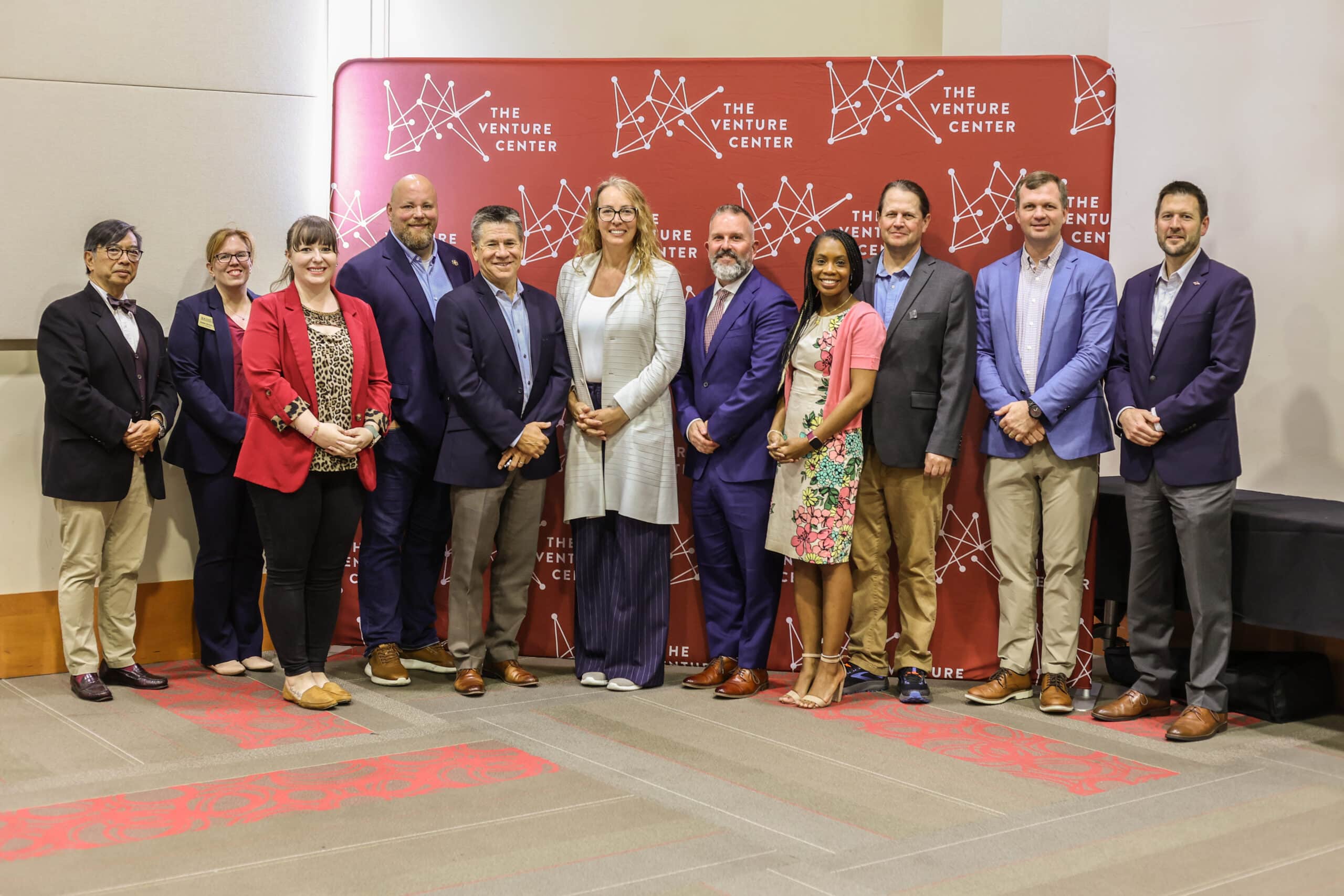
The third cohort presented in El Dorado in April 2026. Its companies included Western CAM, NewGenium and Entegris POCO Materials. The published fourth-cohort itinerary covered September 8-23, moving through El Dorado and Magnolia, Little Rock, then Bentonville and Fayetteville. Lab tours, producer meetings and policy discussions make geography part of the curriculum.
The introductions have a funding bill
The Venture Center is a 501(c)(3) nonprofit. It describes its support as a mixture of grants, program fees, memberships and corporate sponsorships. In December 2024, the Arkansas Economic Development Commission announced separate $200,000 awards for ALTA and the organization’s Business-Driven Accelerator. Those are program grants, rather than equity rounds in the nonprofit.
AEDC awards announced December 2024. These amounts fund programs; they are not participant fees.
A related source of capital has a different structure. The Venture Center Arkansas Fund launched in 2024 as a separately managed, for-profit vehicle. Its website describes investments of up to $250,000 in Arkansas technology startups. Early portfolio companies included Lexamica, Participate, Servato and Sober Sidekick. A founder should distinguish admission to a support program from an investment decision.
Several doors, and some homework
The local entrepreneur need not arrive carrying a battery patent. Spark!, co-founded with the Little Rock Regional Chamber, offers ten weekly sessions on running and growing a business. Origin helps someone explore an idea and work through a Lean Canvas. Membership includes weekday workspace access and monthly mentor appointments. Publicly listed non-member meeting-room rentals range from $35 to $75 an hour.
The veteran accelerator broadens the picture further. Its 2026 class comprised thirteen veteran- and veteran-spouse-owned businesses, including pressure washing, aviation services and telemedicine. The organization reported that earlier participant Ben Lowry’s Northwest Arkansas Sheet Metal secured more than $300,000 in 2025 contracts after completing the program. The timing is encouraging; it does not establish that the program caused every sale.
What can another founder copy? Put a specific customer problem before a specific customer. Ask what prevents adoption. Record the objections, change something and return. The approach depends on a relevant buyer, a product mature enough to discuss and a founder willing to revise it. A company still searching for its first idea needs a different conversation from a bank-ready software supplier. The useful introduction begins when both sides have something concrete to examine.