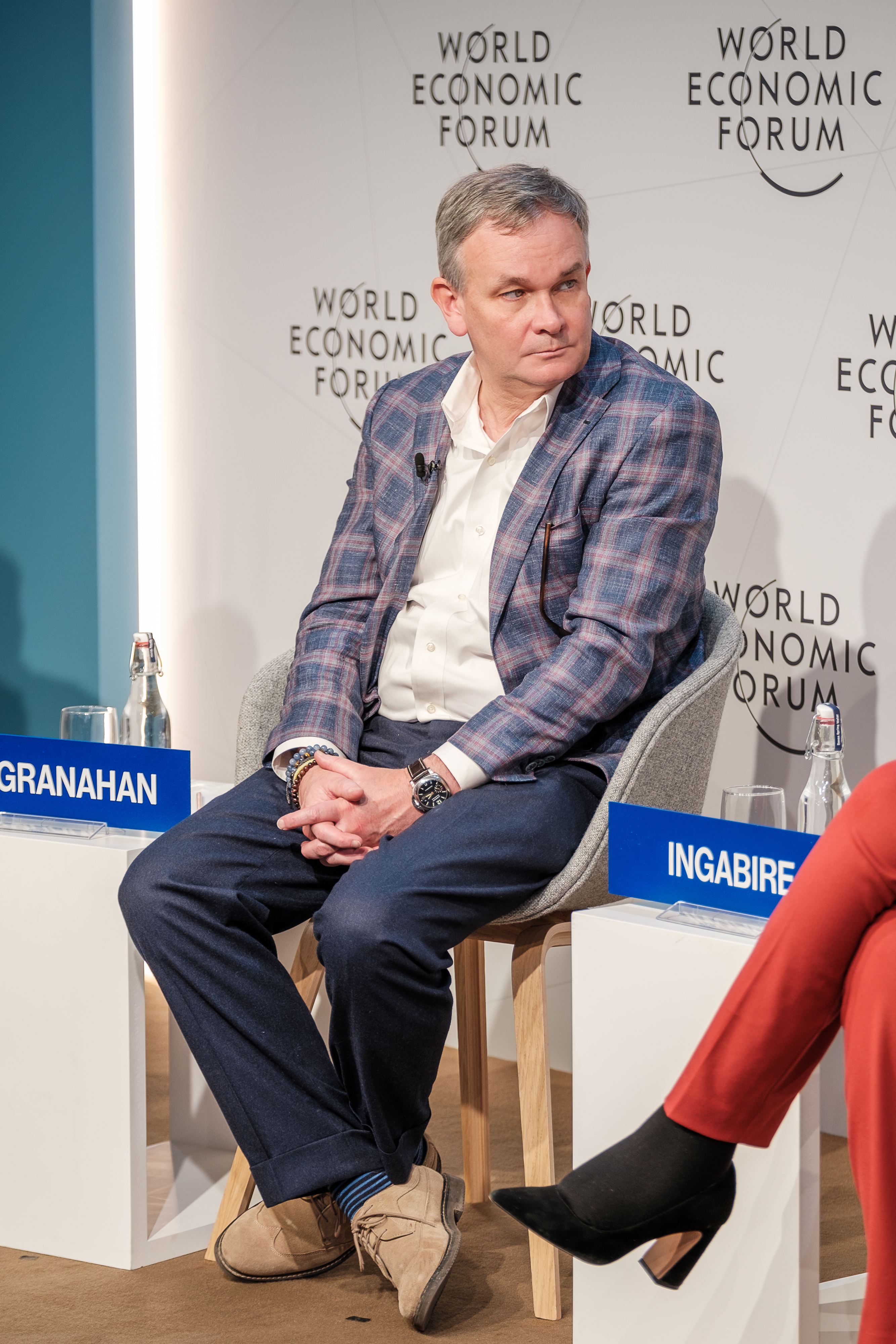
Devin McGranahan brought a soft drink into the stablecoin discussion. Asked in a television interview about the future of money, Western Union’s chief executive observed that a digital token was of limited use if you wanted to buy a Coca-Cola. Somewhere between the blockchain and the bottle, somebody still had work to do.
It was a useful way to explain his wager. Finance loves to announce that distance has disappeared. People sending money home continue to encounter exchange rates, identification checks, opening hours and the small matter of getting spendable currency into someone’s hands. McGranahan runs a company whose business lives among those details. His argument is that they will matter even as the machinery underneath them changes.
That makes him an interesting custodian of Western Union. He arrived as chief executive in December 2021 after a career at McKinsey and Fiserv, bringing the education of a mechanical engineer and economist to a company with a telegraph ancestry. He inherited a recognizable name and a difficult assignment: make an established money-transfer network grow while customers and competitors change the way they move money.
The price of a familiar name
By November 2025, McGranahan was unusually blunt about one of the company’s old assumptions. He said he could find no market evidence that charging a premium had helped Western Union grow. A trusted brand, compliance capabilities and distribution could be useful advantages. Asking customers to pay extra for them had failed to stop competitors taking business.
He had a tart description for the company’s former position: “the industry’s largest share donor.” For a chief executive, it is a memorable way to discuss the generosity nobody wanted. It also reveals something about his public manner. He is willing to puncture the comforting explanation before offering a replacement.
His proposed correction involved competitive pricing and better experiences across digital and retail transactions. The tension was plain. Lowering the price can help win customers while putting pressure on the revenue each transaction earns. Growing the number of transfers and growing the business are related tasks, with an inconvenient amount of arithmetic between them.
“the industry’s largest share donor”
Devin McGranahan, discussing Western Union’s earlier market position, November 2025
His Evolve 2025 strategy, introduced in October 2022, had already set out a broader ambition: build more substantial customer relationships and offer financial services beyond an individual money transfer. The logic was easy to understand. A customer has a financial life between remittances. Persuading that customer to spend more of it with Western Union would require useful products, sensible prices and reasons to return.
Before the yellow sign
McGranahan’s route to this job began well before the present debate over digital dollars. At the University of Pennsylvania, he studied mechanical engineering and economics, earning degrees from Penn’s engineering school and Wharton. He later earned an MBA at Harvard Business School. His LinkedIn education record places the Harvard years in 1994 to 1996.
He joined McKinsey in 1992. Over more than two decades, his work expanded into senior leadership: co-leading its North American financial services practice, leading the global insurance practice and helping oversee the selection of senior partners. Those responsibilities put him inside an institution that sells advice while also giving him a part in deciding who would lead it.
The insurance work left a public paper trail. His publications include writing about customer-centered insurance marketing, multiple distribution channels and the small commercial insurance market. These are less glamorous subjects than digital money, but they involve a familiar problem: how an established financial business reaches customers whose expectations have changed.
In 2016 he moved to Fiserv, initially leading its billing and payments group. He subsequently led Global Business Solutions, overseeing merchant acquiring and processing. His responsibilities included the introduction of Carat, an enterprise commerce platform, along with work on Clover’s software and merchant offerings. Here the product had to function when somebody actually wanted to pay.
That experience reached into sports venues. By 2021, his business was helping teams connect payments with ordering from seats, digital receipts and pickup arrangements. A stadium purchase is a modest transaction with an unforgiving clock: the customer would rather watch the game. The payments industry can describe the architecture at length; the fan would appreciate getting back before the next play.
A boat called Dream Crusher
Away from payments, McGranahan has a competitive pursuit with an admirably unsubtle name. He and his wife, Shannon, own Dream Crusher, a Kernan 47 racing yacht. In the 2021 Annapolis-to-Newport Race, the boat recorded the best corrected time among 65 boats competing under the ORC rating rule.
The crew included their sons, Declan and Lachlain, his brother Colin, and his college roommate Patrick Frisch. Shannon managed shore arrangements and logistics as well as working aboard. McGranahan called her the team’s “backbone.” This was a family operation with a finishing line.
There is no need to turn the boat into a floating management seminar. The details are entertaining enough. His sons had been sailing with their parents since elementary school; he himself had sailed at Penn. The family’s offshore history included an earlier boat named King Daddy. Apparently, quiet understatement was never a requirement at the naming ceremony.
The sailing continued after the move to Western Union. Dream Crusher appears in the 2025 Annapolis-to-Newport prize list, third in ORC 1. The results give this part of his life some useful texture: a recorded win, later competition, and a family activity that has lasted across several stages of his career.
The grocery aisle is part of the system
In McGranahan’s telling, some of Western Union’s changes begin in very ordinary places. Describing the company’s Kroger renewal in late 2025, he spoke about roughly two years of work with the retailer. They had discussed moving remittances into checkout lanes, adding self-service options and connecting loyalty programs with the shopping experience.
That is a more concrete picture of his operating interests than a general promise to modernize. A customer already shopping for groceries has limited enthusiasm for a separate expedition to a service desk. A retailer upgrading its checkout technology has little reason to welcome another awkward system. Western Union’s Partner OS was part of the effort to make those pieces work together.
The story also connects the merchant-payments chapter of his career with the remittance chapter. Both involve a financial transaction embedded in someone else’s working day. The useful question is where it fits, who helps the customer complete it, and what happens when the process gets in the way. Innovation occasionally arrives wearing a supermarket name badge.
Digital dollars, local money
On May 4, 2026, Western Union announced the launch of USDPT, its dollar-denominated payment stablecoin. Anchorage Digital Bank issues it; it runs on Solana. The company described plans that included settlement with agents, connections to digital-asset businesses and consumer spending capabilities. The announcement marked a product launch, while several proposed uses still required development and adoption.
For McGranahan, settlement is central to the proposition. A company promising quick payments across borders must arrange liquidity so money is available where customers need it. His ambition is to make that arrangement less capital-intensive and more continuous, including outside conventional banking hours. The appeal of a faster network depends partly on what it changes behind the counter.
At the Digital Asset Summit in March 2026, he emphasized the difficulty of supplying local currency at scale after a digital asset arrives. A transfer can travel quickly and still encounter an expensive last step. His pitch gives Western Union’s existing treasury capabilities and local relationships a role in the new system.
THE WORK BETWEEN SEND AND SPEND
- 01 / MOVEDigital settlementReduce the time and capital tied up between institutions.
- 02 / CONVERTLocal liquidityExchange digital value for currency people can use.
- 03 / ACCESSA usable payoutConnect the payment to a customer’s everyday life.
Conceptual illustration of the strategy. Availability and implementation vary by service and market.
The idea makes the cash network an asset in a digital discussion, although its economics still have to work. Maintaining relationships, managing compliance and arranging payouts cost money. A new settlement method earns its place by improving that work. The Coca-Cola observation was funny because it reduced an elaborate financial debate to a purchase everyone could picture.
The numbers remain stubborn
The latest reported quarter available for this profile provides a check on the ambition. Western Union’s second-quarter 2026 revenue was approximately $1 billion, down 1% from a year earlier on both reported and adjusted bases. Branded Digital revenue grew 7% on a reported basis. Progress in one part of the business had yet to produce growth across the whole.
year over year
year over year
Q2 2026 · Reported GAAP growth rates · Business measures, not personal achievements
On the July earnings call, McGranahan described a cost program targeting $50 million in annualized operating savings by year-end. He also discussed moving digital staff into regional operating teams and refining spending by individual transfer corridor. These were targets and operating decisions, with their results still to be judged.
That is where his story remains open. The engineer, consultant, merchant-payments executive and sailor now has to make several kinds of infrastructure cooperate while the business is under pressure. His public argument is specific enough to test: competitive prices, easier transactions, less expensive settlement and money that reaches a useful destination.
A company can acquire a new platform faster than it can acquire a new habit. McGranahan’s assignment is to change both. The final judgment will come in repeated, ordinary acts: a customer choosing to return, a retailer finding the service easier to run, a recipient getting money in a form that works. The bottle of Coca-Cola is a small purchase. It is a fairly demanding test.