Before a payment becomes a number on a screen, it can become a small administrative ordeal. Bárbara González Briseño, then Bitso’s head of finance, described the old routine in a 2020 Ripple interview: fill out a form, sign it, scan it, send it to the bank, wait for dollars to be purchased. Somewhere else, a supplier waited too. The mystery was where the money had got to. A business built around bitcoin might seem an unlikely answer to this paperwork problem. Yet that is the useful way into Bitso: follow the payment, rather than the price chart.
- A consumer app for crypto and eligible investment products.
- A business platform connecting digital assets with local bank payments.
- A competitive edge built from liquidity, software and country-specific permissions.
The clever part is the last mile
Bitso launched in Mexico in 2014, founded by Pablo González and Ben Peters. Daniel Vogel first helped with fundraising, then joined full-time in 2015. Its original proposition was straightforward: give people a place to buy and sell bitcoin. The company had to connect an unfamiliar asset to familiar money. That connection became useful far beyond trading. Vogel’s account of the early years makes clear how much work sat beneath the interface.
By late 2018, Bitso and Ripple were building and testing a US-to-Mexico payment route. Dollars could be converted into XRP, transferred, exchanged for pesos and paid out through banking connections. Ripple’s 2020 account described completion in less than a minute. The comparison was with the uncertain, days-long routine González Briseño knew. The recipient could receive local currency without becoming a cryptocurrency trader. That early payment route explains the company's later direction.
Two customers, two different jobs
Today, one customer opens Bitso to manage investments. Another integrates Bitso Business so money can move through their own product. The consumer app advertises more than 100 crypto assets, alongside access to stocks and ETFs where available. Alpha supplies a trading interface for experienced users. The stock service has its own provider and eligibility rules. A single app does not make every financial instrument the same kind of product.

The enterprise customer has less interest in browsing coins. Remittance companies need payouts; marketplaces need collections and disbursements; fintechs need currency conversion and liquidity. Bitso Business bundles these jobs through a platform and APIs. It advertises multi-currency accounts, stablecoin transfers, FX and institutional trading. Its about page includes Briq’s account of connecting an API to simplify cash management. The proposition is operational: fewer separate connections to maintain, with local money available at the destination. The business offering serves a different task from the retail app.
The money that moves is not the money it earns
In December 2025, Bitso announced that its business arm was on track for $82 billion in annualized total payment volume. The same release put Mexican payment flows at $15.6 billion annualized. Those are run-rate figures, not revenue, and do not establish completed calendar-year totals. Keeping the labels attached matters. A payments company can carry enormous sums while earning a small portion of each transfer. Bitso’s announcement also reported more than 1,900 institutional clients.
Annualized total payment volume
A payment run rate. Not company revenue.
The retail exchange makes money through trading fees. Its published lowest-volume Mexican-peso tier charges 0.600% for maker orders and 0.780% for taker orders; higher-volume tiers cost less. These rates apply to exchange trading, not enterprise transfers. Businesses need a quote for their route and requirements. In 2020, Vogel already saw pressure on exchange economics. He told The Block: “The exchange business is one where trading fees continue to collapse.”
A unicorn meets the real world
The capital arrived quickly. A $62 million Series B in December 2020 was followed by a $250 million Series C in May 2021, led by Tiger Global and Coatue. The latter valued Bitso at $2.2 billion. That number belongs to that round. It is not a current appraisal. The funding announcement emphasized expanding access and building additional financial services.
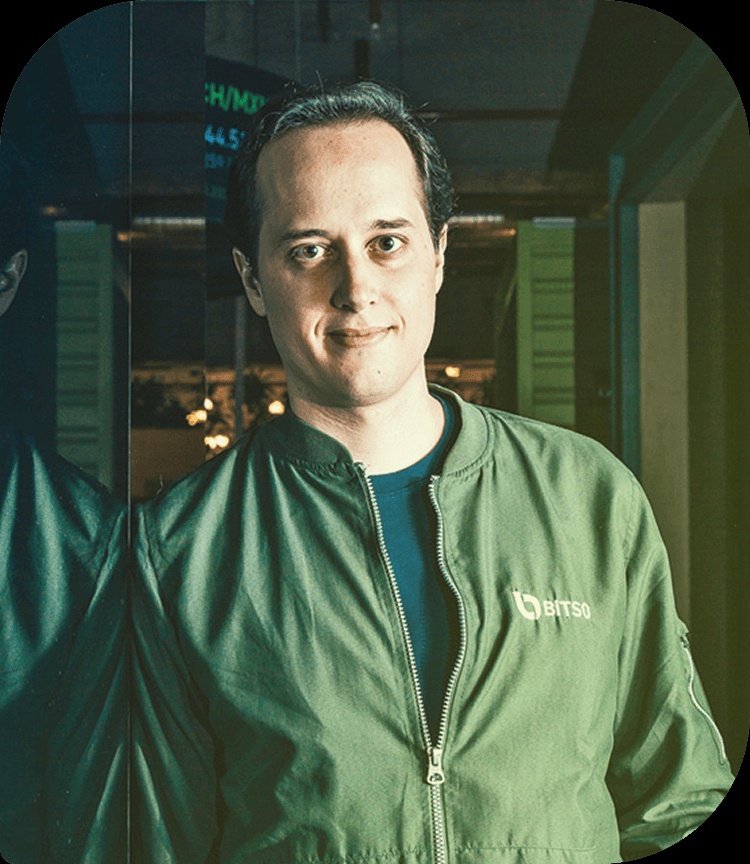
Then came the less photogenic milestone: 80 layoffs in May 2022. Bitso said workforce decisions reflected its long-term strategy and customers’ needs. The cuts exposed the human cost of operating in a volatile industry; they do not prove one particular product had failed. By late 2023, Vogel’s stated priorities included better product quality, faster delivery and substantial B2B revenue growth. Read together, the workforce cuts and later priorities show the distance between raising growth capital and building a durable operating business.
A peso gets a passport
Stablecoins extend the payments logic. Juno, a Bitso company, issues MXNB, a token pegged one-to-one to the Mexican peso. Its documentation describes backing in pesos and cash equivalents, issuance through local deposits, and redemption into bank accounts through SPEI. In June 2026, Ripple announced plans to issue MXNB on the XRP Ledger and integrate it into permissioned exchange infrastructure alongside its dollar stablecoin, RLUSD. Those are announced plans, rather than evidence that every integration is complete.
Here Bitso’s difference from a generic exchange becomes clearer. Binance or Mercado Bitcoin can be alternatives for trading; banks and remittance providers are alternatives for moving money. Bitso’s claim to usefulness sits between those markets. It combines digital-asset liquidity with the bank connections and permissions needed to deliver local currency. A blockchain transfer alone does not finish that job.
Copy the connection, then test the arrival
The lesson for builders is practical: start with an awkward customer workflow, then connect the systems required to finish it. Bitso’s own culture language favors customer needs, simplicity and accountability. The payments business gives those words a concrete test: did the right amount arrive, in the right currency, with usable records?
For a business considering the service, test a supported corridor and compare the complete cost, including conversion and payout. Fast digital settlement cannot fix an unsupported destination, missing account permissions or poor liquidity. Stablecoin backing, custody and redemption also matter. Bitso’s trust disclosures describe segregated assets and proof of solvency, while distinguishing local entities and permissions. The enduring opportunity is easy to understand: make the complicated middle work well enough that the person waiting for money can get on with the day.