A song costing six or nine rupees ought to be an uncomplicated purchase. Choose it, pay for it, play it. In 2012, Sameer Nigam was explaining why that tidy sequence could become a nuisance. Taking out a card for every small purchase was possible. Doing it repeatedly was another matter. The music catalogue might be digital; the customer's patience was still finite.
Nigam was then running digital business at Flipkart, working on its Flyte music store. He described convenient payment as a problem even when customers were willing to buy. More than a decade later, the observation reads like an early sketch of his next company. It would be too neat to call one interview the birth of PhonePe. It does, however, put him in an interesting place: already studying the awkward moment between wanting something and successfully paying for it.
Today, the Bengaluru-based founder and chief executive has a much larger version of that problem on his desk. PhonePe reported crossing 700 million lifetime registered users in April 2026. That figure measures registrations, not a daily audience. Even with that distinction, it describes a considerable responsibility. An irritating checkout is one thing. A payment service that people arrange their day around is quite another.
Lifetime registered users reported by PhonePe.
Registrations are not daily or monthly active users.
Before the purple icon, a music catalogue
His route to payments ran through computer science, shopping search and digital media. Nigam holds a master's degree in computer science from the University of Arizona and an MBA from Wharton. At Shopzilla, he served as director of product management and helped build its shopping search engine. Those jobs involved an enduring internet puzzle: helping someone find the thing they actually want among a great many things they do not.
He founded Mime360, a digital media distribution business, before joining Flipkart through its acquisition in 2011. There he eventually held senior roles in both marketing and engineering. It is an unusual combination, and a useful one. An engineer can make a system work. A marketer has to persuade somebody to try it. A consumer business needs both conversations to end reasonably well.
Flyte brought him close to the peculiar economics of selling digital content in India. In a December 2012 interview, he discussed a catalogue spanning regional music labels, DRM-free songs and an e-book offering designed for devices customers already owned. Regional variety was a practical issue, long before it became a slide in an investor presentation. Discovery, pricing and ease of use all had to meet in the same small screen.
The connection to his later work is an editorial reading of those choices, rather than a claim that he had mapped the whole journey in advance. Music distribution and money transfer are different businesses. Both become more useful when the machinery recedes and a customer can finish a simple task without acquiring a new hobby in troubleshooting.
“People’s willingness to pay is less of an issue today than their ability to pay conveniently.”
Sameer Nigam · discussing Flyte, 2012
Seven thousand rupees, one at a time
Nigam founded PhonePe in 2015 with Rahul Chari and Burzin Engineer. The app went live in August 2016, the year Flipkart acquired the business. The founding team's titles now offer a compact description of the work: Nigam is chief executive, Chari is chief technology officer, and Engineer is chief reliability officer. Reliability gets its own chair at this table.
Looking back at the launch, Chari recalled testing through 7,000 transactions of one rupee each. He also remembered worrying about Play Store reviews. The scale of the experiment is oddly reassuring. Before the immense transaction totals came a group of people trying to get one rupee to its destination, then doing it again.
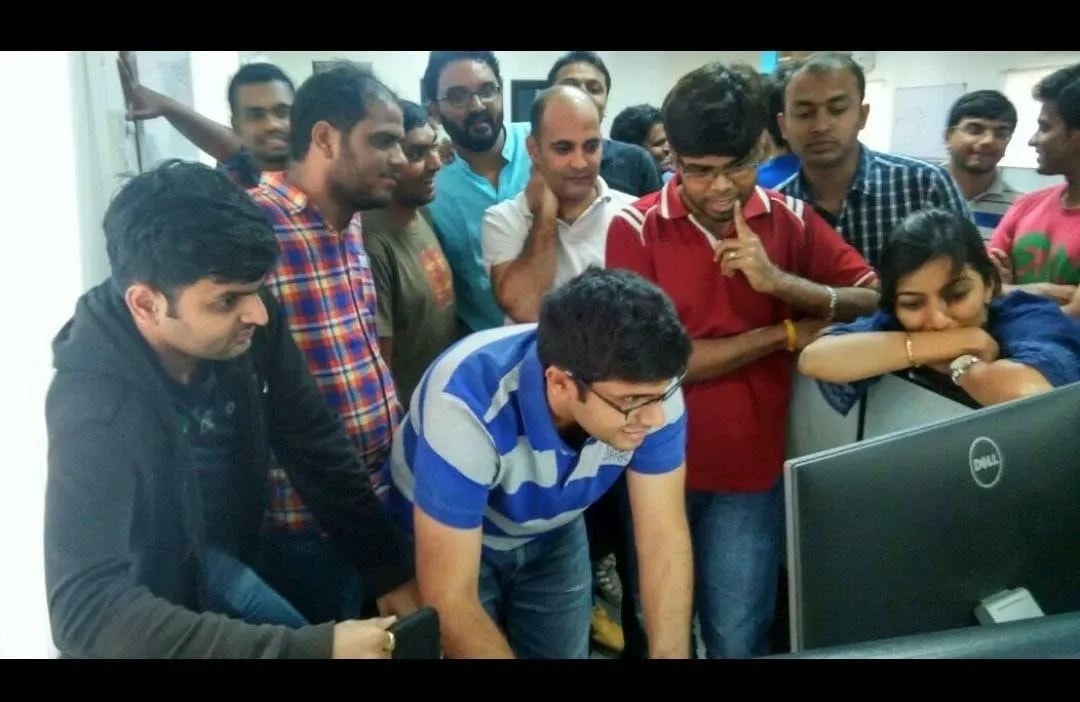
The photograph of the launch has the crowded informality of an office gathered around a screen. PhonePe's fifth-anniversary account dates the moment to 28 August 2016. Chari later joked that Nigam argues for the 29th, using a tweet as evidence, while Chari thinks his colleague simply posted a day late. A company can make money move in seconds and still take years to settle a calendar dispute.
There was another small argument with convention. Chari credited Engineer with pushing for purple when the usual advice said financial apps should be blue. The colour would become familiar. The more consequential choice was to build around UPI, the bank-account payment system, while it was still new to most consumers.
The day the plumbing became visible
In March 2020, restrictions on Yes Bank interrupted PhonePe's services. The banking partner sat behind the interface; the consequences appeared in front of customers. Payments failed. For a business built around making transactions feel easy, the dependency had abruptly become impossible to ignore.
PhonePe restored service after an outage of roughly 24 hours, working with ICICI Bank. Nigam subsequently said the platform processed more than ₹4,000 crore of transactions in the 24 hours after resumption and recorded over 70 million app sessions. These were recovery figures from that episode, rather than a description of its present daily business.
The episode gives some weight to the less glamorous part of his job. A payment company can present an elegant screen, but it also has to coordinate banks, networks and operating teams. The customer has no reason to admire that complexity. From their side of the counter, a payment either arrives or it does not. Competence is often rewarded by being barely noticed.
- 2011Mime360 joins Flipkart
- 2015PhonePe is founded
- 2016The app goes live
- 2022Ownership separation
- 2024Indus reaches consumers
Leaving Flipkart, keeping the connection
In December 2022, PhonePe and Flipkart completed their ownership separation, following a partial separation announced in 2020. The transaction also completed PhonePe's move to an Indian domicile. Walmart remained the majority shareholder of both groups. For Nigam, whose first startup had taken him into Flipkart, it was a new corporate arrangement with a familiar investor still involved.
The separation gave the businesses distinct paths for growth. It also makes his career harder to reduce to the familiar founder story in which someone escapes a large company and never looks back. His working life has involved acquisitions, long-running collaborators and changes in ownership structure. Building independently and building with institutional backing have both been part of it.
His ambitions extended beyond transferring money. PhonePe introduced the consumer version of Indus Appstore in February 2024. At launch, it offered more than 200,000 apps and games, discovery in 12 Indian languages and a choice of third-party payment gateways for developers. External gateways carried no Indus commission under the announced terms.
That placed Nigam in another distribution argument, this time about who gets an app in front of a customer and on what terms. There is a family resemblance to the earlier catalogue work: local languages matter, discovery matters, and the route between a producer and a buyer can shape the whole market. A payment app had brought him back to the business of helping other people's products reach an audience.
A founder with opinions about the neighbourhood
Nigam is capable of making the geography of entrepreneurship sound less solemn than a policy panel. Discussing Bengaluru at Mumbai Tech Week in 2024, he pointed to housing costs and its ability to attract young technology workers. Then came a further consideration: “There's also cheap beer.” The city's microbreweries had made it into the talent argument.
He praised Mumbai's cultural range, too, describing encounters across the arts, sciences, finance and sport. Bengaluru, in his telling, suited concentrated technology work. Mumbai offered a wider mix. That is a more textured answer than declaring one city the winner and waiting for the other city's residents to object.
The Mumbai connection has a concrete educational expression. In December 2024, Nigam and Chari announced a $1 million grant for their alma mater, Sardar Patel Institute of Technology. The stated purposes included infrastructure, student innovation and an entrepreneurial mindset. Returning to an institution with money for future builders is a different kind of milestone from attracting another round of investment.
The next transaction carries more weight
By October 2026, Nigam was talking about a business whose next chapter required several kinds of patience. At TechSparks, he said PhonePe wanted to return to its IPO process when global markets stabilised. The process had been paused in March. His comments expressed an intention; they did not establish a listing date.
He also described payments as a business of trust and spoke about the extensive external auditing the group undergoes. That is a revealing change of emphasis from the early task of winning downloads. Serving a large audience creates obligations that cannot be solved by a more appealing onboarding screen. Governance becomes part of the product's promise, even when users never open an annual report.
At the Moneycontrol Startup Conclave, he identified lending as a focus for the next two to three years and described an ambition to broaden financial-services distribution. He also discussed international expansion, beginning with the UAE, where PhonePe had received in-principle approval for two licences. Approval at that stage is a step towards a business, rather than evidence that the full operation is already running.
His stated ambition was to take a homegrown product-technology company into global markets. The geographical horizon has widened since the days of a music download. The practical question remains recognisable. Can a useful digital service fit into somebody's life so comfortably that they use it again tomorrow?
There is a temptation to tell Nigam's story backwards, making every early job a signpost pointing towards PhonePe. The more interesting version leaves room for the turns. Search taught one kind of discovery. Music exposed a payment inconvenience. A launch required repeated one-rupee tests. An outage exposed dependencies. Now an expanding company needs to earn trust across more products and potentially more countries. The next task is larger, but it still has to work for the person standing at the counter.
“We want to see a homegrown product-tech company go global.”
Sameer Nigam · 2026
Keep the conversation going
Profiles, company reading and a conversation on camera.