The prize photograph catches the easy part: people smiling, a winner in the middle, a healthcare startup enjoying its moment. The harder part comes later. A founder still needs customers, capital and a business that can carry a useful idea into everyday care. For Houston’s Ignite, arranging those next conversations became the work. Eventually, paying for that work became the problem.
Ignite’s leadership announced a wind-down of Ignite Health and Ignite Health Foundation effective June 30, 2026. In the same statement, the organization reported supporting 137 female founders whose companies had raised more than $700 million. Those figures describe alumni fundraising, not money in Ignite’s bank account. Put side by side, the accomplishment and the announcement expose an awkward question for the startup-support business: who supports the supporters?
Organization-reported total
effective date
A hospital insider starts making introductions
Founder Ayse McCracken arrived with experience on the other side of the hospital door. Her career included senior roles at Texas Children’s Hospital and Texas Children’s Pediatrics, leadership at The Methodist Hospital and its physician organization, and the chief executive position at Memorial Hermann Medical Group. Her expertise covered the institutions a startup might hope to sell to, work with or learn from.
That background gave Ignite a particular point of view. A healthcare entrepreneur could benefit from meeting someone who understood how an organization actually operated. An investor might interrogate the business case; a potential customer could interrogate its usefulness. Ignite set out to bring those perspectives into the same founder’s working week.
The network and its first pitch event trace back to 2017. Ignite’s organizational profile lists 2019, the year its annual accelerator began. By October that year, Fire Pitch was already on its third edition. The distinction matters: the competition preceded the more organized program built around it. The stage was an early ingredient; the months of preparation became a larger part of the recipe.
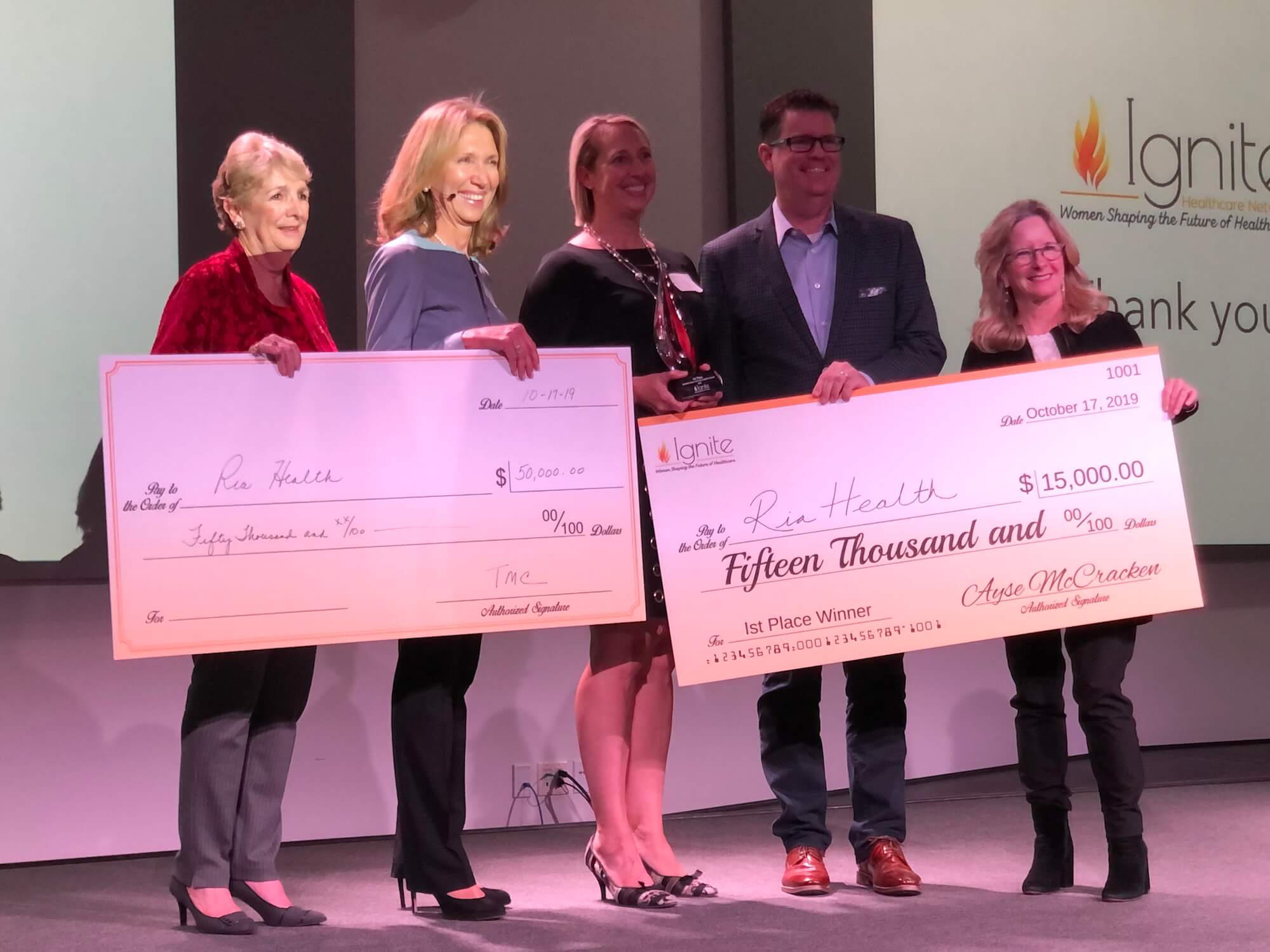
Ria Health, a telehealth company addressing alcohol addiction, took first place in 2019. Sydney-based Sound Scouts, which worked on hearing screening, placed second; neurocognitive assessment company Savonix came third. Even then, the roster reached beyond Houston and beyond a single clinical specialty. The common thread was women leading healthcare businesses.
The useful person might be a future customer
Ignite’s audience was specific: female founders, co-founders and executives building early-stage healthcare companies. Its 2023 application covered healthcare IT, software, digital and mobile health, medical devices and diagnostics. Women’s health was part of that universe. So were products addressing needs across the patient population.
Its differentiator was the way it assembled help. In the 2019 accelerator, startups were paired with healthcare organizations for a ten-week program. Ria Health’s partner was The Menninger Clinic. Path Ex worked with Houston Methodist. Materna Medical and PyrAmes were paired with Texas Children’s Hospital, while Oncora Medical and Savonix were matched with Humana. These were introductions shaped around an industry, with providers and payers in the mix.
That placed Ignite among specialist accelerators, health-system innovation programs and investor networks. The boundaries were porous: Texas Medical Center was a partner and another route to startup support. Ignite’s own role was to discover women-led companies, organize access to relevant people and prepare founders to explain their businesses under questioning. The service depended on the people it could bring into the room.
By 2023, the accelerator ran for twelve weeks. McCracken described matching founders with three or four advisers and adding twice-weekly virtual learning sessions. That detail is more revealing than the word “network.” It gives the relationship a cadence. Founders had repeated opportunities to ask questions, hear objections and return with a better answer.
“Success to me isn’t just getting people an early stage investment.”
Ayse McCracken · Houston Innovators Podcast
In that interview, republished by InnovationMap in December 2024, McCracken tied success to commercialization and products reaching the market. It was a demanding definition for an organization whose most visible annual activity involved choosing pitch winners. The finish line she described sat considerably farther down the road.
A Golden Ticket came with homework
In 2025, Ignite expanded its search through three regional Golden Ticket programs and international recruitment. Eleven startups entered the annual accelerator. The regional programs gave the process a local front door, with North Texas, Northeast and Gulf Coast events feeding a wider network.
The North Texas schedule makes the mechanics tangible. Selected founders had a virtual orientation, followed by a Flash Mentoring session in which a new mentor arrived every fifteen minutes. Then came an in-person pitch competition in Dallas. The top three finalists earned direct entry into the annual accelerator. The ticket bought passage to the next stage of work.
- 01DiscoverRegional Golden Ticket events + international applications
- 02DevelopLearning sessions, customer and investor mentors
- 03DefendVirtual semifinals, feedback and finalist selection
- 04PresentFire Pitch · San Francisco · January 14, 2026
The Northeast program used a similar sequence, culminating in a New York City pitch event. Regional scouting served two purposes in its published description: finding entrepreneurs and identifying local partners who could contribute resources. Ignite was recruiting the support network alongside the startups. For anyone copying the structure, that second assignment deserves as much attention as the application campaign.
The annual program continued through learning sessions, mentoring and December semifinals. Six founders advanced to the January 14, 2026 finale in San Francisco during J.P. Morgan Healthcare Conference week. Calla Lily Clinical Care placed first, Juniver second and Samay third. Moving the finale into that week put the concluding event in a different healthcare gathering place.
The invoice behind the invitation
Participation had a published price. The 2025 accelerator listing charged $150 to apply and $2,000 for selected entrants. For an accepted applicant, those two fees added up to $2,150. The entrance fee helped cover costs left uncovered by sponsorships and contributions. It represented one contribution to the program’s economics, alongside outside support and donated expertise.
$2,150 combined fees for an accepted applicant. Travel and other personal expenses are additional considerations.
The price also came with a calendar commitment. Founders needed time for sessions, mentoring and pitch preparation, with an in-person finale for those selected. A useful way to assess such a program is to ask whether its introductions address the company’s next commercial question. An impressive contact list has limited value if nobody on it understands the customer being pursued.
Ignite offered lighter ways into its community, too. A Cocktails & Conversations event at Dallas’s Pegasus Park listed tickets at $25 and brought together perspectives from a startup, Accenture, a venture investor and a law firm. An earlier education session featured the NIH’s small-business program lead discussing seed-grant applications. The menu extended from a single discussion to months of structured participation.
A prize could mean several different things
Relavo’s Sarah Lee won the 2024 Fire Pitch competition and awards from Johnson & Johnson and Wilson Sonsini Goodrich & Rosati. Relavo’s work concerned home kidney care. CurieDx, developing smartphone-based diagnostic tools, took second, and virtual baby-feeding support provider SimpliFed took third. The winners illustrate the range within Ignite’s chosen audience.
The award descriptions deserve careful reading. Competitions could offer cash, professional services, mentorship, investment opportunities or support connected to potential pilots. Those are different benefits with different next steps. A founder deciding where to spend time should ask exactly what happens after winning, who delivers the benefit and what conditions remain.
Truss Health’s account of the 2024 event, for example, highlighted both a pilot award and an angel cash award. Ignite’s 2023 program listing likewise described the chance to compete for investment and pilot prizes alongside in-kind perks. The practical attraction was a bundle of possible help. Its value depended on which part of that bundle matched the business.
The operating budget had its own story
Ignite Health’s 2025 tax-filing data reports $124,679 in revenue and $150,823 in expenses, a $26,144 deficit. The prior year showed a $11,748 surplus. These figures cover Ignite Health, EIN 84-1887955; they are not consolidated accounts for it and the separate foundation. They nevertheless put an actual operating budget beside the much larger fundraising numbers associated with alumni.
$26,144 deficit. One legal entity’s Form 990-EZ figures; excludes any consolidation with Ignite Health Foundation.
The foundation, announced in 2023, had been an effort to broaden fundraising and support for women in healthcare leadership. That history makes the later decision more pointed. Ignite had already tried to build another vehicle for its ambitions.
In explaining the wind-down, McCracken and Cheryl Stavins said founders needed more extensive resources and continuing engagement to navigate commercialization. Delivering that level of help required investment beyond what their sponsorship-and-volunteer model could sustain. Their stated diagnosis concerned the capacity to keep providing support at the required depth.
Copy the introductions. Budget for the follow-through.
Ignite leaves a practical design worth studying: recruit around a clear founder population, match advisers deliberately, include potential customers and give feedback a schedule. Regional events can discover local talent while recruiting local expertise. A competition supplies a deadline and an audience; the preceding relationships give the deadline a purpose.
The limits are equally practical. This approach needs mentors with relevant experience and enough time to engage. It needs founders ready to use candid feedback. Above all, it needs funding that lasts beyond the event itself. For a company requiring prolonged clinical, regulatory or commercial work, introductions can only carry part of the load.
Following the announced wind-down, Ignite’s old application pages belong to its program history. Readers can still examine the participating businesses, listen to McCracken’s explanation of her priorities and borrow the mechanics of better mentoring. The question its experience leaves for sponsors is concrete: how much of the work after the applause are they prepared to pay for?
Ignite website · Company updates on LinkedIn · Ayse McCracken on LinkedIn
Listen: Houston Innovators Podcast · Meet the 2024 winners · Relavo’s account of Fire Pitch