The humble home-exercise handout has a terrible job. It must survive a patient's pocket, compete with a phone, explain a movement clearly and somehow report back to a clinician who was not in the room when the movement happened. Medbridge took that flimsy handoff seriously. The Bellevue, Washington company now packages the instruction, the exercise video, the reminder, the pain score, the message, the remote-monitoring record and, increasingly, the reimbursement paperwork into one clinical workflow.
That sounds like a modern digital-health pitch. The origin is less grand. Founder Justin Kowalchuk has said he started Medbridge in 2009 after spending a year working in his sister's small physical-therapy practice in Seattle. The first wedge was professional education: expert-led, accredited video courses that clinicians could watch without traveling to a conference. It was specific, useful and close to a compulsory habit. People in licensed professions need continuing education. Medbridge made the experience less annoying.
The company then followed its customer into the treatment room and, from there, followed the patient home. Today Medbridge Educate covers continuing education, certification preparation, compliance, skills and clinical procedures. Medbridge Care includes customizable home exercise programs, guided care pathways, patient education, outcomes collection, messaging, remote therapeutic monitoring, motion capture and integrations with electronic medical records. One side helps the clinician learn. The other helps the clinician's plan survive contact with ordinary life.
The Medbridge product ladder
The real productThe appointment after the appointment
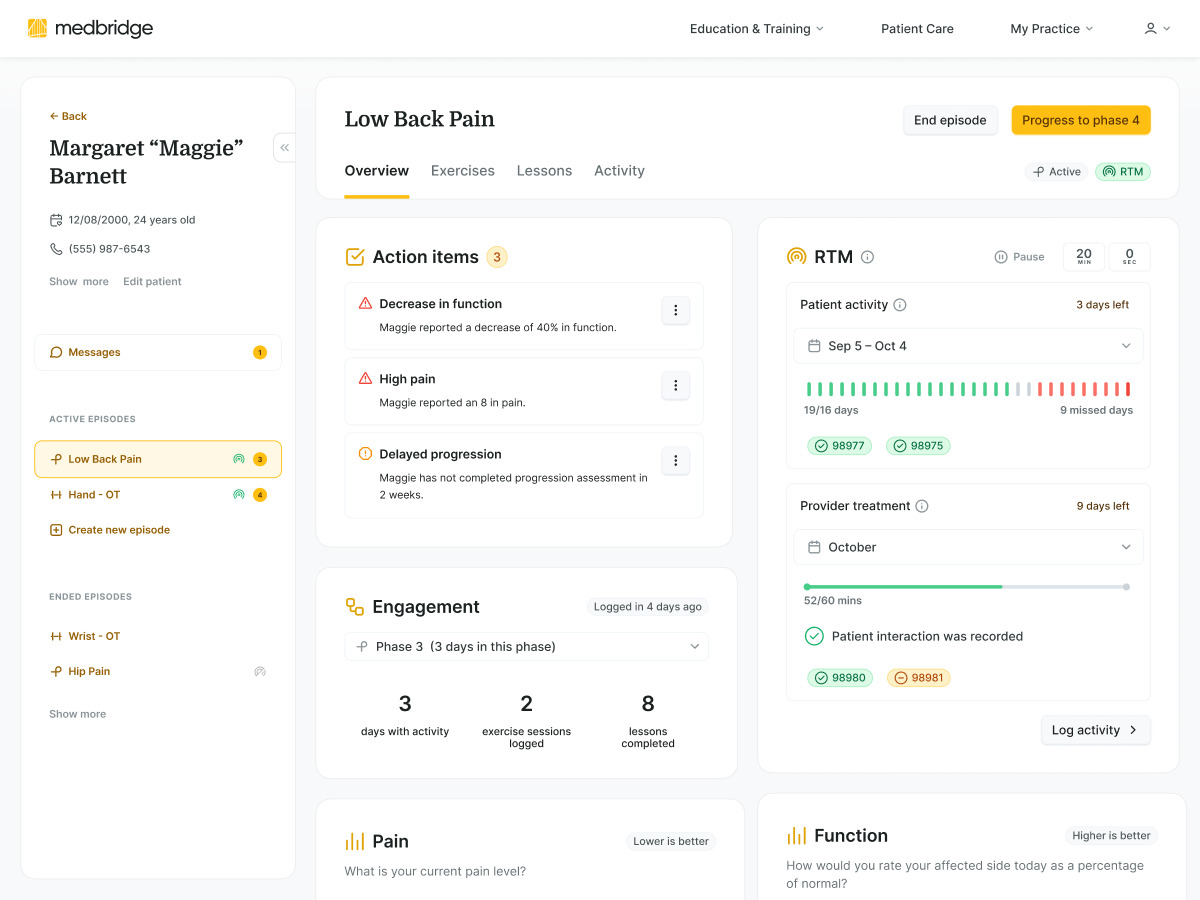
Medbridge is not a virtual clinic in the style of Hinge Health or Sword Health, and it is not merely a library like HEP2go. Its position is in the middle: software for provider organizations that want digital reach while keeping their own clinicians in charge. A therapist can build a custom program from more than 8,000 video exercises, send it by text or email, collect standardized measures such as PROMIS, see adherence and pain reports, adjust the plan, message the patient and document remote work.
For routine conditions, a provider can choose a pre-built Pathway instead. These progressive programs extend into musculoskeletal care, fall prevention, women's health, surgery and workplace injury prevention. The distinction matters. A custom HEP fits patients who need hands-on care and regular clinician judgment. A Pathway fits lower-acuity cases or people who cannot reliably reach a clinic. The platform is trying to make hybrid care a clinical choice, not an ideological one.
The customers range from solo therapists and outpatient groups to hospitals, home-health agencies, hospices and employers. Medbridge says nine of the ten largest US hospital systems and nine of the ten largest physical-therapy private practices use its products. Its case studies name organizations including Pivot Physical Therapy, Freeman Health System, CORA Physical Therapy, Well Care and AngMar Medical Holdings. These are company-reported results, not a randomized verdict, but they explain what buyers are shopping for: more consistent care, faster onboarding, better retention, visible outcomes and fewer pieces of paper.
Make conservative care the easiest choice.Medbridge's current company line
The businessA seat, an episode and the meter running
Medbridge makes money as vertical SaaS, sold to individuals and organizations. Public small-business pricing is unusually legible for healthcare software. Several plans list at $329 per seat per year. Care Essentials includes a pooled allowance of 100 home-exercise episodes per seat; additional episodes are $1.50. Care Elite includes unlimited HEP episodes and lists remote therapeutic monitoring and Guided Pathways at $10 per program. Large organizations negotiate pricing.
The hybrid pricing is revealing. The seat fee pays for access; episode fees rise with patient use. That gives a small practice a comprehensible starting number while letting Medbridge participate in expansion. It also creates a test the product must keep passing: does one more digital episode save enough time, support enough reimbursement or improve enough follow-through to justify the meter?
Medbridge bootstrapped for roughly nine years. In 2016, it won GeekWire's Bootstrapper of the Year award and, according to company-data services, raised $3 million in debt. LLR Partners made an undisclosed growth investment in 2018. Brentwood Associates recapitalized the business in 2021 on undisclosed terms. No reliable public valuation exists. An external company dataset supplied for this profile estimates annual revenue at $32.9 million, but Medbridge does not publish audited revenue.
What failed firstThe software worked. The operation wheezed.
The first weak link in remote therapeutic monitoring was not the idea of checking on patients between visits. It was the machinery around it. Practices had to enroll the right people, generate enough interaction, document time, hit billing thresholds, move data through an EMR and submit clean claims. In 2026, Medbridge said even strong practices captured only 80 to 85 percent of eligible RTM codes, while some operated in the single digits. Clinical work was happening; revenue was leaking through workflow cracks.
That reality changed the product answer. Medbridge now offers three operational modes. A practice with staff and billing confidence can run RTM itself. A partnership with SaRA Health adds billing validation, claims and denial support while the practice keeps care coordination. A partnership with Tandem RTM outsources enrollment, navigation and billing. The important move was admitting that customers did not share one definition of "easy." The platform stayed common; the service layer became adjustable.
COVID-19 forced remote care from optional experiment to practical necessity. Later reimbursement codes created an economic path, while the operational burden revealed where software alone was insufficient.
A second expansion pushes from clinical proof into payment. In August 2026, Medbridge partnered with Patient360, a CMS-approved registry, to turn patient-reported outcomes already collected in the platform into MIPS quality reporting. For eligible clinicians, failure to report can reduce Medicare Part B reimbursement by as much as 9 percent. Medbridge is moving the evidence from a dashboard toward the place where a CFO notices it.
The AI chapterA camera, a squat and a sensible limit
Medbridge acquired Rehab Boost in 2024 and turned its computer-vision technology into Medbridge Motion Capture. A phone camera can score movement assessments and feed the result into a care pathway. In 2025, the company wrapped motion analysis, triage and workflow assistance into an AI-assisted One Care platform. The distinction in its messaging is deliberate: AI assists the clinician rather than impersonating one.
That is also where Medbridge differs from direct-to-consumer digital MSK businesses. Its advantage is not an autonomous care bot. It is the installed relationship with providers, the education catalog and the ability to put a new tool beside something a clinician already uses. The cost is complexity. Every adjacent feature adds another integration, permission, training decision and promise to support. A bundle becomes a moat only when the seams disappear.
The stealable playbookStart with trust. Expand into friction.
There is a clean strategy here for founders in other regulated markets. Begin with a recurring obligation - continuing education, certification, compliance - and make it pleasant. Use expert content to earn professional trust. Then watch what the customer does immediately before and after that obligation. Medbridge moved from teaching therapists to helping them prescribe, monitor, measure and document care. Each step served the same buyer and reused part of the same knowledge base.
The second lesson is to package the boring parts. Motion capture gets the demo, but billing thresholds, patient reminders, outcomes collection and EMR documentation decide whether a program lives past the pilot. Medbridge's recent partnerships are a map of the chores customers will pay to stop coordinating themselves.
The model will not travel everywhere. It works best when users face recurring education requirements, deliver repeatable plans, collect standardized outcomes and can earn or protect revenue through better documentation. It is weaker when care is highly acute, the workflow changes case by case, internet access is poor, patients will not engage digitally, or the organization already has deeply integrated point tools. A $329 seat is cheap if it replaces clicks and captures revenue. It is expensive if it becomes tab number twelve.
Medbridge's most interesting achievement is not digitizing a handout. Plenty of companies can host exercise videos. It is the patient, deliberate expansion around a moment of professional trust. First the clinician came for knowledge. Then the care plan stayed for company. The next test is whether outcomes, AI and reimbursement can live in that same room without making it crowded.