The modern healthcare employee can forgive many things. A password reset at 6 a.m. is not one of them. Neither is a 47-minute compliance module waiting at the end of a shift. Yet the unlovely machinery of training matters: a missed certification can become an audit problem, a skill gap can become a patient problem, and a chaotic onboarding process can send a new nurse elsewhere. Relias built a business in that narrow space between the eye roll and the incident report.
Based in Morrisville, North Carolina, the company serves roughly 13,000 healthcare and human-services organizations and 4.5 million caregivers. Its software assigns courses, tracks licenses, delivers continuing education, tests clinical judgment, documents hands-on skills, and gives administrators a record of who is ready for what. The library contains more than 5,000 interactive clinical and non-clinical courses. It is the sort of scale that makes “we'll keep it in a spreadsheet” sound brave.
A company assembled, not mythologized
Relias has no tidy garage legend. It was formed in 2012 when Vista Equity Partners combined Essential Learning, which served behavioral health and human services, with Silverchair Learning Systems, which focused on post-acute care. The original insight was wonderfully unromantic: regulated care businesses need both the software that manages learning and the specialist content employees must complete.
Acquisitions made the thesis wider. Care2Learn and Hospice Education Network brought more post-acute material. Assessment Intelligence Systems added testing and analytics. Advanced Practice Strategies brought clinical tools. OnCourse Learning delivered Nurse.com and the Wound Care Education Institute. InceptionXR added virtual reality. Feedtrail brought patient and employee feedback. The company dropped “Learning” from its name in 2018, a small edit with a large strategic meaning.
Bertelsmann bought Relias in 2014 for an amount described at the time as in the mid-hundreds of millions of dollars, widely reported as about $540 million. It was the German group's largest American acquisition since Random House. Relias then became a cornerstone of the Bertelsmann Education Group, proof that a vertical training company could be more than a content vendor.
The first thing to fail was the homemade system
Relias' case studies repeat a familiar sequence. Training begins in classrooms. Records live in paper folders, an Access database, or a workbook maintained by one heroic administrator. Growth arrives. Rules change. New locations open. Employees need different courses for different roles. The calendar cracks first, then the recordkeeping, then everyone's patience.
At Pathways, a behavioral and mental-health provider with more than 6,000 employees, new-hire orientation was expensive to deliver across 23 states. After moving material online and creating internal courses with subject-matter experts, the organization said it shortened the route from hire to service by 25 days and calculated about $1.2 million in annual orientation savings in one state alone. One instructional designer could support more than 6,000 users. That is not a prettier course catalog. It is a different cost structure.
“You just can't beat the cost savings that we get from utilizing Relias.”Brandy Arana, Pathways instructional designer
The sticker price is harder to pin down. Relias does not publish a standard enterprise rate. Quotes vary with users, modules, content, and implementation. That opacity is a weakness for buyers trying to shortlist tools without taking a sales call. It also makes the honest purchasing question less satisfying and more useful: not “What is the price per seat?” but “What does training cost after payroll time, travel, administration, duplicated content, delayed starts, and turnover are counted?”
What changed buyers' minds
The winning argument was rarely “digital transformation.” At Grant Regional Health Center, it was customization and implementation support. At Alternatives, Inc., it was a library of more than 700 relevant courses and a web-based system that replaced an Access database. For the Missouri Division of Developmental Disabilities, self-registration and portable learner records removed roughly 800 hours of annual administrative work and an estimated $20,000 in costs.
The pattern is worth stealing. First, sell relief from a recurring obligation. Second, bundle software with expertise the customer cannot economically maintain alone. Third, let customers add their own knowledge. Finally, use the resulting data to solve a more valuable problem. Relias entered through training administration, then moved toward hiring fit, competency, retention, patient experience, and care quality.
Where the platform is genuinely different
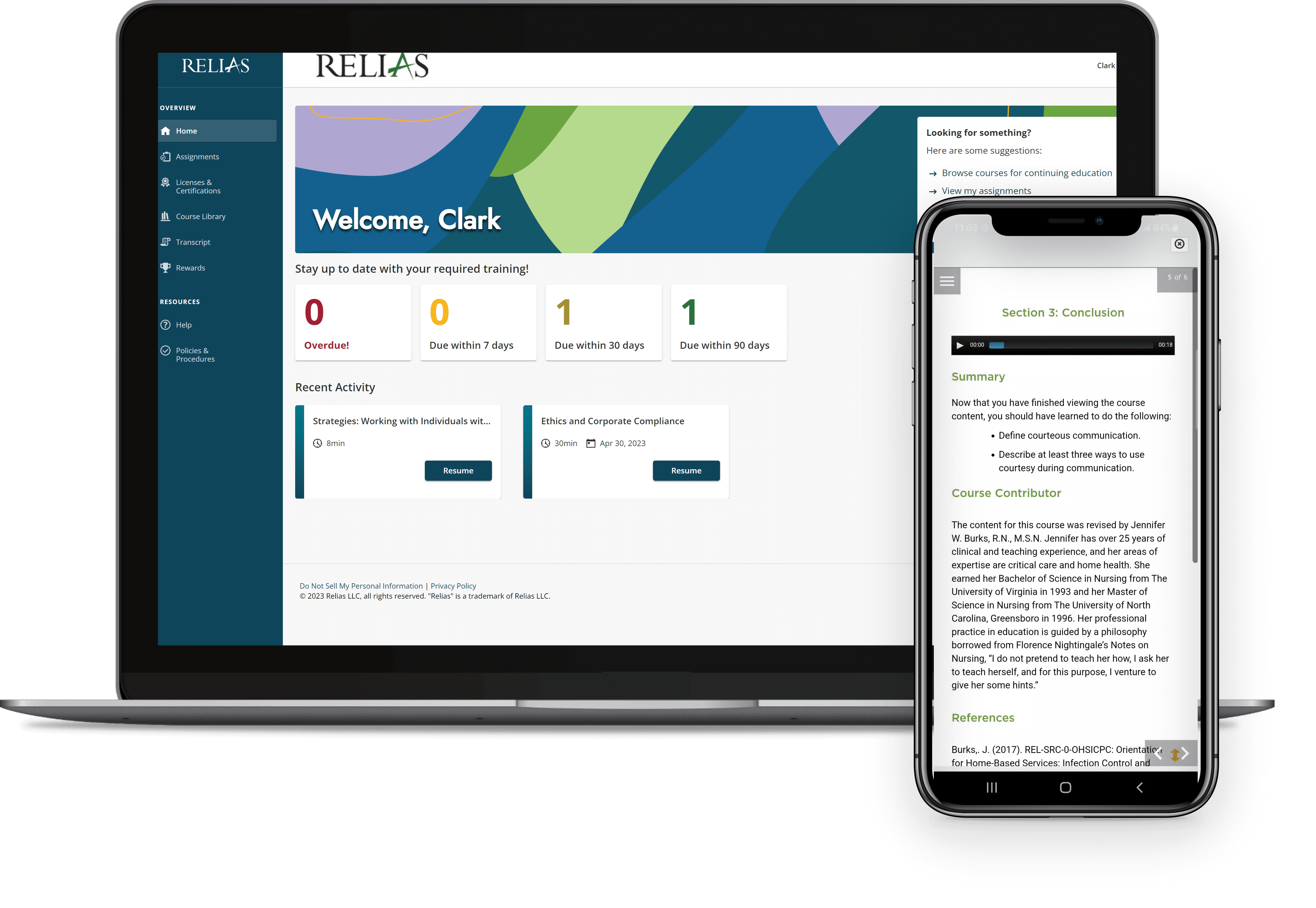
A generic learning management system can host a video, issue a quiz, and record completion. Relias' advantage is healthcare specificity. Its content is built and updated with clinicians and instructional experts. Courses can carry continuing-education credit. Assignments can reflect roles, locations, regulations, and licenses. Assessments cover clinical knowledge, behavior, and situations. Skills checklists document observation at the point of care.
That mix creates a content-plus-workflow moat. A hospital can buy software elsewhere. It can commission courses elsewhere. It can run assessments elsewhere. Relias argues that bringing those pieces together reduces handoffs and makes learning data operational. The company now organizes its offering around five jobs: Learning, Performance, Compliance, Quality, and Recruiting. Relias XM, built from the Feedtrail acquisition, adds patient and employee feedback. Relias VR uses immersive scenarios where a slide deck may be a poor substitute for pressure.
Relias is strongest when...
Training is regulated, frequent, role-specific, distributed across locations, tied to credentials, and expensive to administer badly.
Relias is weaker when...
A small team needs a few generic lessons, demands transparent self-serve pricing, or already has content and a satisfactory enterprise LMS.
The main healthcare-native alternatives include HealthStream, MedTrainer, symplr, Healthicity, and CareAcademy. Broader platforms such as Cornerstone, Docebo, Workday, Oracle, SAP, Absorb, and TalentLMS compete when one corporate standard matters more than clinical depth. Relias will not win every comparison. Reviewers and administrators sometimes complain about bugs, seat costs, irrelevant assignments, and long contracts. A platform designed to satisfy many regulators can feel like a regulator itself.
The metric is not completion
The most interesting Relias results happen outside the learning screen. Cleveland Area Hospital reported more than $94,000 in annual savings and a 75 percent reduction in administrative time. KenCrest reported a 20 percent retention increase after using assessments before hire. Brightview Senior Living reported a 39 percent improvement in course compliance. Providence said its clinical academy, which uses Relias OB Onboarding, produced 21 to 32 percent lower monthly RN turnover than its system overall and more than $20 million per year in avoided turnover costs for three years.
These are customer-reported outcomes, not laboratory results. Software did not save the money by itself. Managers redesigned onboarding, educators standardized practice, leaders acted on the data, and staff still had to learn. That condition matters. Relias will not rescue a workplace that assigns irrelevant modules, ignores assessment results, or treats completion as competence.
The software earns its keep when a completion record changes a staffing decision, an onboarding plan, or a patient's odds.YesPress analysis
A practical copybook
Operators can borrow five moves. Map the expensive manual workflow before shopping. Calculate the full cost of classroom time and administration. Pilot with one role where success can be measured. Keep internal experts involved so generic content does not flatten local practice. Then track an operational result such as days to independent work, audit preparation hours, turnover, or error rates.
Founders can copy the business architecture. Pick a regulated niche with recurring obligations. Pair a system of record with trusted content. Make updates part of the subscription. Build integrations where customers already keep employee data. Expand only when the original workflow generates information useful to the next product. Relias' acquisitions look sprawling from a distance, but most orbit the same question: is this person ready to deliver care?
The model breaks under clear conditions. Regulation alone is not a moat if content is easy to copy. A huge library becomes clutter when recommendations are poor. Assessment data becomes theater when managers do not act. And enterprise bundling becomes a tax when customers need only one narrow tool. The buyer still has to demand a pilot, clean contract terms, accessible content, reliable integrations, and evidence that applies to its own workforce.
The boring work keeps getting bigger
Relias' latest moves show where it thinks the market is going. The InceptionXR acquisition gives it new training formats. Feedtrail brings workforce and patient sentiment into view. A partnership with Kahuna connects learning assignments to competency validation. Work with KVC is training more than 400 youth-serving clinicians to recognize and respond to suicide risk. The company is positioning itself less as the place employees watch required videos and more as the place leaders decide whether a workforce is prepared.
That ambition is plausible because Relias already owns the boring doorway. Healthcare organizations cannot stop documenting training just because staff dislike it. They can, however, make the obligation shorter, more relevant, easier to prove, and more useful afterward. Relias' bet is that the record nobody wants to create can become the intelligence every operator needs.