The uncomfortable fact about medical AI is that an algorithm can be cleared, accurate and commercially available - and still do nothing for a patient. Pelu Tran learned that gap personally. His uncle's lung cancer went undetected for more than five years across three imaging studies. By the time doctors found it, the disease had spread. He died roughly six months later. Tools capable of flagging suspicious lung findings already existed. They simply were not inside the workflow that mattered.
That failure became Ferrum Health's defining mandate. Tran, a Stanford-trained biomechanical engineer and medical student, had already co-founded the clinical-documentation company Augmedix. Public company profiles date Ferrum to 2017; after his uncle's death in 2018, Tran and longtime friend Kenneth Ko, an enterprise infrastructure specialist, focused it on a less glamorous problem: getting clinical software through a hospital's technical, legal and operational maze.
Ferrum does not primarily ask hospitals to believe in one magic model. It sells the layer beneath a portfolio of models - the connections, private compute, catalog, controls and evidence required to move AI from a pilot deck into routine care. In a market mesmerized by what algorithms can see, Ferrum is focused on whether a health system can install them, trust them and notice when they stop behaving as expected.
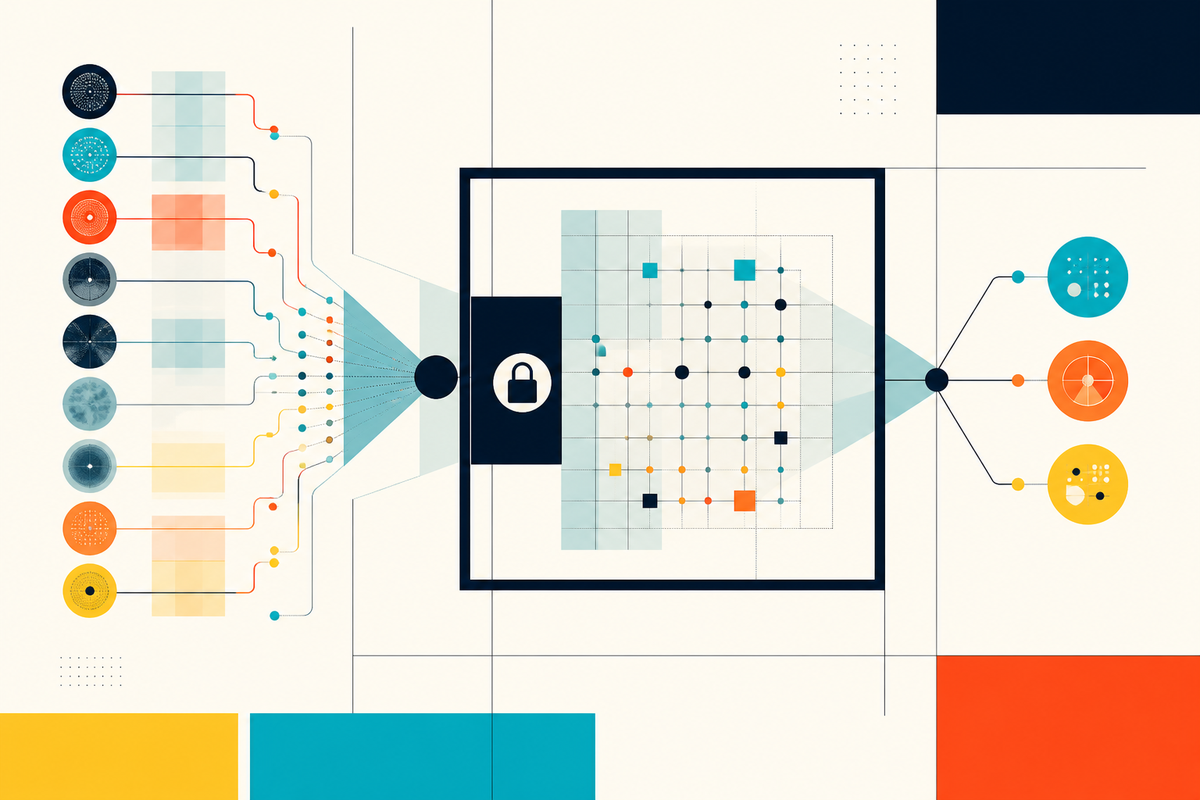
A control plane for the model zoo
Ferrum calls its current product the AI Governance Suite. Its first piece, Deployment Fabric, connects once to the electronic medical record, picture archiving and communication system, worklists and reporting software. New models can then travel the same governed route instead of demanding a fresh integration every time. The system can run on hospital premises or in a single-tenant cloud controlled by the customer. Protected health information stays within that customer's security perimeter.
The Model Hub is the library and traffic desk. A hospital can manage FDA-cleared, CE-marked, open-source, homegrown and third-party models in one place. Models can be approved, versioned and routed by site or service line. Ferrum's commercial distinction is choice: it presents itself as vendor-neutral and offers models à la carte, rather than requiring a health system to buy a fixed bundle from the company that also made the algorithms.
Observability Lens is the referee. It links predictions with ground truth and outcomes, then watches performance, utilization, bias and drift. That last job matters because a model's behavior can change when patient demographics, equipment, protocols or clinical practice change. A model validated elsewhere is not automatically a model validated here.
PACS · EMR · worklists
Any approved source
Ground truth · outcomes
“It doesn't really matter what technology is out there, but if doctors aren't able to use it, then patient care unfortunately can't improve.”Pelu Tran, co-founder and CEOThe buyer
The customer is a committee
Ferrum sells enterprise software to health systems, hospitals, imaging networks and radiology groups. But “customer” is misleadingly singular. A clinical leader wants fewer missed findings. A radiologist wants useful information without another dashboard. IT wants fewer brittle interfaces. Security wants patient data contained. Compliance wants an audit trail. Finance wants proof that an expensive model is being used. Ferrum's platform is a truce among all of them.
Publicly named organizations include Sutter Health, Carle Health, ARA Health Specialists, Premier, Mercy Radiology and members of Strategic Radiology. The company said that more than 2.5 million unique patient records had been analyzed by 2024. Its current site describes governance programs spanning 40 million lives. Those figures measure different things, but together they show Ferrum moving from radiology installations toward an enterprise-wide accountability pitch.
The most revealing customer story may be smaller. ARA Health Specialists tested six algorithms on its own population and equipment. Four were judged useful enough to enter clinical practice. In a three-month review, those tools processed tens of thousands of studies and were associated with improved care for 77 patients, according to Ferrum's case study. The two rejected tools are the point. A validation program that never says no is sales theater.
The economicsWhat repetition costs
Ferrum does not publish a standard price. Its business is enterprise B2B software, with contracts shaped by health-system scale, deployment environment, services and model portfolio. The economic argument is easier to see than the invoice: integrating every point solution separately repeats security assessment, contracting, data routing, compute setup, workflow design, training and maintenance. That is tolerable for one pilot and punishing for twenty.
In its 2024 funding announcement, Ferrum said customers had cut implementation from an average of six weeks to less than a day and reduced internal IT staffing and compute costs by 75 percent. Its newer site uses a more conservative enterprise measure, promising a typical ten weeks from decision to first production launch versus twelve months for fragmented deployment. The baselines differ, so the claims should not be stacked. The durable idea is reusable infrastructure: the second model should be cheaper and faster than the first.
Company-reported benchmarks. The timing comparison reflects Ferrum's current enterprise positioning; compute is shown relative to the company's claimed 75% reduction versus typical vendor cloud.
The wedgeNeutrality, with a difficult burden of proof
Ferrum sits between model makers and the hospitals buying their work. That position is its differentiator and its risk. Direct alternatives include Aidoc, CARPL.ai, Blackford and deepcOS. Some competitors combine orchestration with their own algorithms or bundles. Ferrum argues that separating distribution and measurement produces a more credible verdict. A hospital can replace a weak model without replacing its underlying infrastructure.
Neutrality is not automatic, however. A marketplace still chooses partners, negotiates commercial terms and influences what buyers see. Ferrum must prove that its ground truth is clinically sound, that it measures every vendor consistently and that customers can act on a bad result. SOC 2 Type II assurance, announced in 2025, supports the security case. It does not settle the clinical one. That requires transparent methods and patient-level follow-through.
Partnerships extend the platform's reach. Strategic Radiology selected Ferrum to help member practices validate and monitor models. Oracle put the platform in its cloud marketplace in 2023. Google lists Ferrum as one of three implementation partners for its Health AI Developer Foundations, able to help organizations customize, validate, deploy and monitor models inside their own environments. This shifts Ferrum beyond a catalog of fixed imaging tools toward infrastructure for foundation models, too.
The company has financed that expansion with $31 million in announced funding. A $16 million Series A led by Foundry in September 2024 included Catalyst by Wellstar, Headwaters Ventures and UnitedHealthcare Accelerator, alongside returning investors. Ferrum said the money would support product development and partner growth. It remains a compact operation: LinkedIn places the company in its 11-to-50 employee band. That makes the platform strategy practical as well as philosophical. A small vendor cannot build the best algorithm for every disease, but it can build a common route for specialists who do.
What changedFrom deployment speed to accountable AI
Ferrum's language has evolved with its market. Early materials described an Enterprise AI Hub, a way to bring applications into radiology without building new infrastructure for each one. The current suite still does that, but the emphasis has moved to governance and measurable outcomes. Health systems are no longer merely asking whether they can launch AI. They are asking who owns the portfolio, how performance is compared, what happens when a model drifts and whether the investment paid off.
The personal mission remains intact. Tran did not start Ferrum because the world lacked a lung-cancer model. He started it because available models failed to reach the doctors who needed them. The first thing that failed was adoption. His change of mind was to stop treating the algorithm as the whole intervention.
The part worth copying
- Begin with one measurable clinical failure, not an abstract AI strategy.
- Integrate once, then make every later model reuse the same route and controls.
- Test on local patients, equipment and workflows before purchasing at scale.
- Define ground truth and an owner for monitoring before go-live.
- Keep the right to reject, replace or retire a model that underperforms.
The approach will not work everywhere. A clinic seeking one lightweight tool may not need an orchestration layer. A health system without reliable integrations, clinical champions, governance staff or measurable outcomes can buy a platform and still produce another stranded pilot. Monitoring is only useful when someone has authority to respond. Local validation is only credible when the ground truth is strong.
Ferrum's bet is that clinical AI will resemble an operating system more than an app store: the winners will not merely offer many tools, but make them interoperable, inspectable and replaceable. For hospitals, the attraction is control. For Ferrum, the task is harder than installing software. It must make evidence part of the workflow - and ensure that the next useful algorithm does not wait outside the door.
Continue exploring