Before an artificial-intelligence system gets anywhere near a hospital workflow, Vidur Mahajan would like to ask it a few questions. The model may have a splendid résumé. It may have performed beautifully on somebody else's data. It may even arrive bearing the modern equivalent of glowing references: a clearance, a benchmark, a paper with a handsome chart. Mahajan is still not ready to hire it. “An AI system, just like a human, needs to be interviewed prior to being let loose on patients,” he has said. It is the line that explains his company better than any pile of technical nouns could.
Mahajan is a physician with an MBA, an operator who became a founder, and a researcher who learned to distrust the distance between an impressive experiment and an ordinary Tuesday at work. CARPL.ai, the company he leads from New York, is designed for that distance. It gives radiology groups a single place to discover algorithms, test them on local data, connect them to existing systems, buy them, watch their performance and retire them if the evidence turns sour.
The company does not make the diagnostician at the center of the drama. It builds the stage, checks the wiring and keeps a clipboard near the fire exit. In an industry addicted to proclamations about what AI will do, CARPL concerns itself with what AI is doing now, on this scanner, in this institution, for this particular workflow. It is less cinematic. It is also where most technology either becomes useful or dies of administrative exposure.
“An AI system, just like a human, needs to be interviewed prior to being let loose on patients.”Vidur Mahajan on local validation
Chapter 01The useful inheritance
The route to this problem began inside a family business. Mahajan trained in medicine at Lokmanya Tilak Municipal Medical College in Mumbai, completing his MBBS in 2009. He then worked at Mahajan Imaging, the radiology-center chain associated with his family. There he was close enough to the machinery of diagnosis to see both the promise of computation and the frictions that a conference slide usually edits out.
He left for the Wharton School in 2014, earning an MBA with dual majors in finance and health-care management. At Wharton he served as president of the India Club and co-chair of the Wharton India Economic Forum. The degree added procurement, incentives and capital to a worldview already shaped by clinics and scans. If medicine asks whether something works, business school has the mildly impolite habit of asking whether anyone will pay for it, integrate it and use it twice.
Back in India, Mahajan returned to Mahajan Imaging and worked around the Center for Advanced Research in Imaging, Neurosciences and Genomics, aptly shortened to CARING. The group collaborated on AI research and wrestled with the practical business of testing algorithms. An internal software project emerged: the CARING Analytics Platform. Its compressed name, CARPL, would outlive the original assignment.
This was not a founder dreaming up a market from a whiteboard. It was an operator growing annoyed with a recurring chore. Radiology AI companies were multiplying, often with narrowly focused products. Hospitals were being asked to evaluate each one, integrate each one and manage each vendor separately. The algorithms were clever; the arrangement was absurd.
The job interview never really ends
Chapter 02A marketplace with a stethoscope
Mahajan founded CARPL as a standalone company in 2021. He describes it as a middle layer: one user interface, one data channel and one procurement channel between hospitals and a crowded field of AI developers. The marketplace is the obvious part. A customer can reach many specialized applications without negotiating an independent technical marriage with every vendor.
The less visible part is more consequential. A model trained elsewhere can behave differently when it meets a new mix of equipment, imaging protocols and working habits. CARPL lets an institution test that model locally before deployment and monitor it afterward. In Mahajan's hiring metaphor, the reference check is not enough; the probationary period matters, and so do the performance reviews.
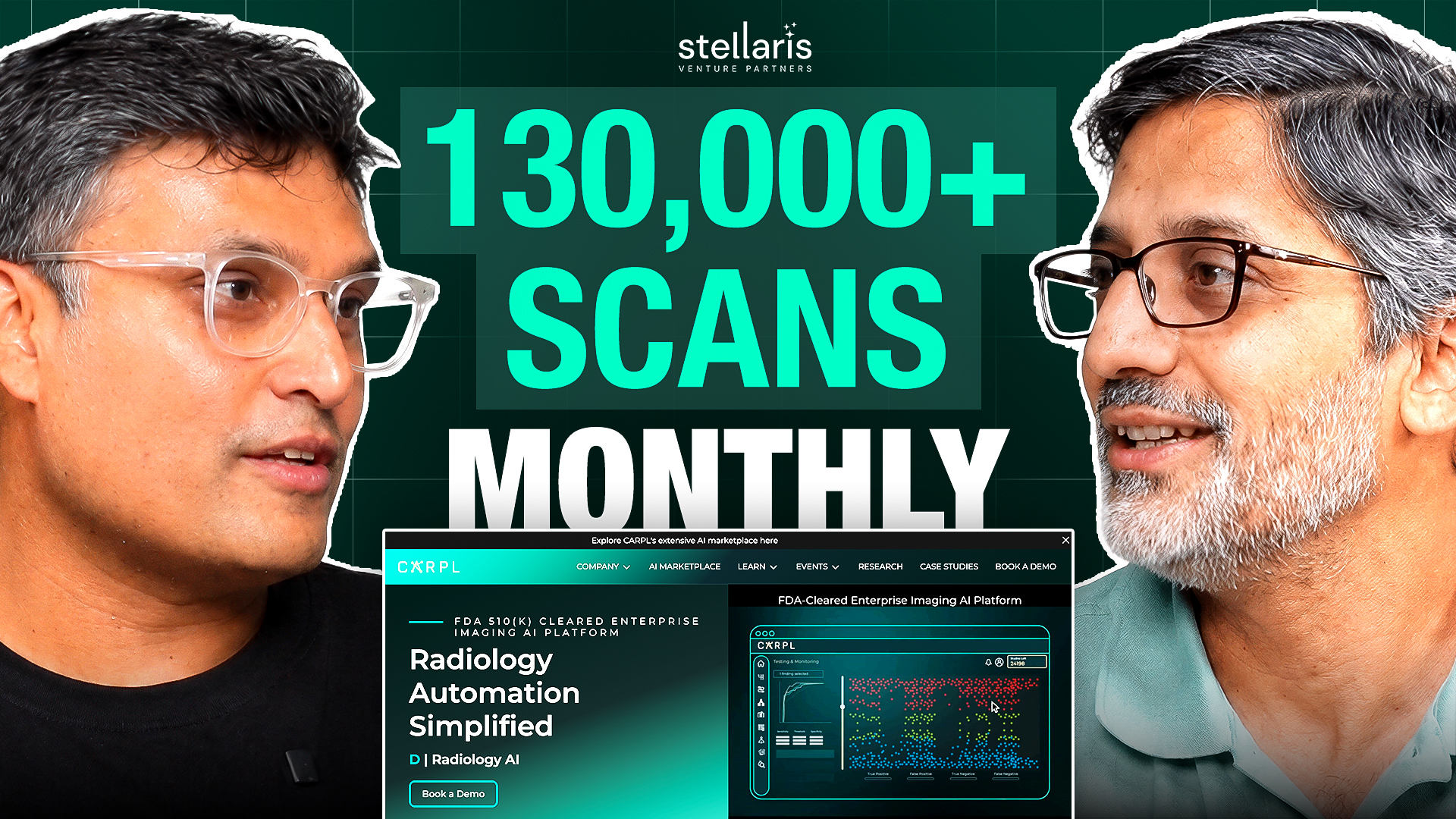
By July 2026, CARPL said its platform offered more than 300 applications from over 100 partners. It was being used by four of the world's five largest private radiology groups and by public-sector organizations in Brazil, India, Singapore, Spain and the UAE. A Stellaris Venture Partners discussion that month put the platform's volume at roughly 130,000 patient scans every month.
Numbers at that scale can sound bloodless, but they mark a decisive change in the company's role. CARPL is no longer merely helping researchers compare models. It is infrastructure inside working systems. In 2024, its medical image management and processing system received FDA 510(k) clearance. That clearance concerned the platform's image-management function, not a magic blessing for every diagnostic algorithm passing through it. The distinction is important, and unusually suited to Mahajan's insistence that every tool still prove itself.
Chapter 03The researcher becomes the referee
Mahajan's skepticism is not hostility toward algorithms. His research record shows the opposite. He has co-authored more than 120 academic and conference papers, according to his public biographies. One of the best known was a 2018 Lancet study on deep-learning detection of critical findings in head CT scans. The research drew on more than 313,000 scans and tested algorithms for findings including hemorrhages, fractures and mass effect.
That experience helps explain why he speaks about evidence as a local practice rather than a ceremonial document. A research result answers a defined question on a defined dataset. A hospital deployment creates new questions every day. Has the mix of scans changed? Is the model's output reaching the right person? Is a new scanner introducing a quiet wobble? Clinical AI does not graduate from scrutiny when it ships. Shipping is when the expensive scrutiny begins.
There is also a delightful tension in Mahajan's public positions. Earlier in his career, he argued that many radiologists' tasks could eventually be automated. Yet CARPL is built around a human institution making choices, setting guardrails and measuring results. The apparent contradiction disappears on inspection. He is bullish about technical capability and fussy about operational permission. The future may be automated; the present still needs someone checking the guest list.
Watch: The future of AI in radiologyMasters' Union conversation · April 2025 · YouTubeChapter 04The plumbing gets capital
In February 2024, CARPL announced a $6 million seed round led by Stellaris Venture Partners. In July 2026 came another $10 million, this time a Series A led by International Finance Corporation, the private-sector arm of the World Bank Group, with Stellaris and other investors participating. The two rounds brought the company's announced total to $16 million.
Mahajan marked the later round with a phrase that managed to be sentimental and cheeky at once: “A small team, with a crazy dream, that is just getting started.” He also noted, with winking emojis, that having the World Bank Group behind the business felt rather nice. His public voice often works this way. Dense systems thinking arrives in conversational packaging. A validation framework becomes a job interview. A global infrastructure plan turns up wearing a hoodie.
The money is intended for product development, a larger partner network and commercial growth across North America, Latin America, Europe, Asia-Pacific and emerging markets. That breadth fits Mahajan's central argument. The more fragmented the market becomes, the more useful a neutral control layer should be. CARPL does not need one algorithm to win. It needs hospitals to keep wanting several.
- 2009Completes medical training in Mumbai.
- 2014-2016Adds finance and health-care management at Wharton.
- 2018Co-authors large-scale head CT research published in The Lancet.
- 2021Begins leading CARPL.ai as founder and CEO.
- 2024Raises a $6 million seed round and secures FDA clearance for the platform.
- 2026Raises a $10 million Series A led by IFC.
Chapter 05Beyond the reading room
Radiology is only Mahajan's opening case. It happens to be unusually fertile ground: imaging creates enormous volumes of structured digital material, and the field has attracted a profusion of specialized AI products. The same fragmentation, however, is arriving elsewhere. Pathology, genomics and general medicine all produce models that will need integration, procurement, measurement and oversight.
His ambition is accordingly broad. Mahajan has said that CARPL wants to become the integration, utilization and procurement layer for all clinical AI. He offered a distant endpoint worthy of a founder who enjoys making an idea memorable: if an AI-powered robotic surgeon is operating somewhere one day, he hopes it will be running through CARPL.
That future remains a declaration, not a fact. The more revealing aspiration is embedded in the verbs he uses today: build, test, deploy, monitor. None is glamorous alone. Together they form an operating system for earned trust. They also turn Mahajan's peculiar career path into a coherent one. Medicine taught him the stakes. Radiology operations showed him the bottleneck. Research taught him what validation can and cannot prove. Wharton gave him the commercial grammar to make the solution travel.
He calls himself “forever a student of healthcare technology adoption.” It is a shrewd choice of subject. Invention gets a launch date. Adoption is a long, messy seminar with poor attendance, difficult group projects and no final exam. Mahajan has built a company for that seminar. Every AI still has to interview. The promising ones get hired. And then, quite properly, somebody keeps watching their work.