The most expensive word in hospital technology may be almost. The algorithm almost works with the scanner. The result almost appears where a radiologist reads. The promising pilot almost becomes routine care. In medical imaging, there are now plenty of clever programs looking for fractures, lung nodules and other findings. The awkward part is getting any one of them through a hospital’s doors, into its data stream and under continuing scrutiny. That is where CARPL has built a business.
- CARPL gives imaging teams one place to discover, compare, deploy and monitor AI from many vendors.
- Its July 2026 catalogue count: more than 300 applications from over 100 partners.
- Hospitals pay for access to the platform and, according to founder comments, for usage tied to scans.
- The useful trick is local testing: try an algorithm on your own data before committing to it.
The bottleneck before the breakthrough
Founder Vidur Mahajan came to this problem from inside the reading room. A physician with an MBA, he had run Mahajan Imaging, his family’s radiology business in India. A 2020 paper he co-authored described an “algorithmic audit”: independent testing on data an AI system had never seen, followed by close study of its false alarms and missed cases. The idea sounds obvious until one imagines doing it again for every vendor knocking on a hospital’s door.
CARPL’s corporate roots reach back to 2018; the company dates the platform’s launch to 2021. The early obstacle was not a lack of models. It was the repeated work of evaluating each one and then connecting it to clinical systems. In a 2024 account, Mahajan put a single integration at roughly $10,000 to $100,000 and six to 18 months. Those are reported ranges, not a CARPL price list. They explain why the company chose to build shared infrastructure rather than another diagnostic model.
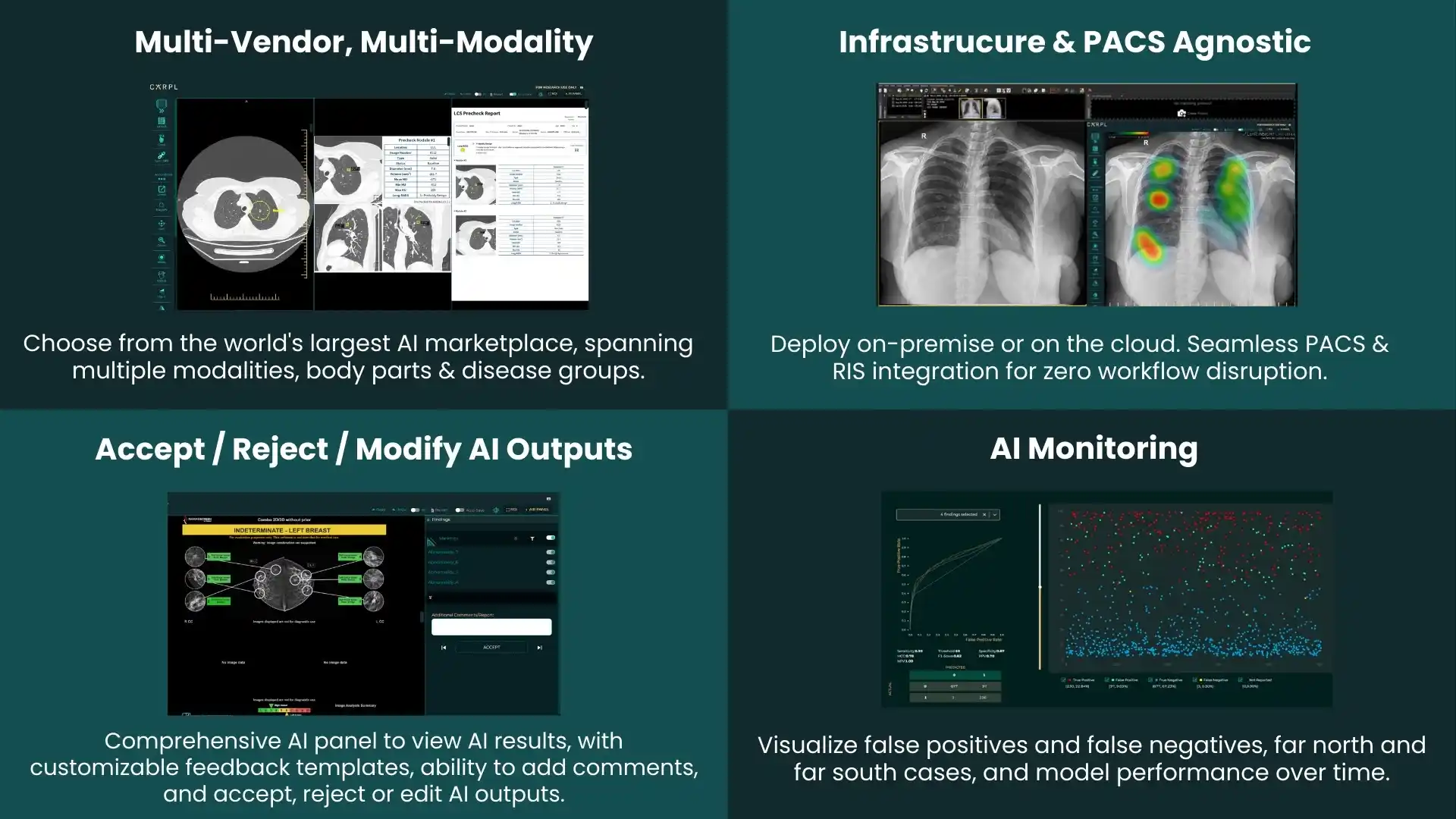
The alternative is familiar to anyone who has bought enterprise software: several vendors, several contracts, several security reviews, several output formats, and an IT team asked to keep all the pipes from leaking. CARPL combines a marketplace with an orchestration layer. It can route imaging studies from existing PACS and RIS systems to selected algorithms, display their outputs in a universal viewer, and monitor what happens after launch. Providers can use the service in the cloud or on premises.
A fitting room for algorithms
CARPL calls its route from curiosity to clinic DEV-D: Discover, Explore, Validate, Deploy. The middle word deserves the attention. A model can have a regulator’s clearance and still produce an unhelpful number of false positives on a particular patient population, scanner mix or imaging protocol. CARPL lets teams run candidate products against their own studies, compare predictions with radiologists’ reports, inspect errors, and look at measures such as sensitivity and specificity. Its validation tools can also examine performance across patient or equipment subgroups.
That last verb matters. A pilot is a snapshot. A radiology service changes scanners, protocols and patient mix over time. CARPL’s monitoring tools are meant to show whether a model keeps earning its place. The company also lets hospitals and research teams bring their own models, benchmark them against commercial options and send them through the same workflow. For an AI developer, the platform is a route into institutions that would otherwise require individual integrations and sales campaigns.
“Choosing the right AI solution was our biggest challenge.”Bruno Rocha, MD, in a CARPL customer testimonial
The buyer is usually an enterprise: a hospital, imaging network, radiology group or health system. Named users and collaborators include Radiology Partners in the United States, I-MED and Qscan in Australia, Fleury in Brazil, and Singapore health institutions. CARPL says four of the world’s five largest private radiology groups use its platform. That claim is the company’s own; the more tangible point is that its customers are organizations for which one extra integration can multiply across thousands or millions of scans.
What a shared doorway buys
Radiology Partners offers a neat example. The group wanted to compare algorithms from four vendors on about 20,000 patients. CARPL told TechCrunch that its platform cut the pilot from a year to a few months, and reduced testing of one vendor to a day. That is a reported customer case, not a promise that every deployment moves at the same speed. It shows where reusable testing machinery has value: the second and third trial become less like starting again.
University Hospitals in Cleveland has used CARPL to build, validate and deploy AI in clinical practice, including an AZmed fracture detection tool. Tan Tock Seng Hospital’s Alvin Soon described validating chest X-ray and thyroid algorithms on the same platform. These are different reasons to buy the same underlying product. A research team may want a fair comparison; an IT department wants fewer bespoke connections; a radiologist wants results in the place the work already happens.
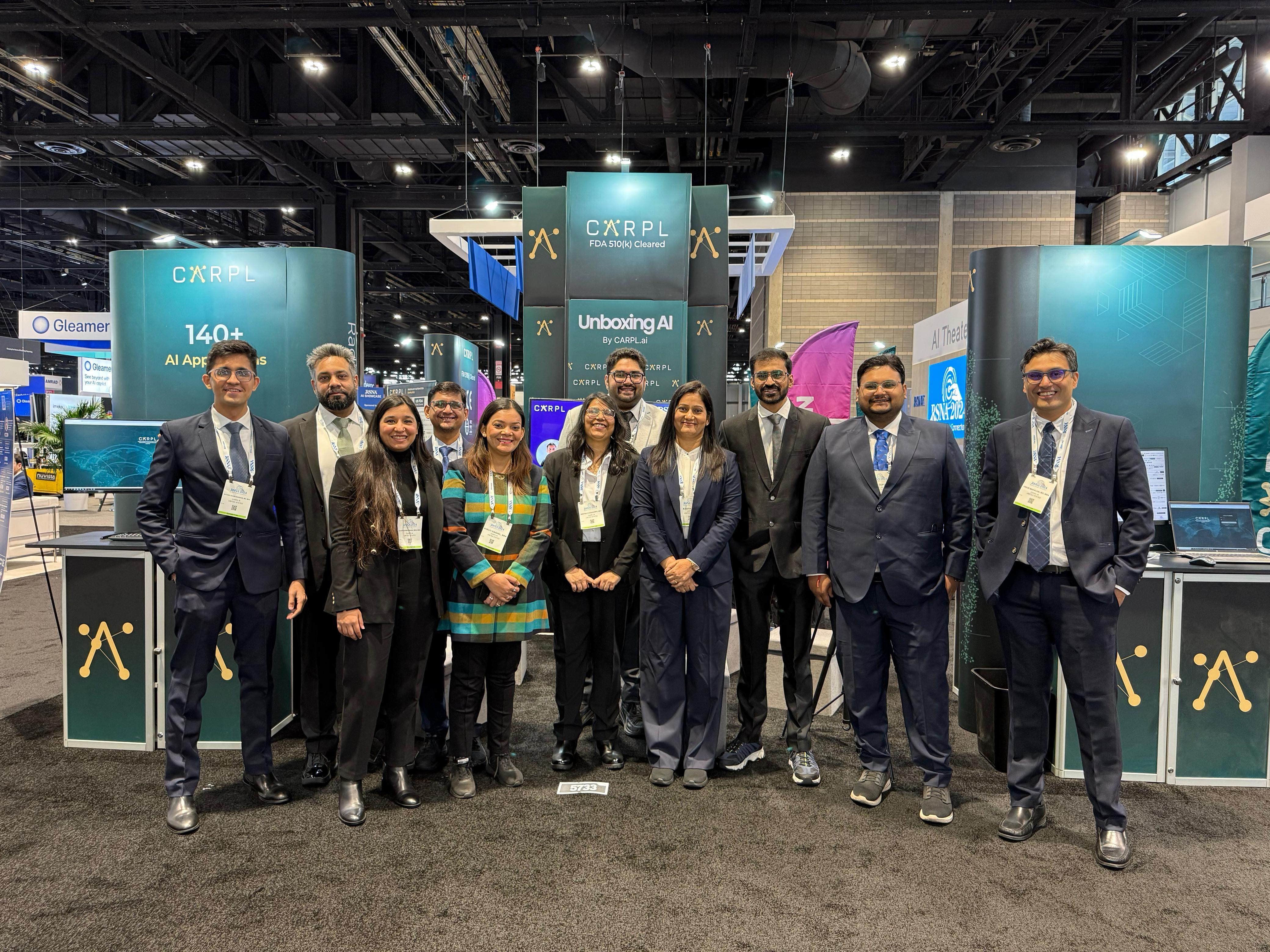
CARPL’s revenue model reflects that enterprise role. Mahajan told MedCity News that customers pay a fixed monthly platform subscription plus a usage fee based on scan volume and type. No public tariff makes it possible to quote a hospital bill. The $16 million raised across a $6 million seed round in 2024 and a $10 million Series A announced in July 2026 is capital for building and selling the platform, not evidence that it costs $16 million to run one. The later round was led by International Finance Corporation, with Stellaris Venture Partners also participating.
CARPL received FDA 510(k) clearance in March 2024 for its radiological image processing platform. The FDA summary says CARPL displays the outputs of separately cleared third-party algorithms without altering them. Clinicians remain responsible for evaluating those outputs and making diagnoses.
The crowded middle
There are other companies selling radiology AI orchestration and marketplaces, including Blackford, deepc and Incepto. There is also the straightforward route of buying from an AI vendor directly. CARPL’s distinction is its combination of a broad catalogue, local validation, deployment plumbing and continuing measurement. This matters most when a provider expects to use several models, perhaps across multiple sites. A small practice buying a single tool may see less benefit from an extra platform layer.
The company has been working closer to the systems radiologists already use. Partnerships with Intelerad, AGFA HealthCare and RamSoft put CARPL into established PACS ecosystems. DeepHealth, a RadNet subsidiary, is collaborating with it on a clinical AI performance and safety control system. Enlitic is helping structure imaging data for validation. In August 2026 CARPL announced a partnership with GenServe.AI to connect image-derived outputs to patient care workflows. These relationships are less glamorous than another model claiming to find a hidden lesion. They may be more decisive in getting any model seen.
CARPL says it wants to expand beyond radiology into pathology, genomics and other clinical AI. That remains an ambition. Its present lesson is portable: when a market is crowded with brilliant components, the scarce product can be the one that makes comparison cheap, integration repeatable and performance visible after the applause for launch has died away. The algorithm may be clever. The switchboard has to be dependable.
Follow the work
Explore the platform, its research and the conversations CARPL hosts about putting AI into clinical use.