The revealing question about a hospital’s artificial intelligence is often asked before anyone reads a scan: which product should we buy? At Fleury, the Brazilian healthcare group, that question was sufficiently troublesome to feature in a customer account published by CARPL. Comparing vendors was hard. So was calculating a return on investment. The obstacle was already there, somewhere between the sales presentation and the purchase order.
- CARPL gives hospitals one place to test and deploy imaging AI.
- Its customers include radiology groups and public healthcare systems.
- The useful habit: compare locally, then keep measuring.
“Choosing the right AI solution was our biggest challenge.”
Bruno Rocha · Fleury
CARPL helped the team compare options before committing. It is a wonderfully practical introduction to a company operating in a field fond of futuristic introductions. Before software can help a patient, somebody has to work out whether it deserves a place in the hospital.
The interview before the algorithm
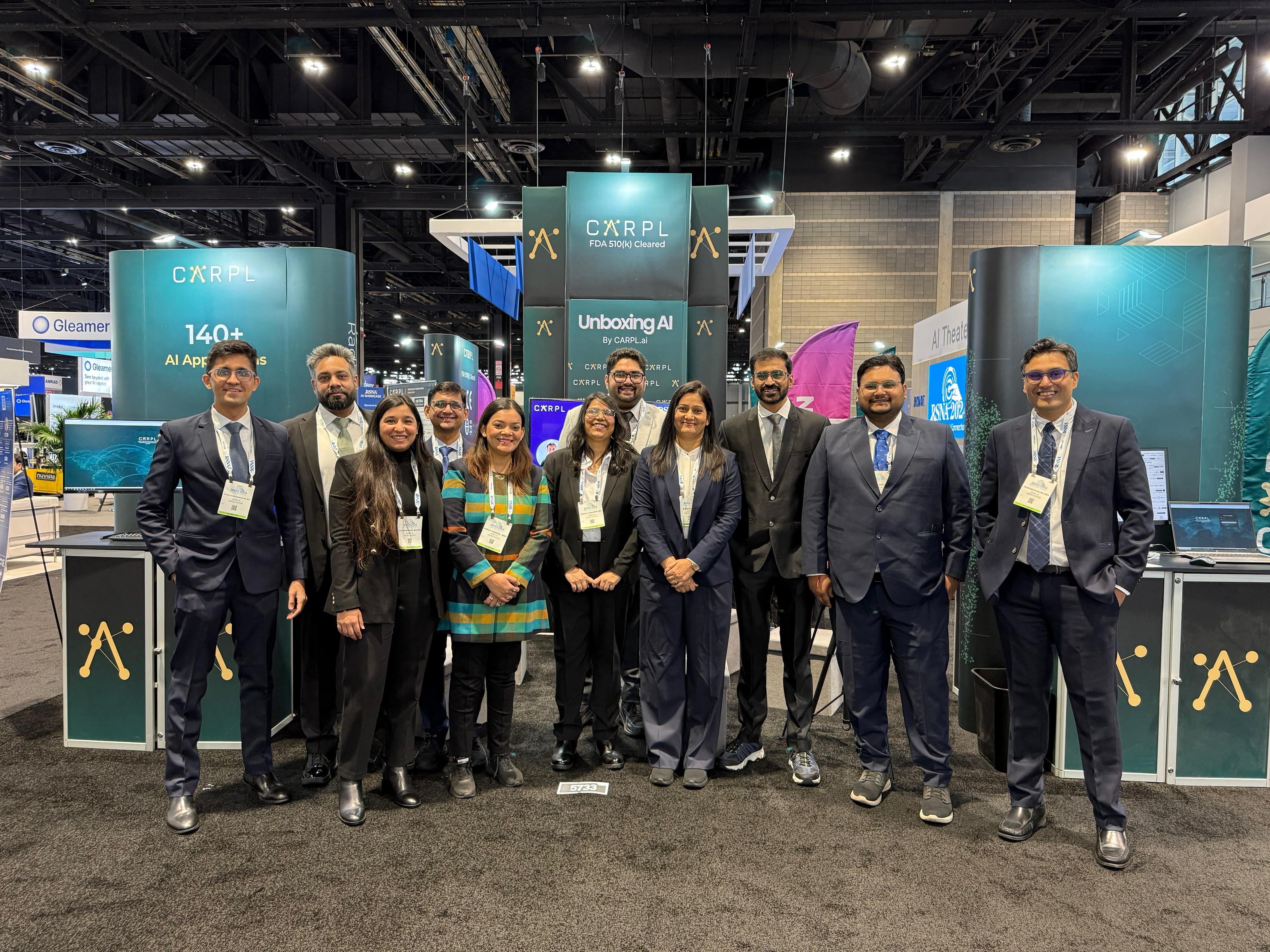
CARPL.ai is a marketplace and enterprise platform for medical imaging AI. It helps organizations discover applications, evaluate them, put selected tools into clinical workflows and monitor them afterward. Think of the purchaser juggling several vendors, several output formats and several committees. CARPL’s product is the common working environment that makes those separate decisions manageable.
Founder and CEO Vidur Mahajan is a physician. In a July 2026 conversation with investor Stellaris, he described the gap that interested him: developers were building radiology AI, while adoption lagged. CARPL launched in 2021. Its ambition follows that observation. There is a business in helping institutions use the tools that already exist.
The buyers are hospitals, imaging groups and public healthcare organizations. The users extend from radiologists to researchers and IT teams. Publicly named relationships include I-MED and Qscan in Australia, Fleury and FIDI in Brazil, and Singapore’s healthcare system. The company’s published case studies range from chest X-rays to fracture detection and lung screening. The common customer need is a workable route into practice.
An audition on your own scans
CARPL calls its sequence DEV-D: discover, explore, validate, deploy. The order matters. A catalog answers what is available. A local evaluation asks what is useful here. Those questions can produce different answers because scanners, acquisition protocols and patient populations vary.
Its validation tools let a team load imaging studies, add reference findings and compare AI predictions with clinical judgments. Reviewers can examine individual errors and look across subgroups, including scanner type or patient age. The point is to make selection an exercise in evidence. A polished demonstration is a poor substitute for the cases a department actually sees.
- 01DiscoverPick a use case
- 02ExploreUse local scans
- 03ValidateInspect the errors
- 04DeployFit the workflow
That approach has consequences for the buyer’s workload. Someone still needs to define the clinical question, assemble suitable cases and judge the reference answers. My reading of the model is straightforward: the platform reduces repeated setup, while the institution remains responsible for deciding what good performance means. A convenient test bench cannot rescue an irrelevant test.
Stay in the reading room
The next problem is where results appear. Radiologists use picture archiving and communication systems, or PACS, to review images. Asking them to leave that environment introduces another step. CARPL’s January 2025 Intelerad partnership places its viewer and widget inside InteleViewer, letting clinicians access AI findings within software they already use.
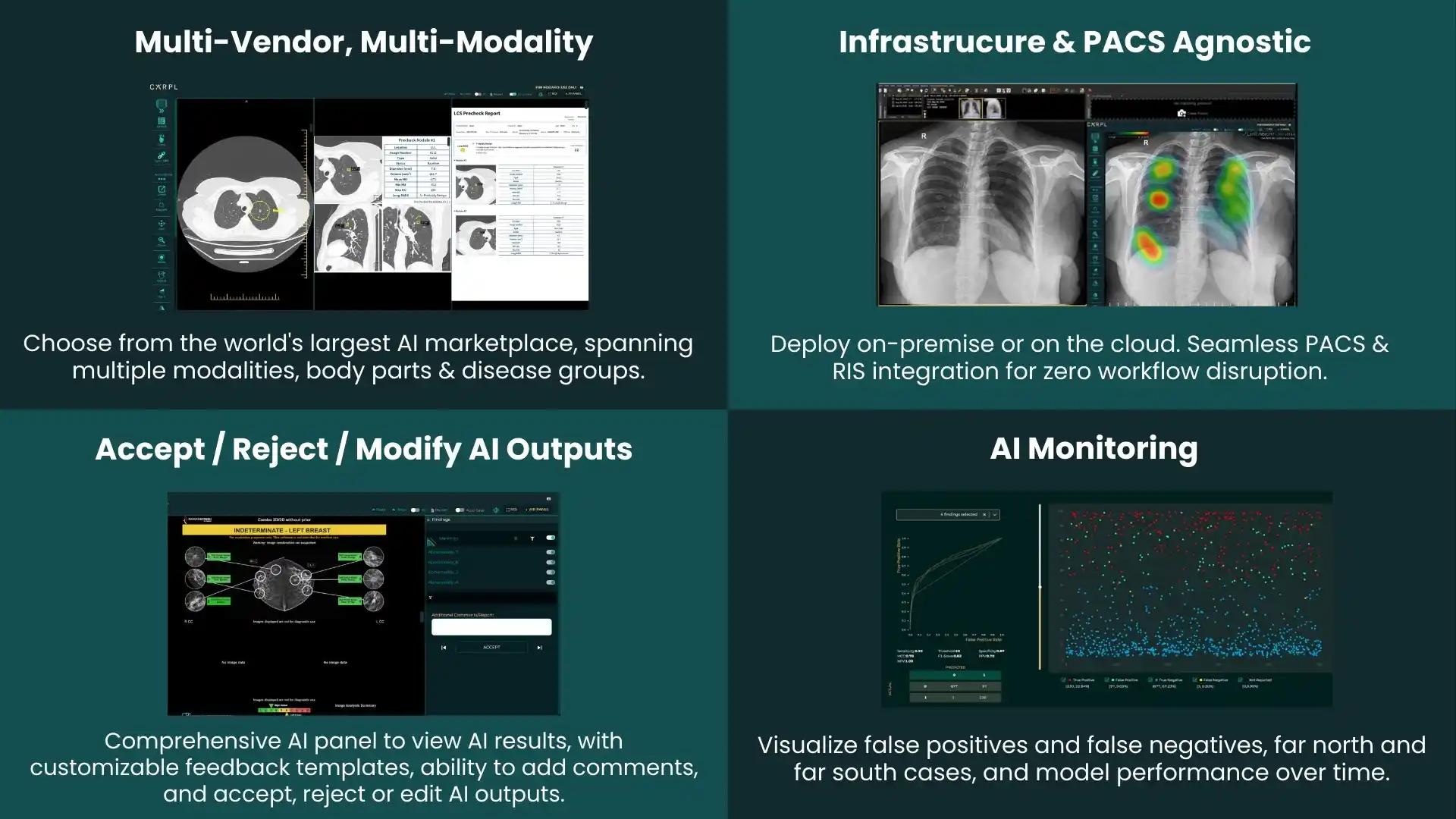
There are other routes onto the platform. A May 2025 PaxeraHealth collaboration connects its ARK no-code authoring tools with CARPL’s orchestration infrastructure. An institution developing a model can therefore work toward deployment through the same ecosystem. CARPL offers cloud and on-premise options, making infrastructure choice part of implementation.
One distinction deserves precision. The FDA granted CARPL clearance K232891 on March 27, 2024. It covers an image-management and processing system. Individual third-party algorithms retain their own regulatory responsibilities. The clearance is meaningful for the platform’s role, but it does not establish that every application is appropriate for every patient or clinical question.
The bill has more than one line
CARPL sells enterprise platform access for AI evaluation and deployment. Hospitals are buying shared infrastructure as well as access to applications. The economic argument is that each additional vendor should require less duplicated work. 2024 integration estimates: $10,000-$100,000 and 6-18 months. Those are industry-project estimates, not CARPL’s tariff.
Financing is a separate number. CARPL announced a $6 million seed round in February 2024, led by Stellaris Venture Partners. In July 2026 it announced a $10 million Series A led by International Finance Corporation, with Stellaris participating. The new capital is intended for product development, partnerships and commercial expansion across several regions.
Keep the audition running
Installation leaves another question: does the tool continue to perform? CARPL’s December 2024 DeepHealth collaboration proposed a feedback system to monitor accuracy, sensitivity, specificity and drift. That makes ongoing evaluation part of the product’s purpose. A model’s first examination cannot settle every future one.
The market has noticed the same need. Blackford and deepc also offer integration, evaluation and monitoring. CARPL’s proposition must therefore be judged through its application coverage, local testing tools, working partnerships and execution. A feature checklist alone will not distinguish it.
Its expanding Medimaps agreement offers a concrete example: TBS Reveal assesses bone-fragility risk from routine X-rays, while RBfracture addresses trauma findings. Different questions can travel through a shared integration. The announced GenServe.AI partnership pushes further toward follow-up and operational workflows, where an imaging finding has to become an action.
The lesson a hospital can copy is pleasingly specific. Choose the problem first. Compare candidates on representative local scans. Decide who reviews mistakes and what happens when performance changes. CARPL has built a business around that sequence. The interesting test is whether the hospital can repeat it when the next promising application arrives.
Open the next tab
Watch the workflow
▶Why build CARPL?Vidur Mahajan with Alok Goyal · Founder interview↗▶Test before deploymentCARPL’s Unboxing AI · Validation walkthrough↗▶Putting AI into practiceCARPL’s Unboxing AI · Deployment walkthrough↗