A patient mannequin can make a room look remarkably like a hospital. It cannot remember who booked the room, which student hesitated, or whether that hesitation also appeared in last month’s assessment. A simulated crisis ends. The educational problem has a longer shift.
Education Management Solutions, usually shortened to EMS, works in that less photogenic part of healthcare training. It supplies the recording systems, software, assessment tools, and support that help educators capture an encounter, discuss it, and connect it to a learner’s progress. The mannequin may get the attention. The record does much of the travelling.
- Record the rehearsal: synchronized audiovisual capture, live observation, playback, and debriefing.
- Keep the evidence connected: simulation management, competency tracking, curriculum mapping, and clinical rotations.
- Choose the setting: a fixed lab, multiple sites, or a portable kit with offline recording.
- Budget for the relationship: hardware, implementation, subscriptions, and continuing support.
A rehearsal needs a memory
Consider the ambition of building a virtual hospital inside a simulation center. In an EMS-published testimonial, Antonio Re of Madison Area Technical College describes evaluating the equipment and software already in place and discovering “we could not fulfill our vision.” The team looked for a different product and found EMS.
That is a useful description of what failed first: the existing setup could not support the intended teaching environment. There is no need to invent a dramatic broken camera. Re’s account points to a mismatch between the program’s ambition and its infrastructure. It also explains the decision to look elsewhere.
EMS’s customers include medical and nursing schools, universities, healthcare systems, and government training organizations. Its public customer accounts name Samuel Merritt University, Rocky Vista University, Oklahoma State University Center for Health Sciences, and Texas Tech University Health Sciences Center. Their job is larger than collecting footage. They need to make a training event reviewable and useful to faculty and learners.
An illustration of the workflow, not a measured outcomes chart.
Three levels of coordination
SIMULATIONiQ is the core simulation management product. In March 2026, EMS announced version 2.0 as a three-tier offering built on a unified platform. Each level supports cloud or on-premises deployment and multi-site integration. The buying decision becomes a question of how much coordination a program needs.
The base capabilities include HD recording, manikin integration, live viewing, playback, and immediate debriefing. More advanced levels add operational tools and analytics; the enterprise offering includes support for standardized patients and OSCEs, the structured clinical examinations that move learners through assessed encounters. Automated paging belongs to this world too. Someone has to tell everyone when to move.
Current product descriptions call the tiers Pro, Pro+, and Enterprise. Pro concentrates on capture and debriefing. Pro+ adds connected scheduling, inventory, assessments, and AI-assisted scoring. Enterprise addresses larger assessment operations, longitudinal insights, and coordination across programs and sites. This is an institutional purchase whose usefulness depends on the work being organized around it.
The lab fits in a case
A dedicated simulation center is one setting. An ambulance or a remote training location is another. EMS’s Training in Motion packs audiovisual capture and debriefing into portable equipment, with cameras, a preconfigured wireless network, and a rugged case. Its product page advertises up to 300 hours of on-device video backup and up to four hours of offline simulation activity on a charge.
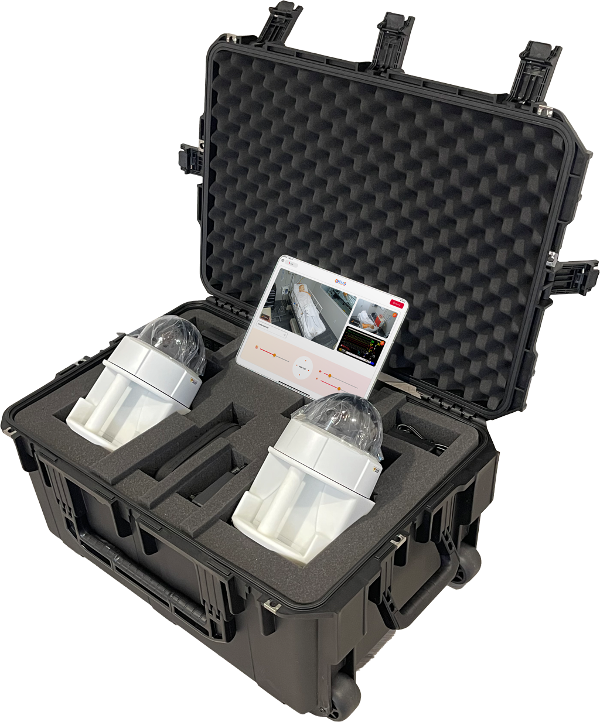
The appeal is concrete: record the training where it makes sense to conduct it, then review the encounter with learners. EMS describes uses in emergency medicine, health systems, medical schools, and military training. Streaming can extend an audience when connectivity is available; offline capture gives the instructor another option when it is not.
In July 2026, EMS announced a contract with the North Carolina Community College System, following a request for quote process, to provide simulation and training equipment across its 58 member institutions. The company said it planned to meet participating colleges’ needs through Training in Motion. That is access through a systemwide contract. It does not establish that every college has installed a kit.
The cost of keeping it running
A public institution offers a useful glimpse of the bill. Florida International University’s April 2025 board materials list a $653,722 TotalCAREiQ Platinum renewal for 2025-2027, plus an estimated $60,000 camera replacement. Together with the earlier $902,797.06 agreement, the listed total was $1,616,519.06.
FIU’s listed three-year support renewal, 2025-2027.
These figures describe one installed system and its support arrangements, rather than a universal software price. The packet discusses maintenance, equipment replacement, software updates, and staff education. The practical lesson: evaluate the years of operation after the opening-day demonstration.
EMS combines software subscriptions and enterprise deployments with hardware, installation, and recurring support. Training in Motion explicitly offers multi-year subscription and support packages. An institutional buyer is purchasing an operating relationship as well as a product.
From the camera to the curriculum
The company was founded in 1994 by Anurag and Sharada Singh. Renovus Capital Partners took a minority stake in 2014 and supplied expansion capital. When Renovus announced its exit in 2020, it described new products, new markets, and a transition to SaaS during its investment. Collegis acquired EMS that August, adding learning technology to its education managed services business.
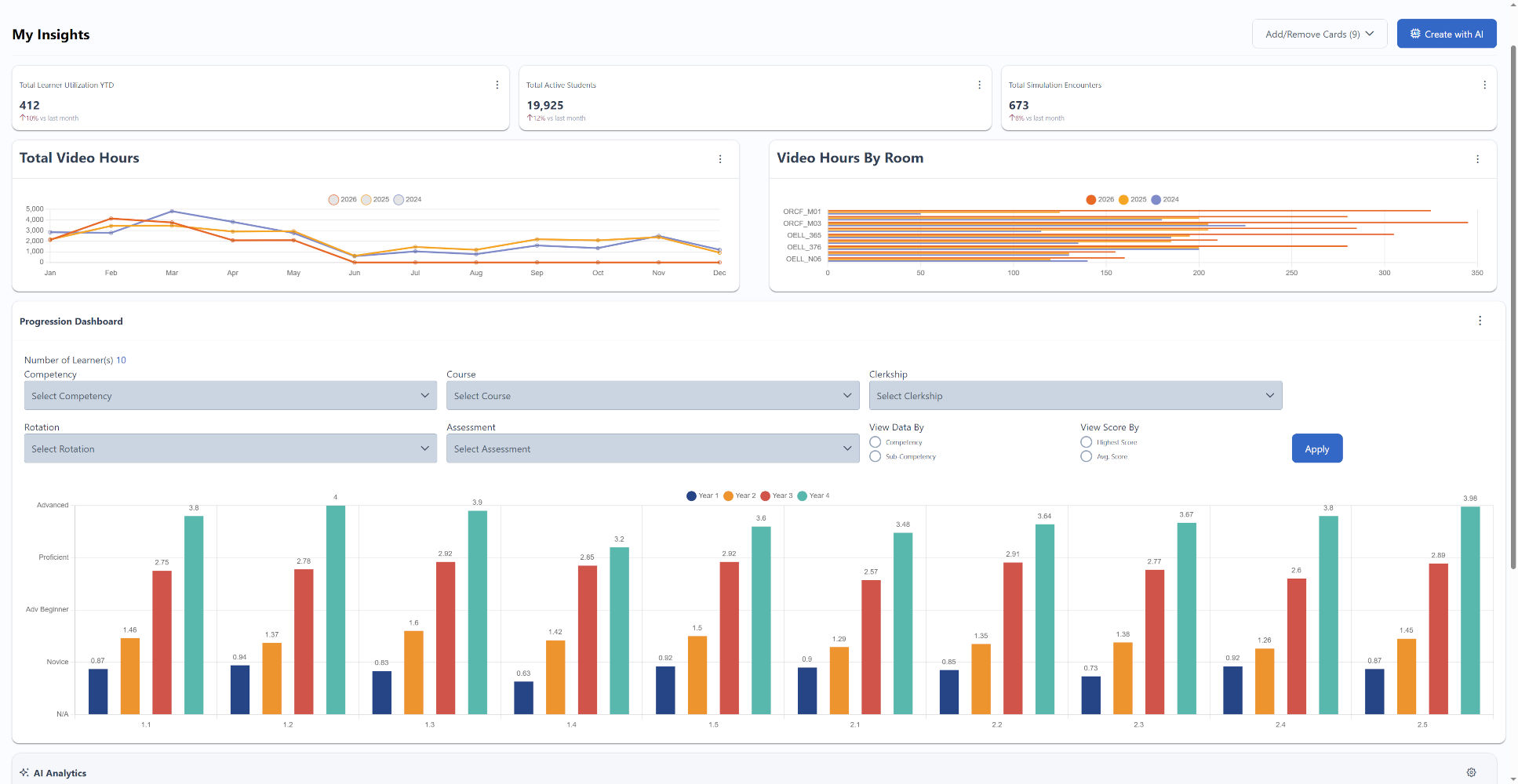
The portfolio now reaches beyond the simulation room. Competency.AI handles curriculum mapping, assessment, student progression, and clinical rotations. A preceptor can scan a QR code on a learner’s phone to open a checklist. That small convenience matters: the person observing a learner in practice may be nowhere near the campus software administrator.
EDUCATIONiQ brings EMS tools into a unified interface. Its current offering includes analytics, an Ask Emily assistant, professional development resources, and a Learning Exchange where teams can discover and sell training content. The direction is clear: connect individual teaching events with the administration of the broader program.
A score still needs a teacher
Louis Faustini became CEO in April 2025, succeeding Matt Merino, who moved into an executive advisory role. That June, EMS announced completion of a SOC 2 Type I audit. Security controls matter when an institution is storing recordings and performance records about identifiable learners.
The newer assessment proposition is AI-Enhanced Scoring. EMS describes analyzing available video, audio, transcripts, learner documentation, and established criteria to recommend scores. Faculty review and approve the results. The company advertises an estimated reduction of up to 50 percent in grading time; that remains a vendor estimate, not a result to assume for every program.
A recommended score is a starting point. Someone still has to decide what it means.
Editorial observation
EMS’s September 2026 responsible AI guidance makes the human role explicit: define the educational purpose, protect learner information, increase oversight as the stakes rise, and allow outputs to be questioned. For a faculty member, a time-saving tool earns its place by making the review process more useful. Speed alone is a rather thin qualification for judging someone else’s competence.
Borrow the method, then test the fit
EMS occupies the simulation management and assessment layer of healthcare education. Direct alternatives include Laerdal’s SimCapture and LearningSpace, both of which offer recording, debriefing, and center management. Laerdal also appears in EMS’s partner directory. Equipment integration and software competition can share a corridor.
EMS emphasizes working with existing hardware, offering deployment choices, and connecting simulation with competency workflows and support. Those are buying criteria to test against competitors, rather than exclusive features to accept on faith. Ask a vendor to demonstrate the particular simulator, assessment form, and institutional system your team actually uses.
The method is worth copying: start with the teaching objective, capture the encounter, review the evidence, and connect the assessment to the learner’s next step. Try it with a real workflow before expanding it across a campus. A weak rubric remains weak when digitized. Poor audio leaves a reviewer guessing. A program without staff time for debriefing will need an operational change alongside the technology.
The interesting promise of EMS is continuity: a rehearsal can become part of a longer account of learning. In healthcare education, there is considerable value in being able to revisit the moment, agree on what happened, and decide what to practise next.
Visit the working parts
Explore the products, company news, and conversations with educators.