At the University of Wisconsin-Madison, a nursing exercise begins in an apartment and ends in a hospice room. The patient dies. There is no miraculous intervention waiting for the cleverest student. The exercise asks something harder: how do you care for someone when you cannot change what happens next?
In Elevate Healthcare’s account of the program, a clinical instructor plays the patient’s partner, and an expert joins the debrief. The simulation is ungraded. Learners can ask awkward questions and make mistakes without a mark attached to every hesitation. The same center uses Elevate’s Apollo, Lucina and Luna manikins, with LearningSpace recording and streaming technology supporting its wider teaching program.
- The business: simulated patients, procedural trainers and software for healthcare educators.
- The buyers: nursing and medical schools, hospitals and simulation centers.
- The useful twist: the equipment is connected to recording, assessment and educator support.
- The buying lesson: budget for the rehearsal, including the people who run it.
A catalog photograph of a manikin cannot convey all of this. It shows a body. The institution is buying the ability to arrange an experience: a difficult conversation, an unfamiliar procedure, a team making decisions under pressure. Elevate’s place in the market becomes clearer when you look at what happens around that body.
“A lot of students don’t get an experience with the death of a patient.”
Rebecca Muehrer · Clinical Professor, UW-Madison
01A body built for the timetable
Elevate’s adult simulator, Evo, supports airway management, medication administration, assessment and patient communication. It breathes, provides palpable pulses, produces heart and lung sounds, and supplies real-time CPR feedback. Maestro software drives physiological responses, giving learners something to interpret as they act.
Its head, arms, torso and legs can be replaced. Batteries can be swapped while it operates. Different skin tones and anatomical configurations let educators vary the patient. These features have an educational purpose, but they also address the practical indignities of running a lab: a worn part, another class waiting, a scenario that needs a different configuration.
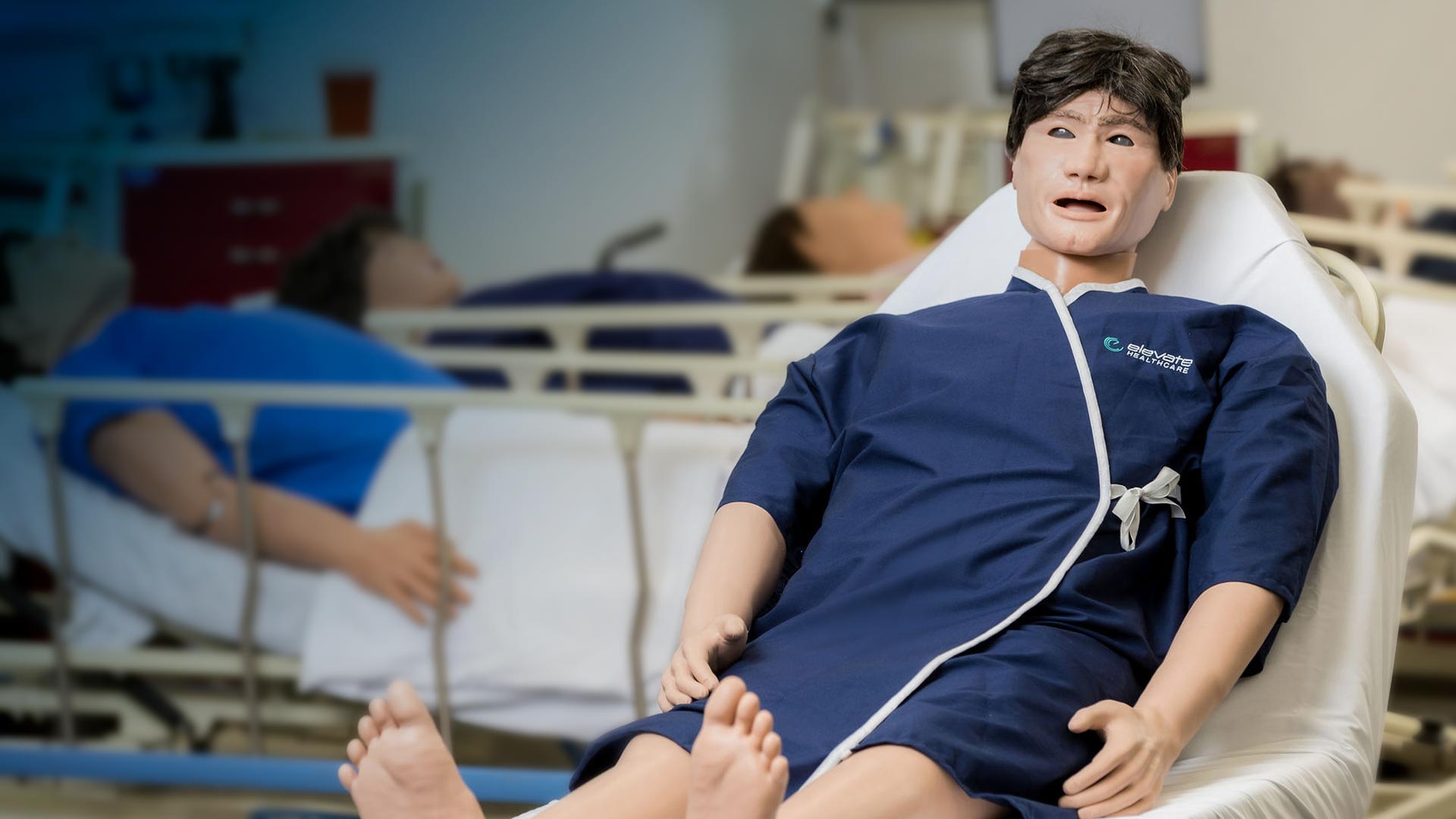
That combination of anatomy and operations is a useful way to understand the company. A simulator must present a credible patient, then survive the timetable. Features that help a learner practice and features that help an educator keep teaching belong in the same purchasing conversation.
02Reality has a maintenance bill
The tradeoff has a history. Elevate’s published retrospective says the original realistic skin on iStan, its 2007 tetherless simulator, proved too delicate for military applications and required redesign. Fidelity had met an environment that would not handle it gently.
The same account describes another obstacle: sophisticated physiology was difficult for some instructors to manipulate. MÜSE offered both physiology-based operation and more scripted control through selectable patient parameters. Giving educators more ways to run a scenario helped make the engineering usable. These are documented design lessons, rather than a tidy tale in which every invention succeeds on arrival.
There is a financial version of that lesson. Elevate’s June 2026 buying guide estimates that high-fidelity simulators generally start around US$30,000 and can reach US$70,000 or more. It also offers an illustrative US$50,000 adult simulator whose five-year ownership cost reaches roughly US$110,000-US$130,000 after maintenance, software, consumables and faculty development.
US dollars · Illustrative adult-simulator budget from Elevate’s guide. The lighter segment marks the $110k-$130k range. This is not an Evo quotation.
The guide also flags space, audiovisual infrastructure and support staff as costs that belong in institutional planning. A device can have a sensible purchase price and still be the wrong commitment for a program without the people or budget to operate it. The attractive number on a purchase order deserves company.
03The second bedside is a screen
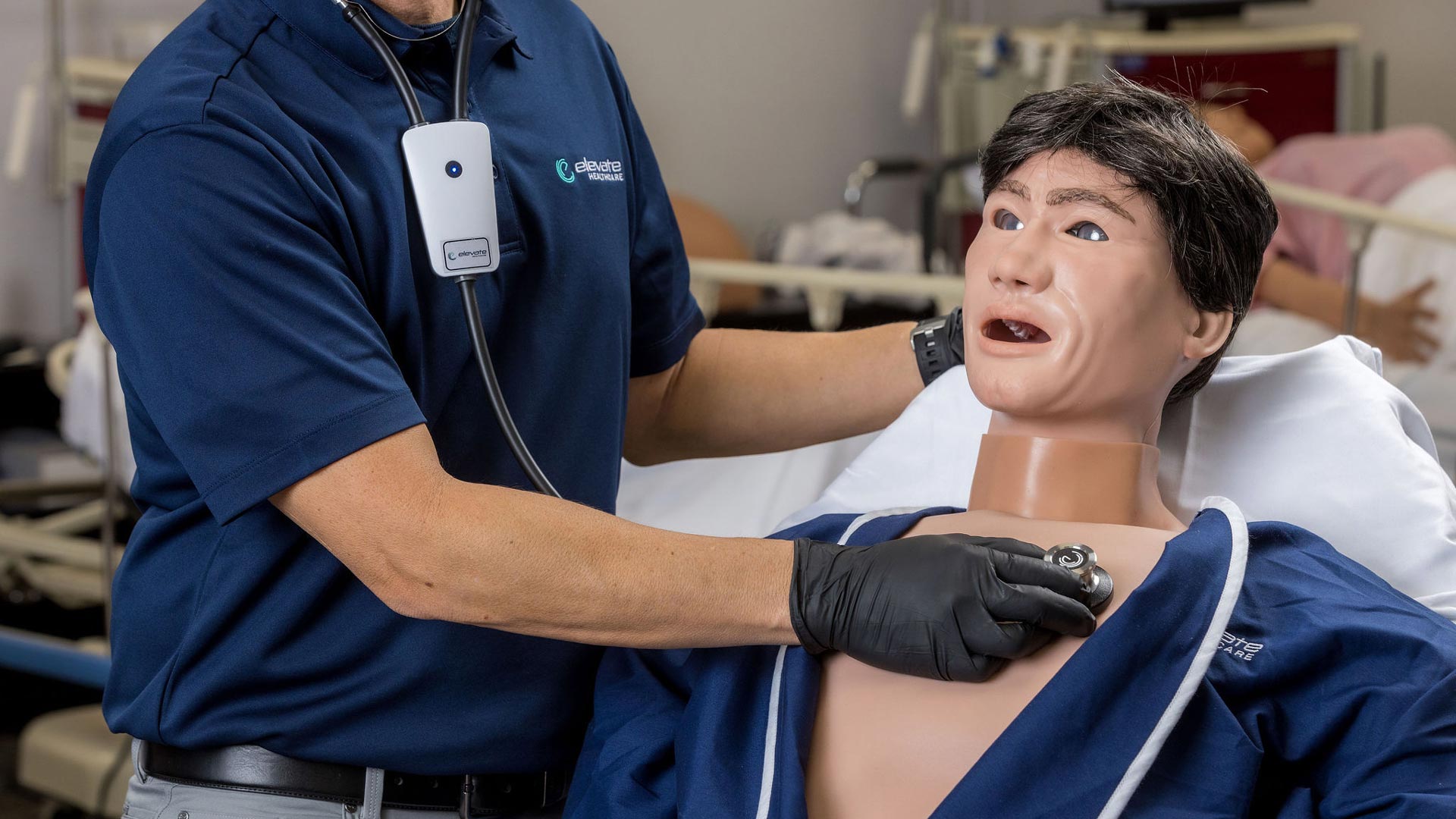
After a simulation, people remember different versions of the same encounter. LearningSpace collects video, simulator data, observer notes, checklists and surveys so educators can revisit what happened. It also handles scheduling and reporting. Essentials covers core capture and assessment; Enterprise adds capabilities for larger or more complex programs.
The newer AI assistant, Ehli, transcribes recordings and suggests checklist scores with timestamped evidence. Faculty retain the decision. That division of labor is the point: a recording creates material to review, and someone still has to review it. Automating the first pass could make more room for feedback.
Elevate published a UAB pilot introduction in February 2026 examining AI-graded transcripts for standardized-patient checklist assessment. A University of Houston pilot introduction, published in June, describes comparing AI-prefilled checklists with two expert observers and an adjudicated reference. Those are specific assessment questions; they should be judged as such, rather than treated as proof that software can evaluate every clinical encounter.
There is also a commercial change. The LearningSpace knowledge base describes Ehli as its first subscription product line and documents a 60-day trial. Elevate’s business spans equipment, software, ongoing support and services. AI adds a recurring offer to a portfolio already concerned with the work after delivery.
04The room is not the curriculum
At Montana Tech, the simulation program grew from a manikin into a dedicated center. Faculty then pursued something less visible than a new room: consistent practice. Kathy Roth led a gap analysis against simulation standards, and the team standardized policies and procedures across briefing, scenarios and debriefing. The nursing school earned INACSL standards endorsement in January 2025.
The portable lesson is procedural. Decide what learners should practice. Give them comparable starting conditions. Make room to discuss their decisions afterward. A scenario does not become useful simply because the manikin is expensive; faculty have to connect it to the curriculum and respond intelligently to what learners do.
Elevate sells help with that work through the education and consulting side of its business, alongside training and support for its products. Its leadership combines experience in clinical practice, education, engineering and technology. The company says its manikins are assembled by hand in Sarasota. Making the patient and helping someone teach with it require different kinds of expertise.
05A new name, a wider rehearsal
The Elevate name arrived in May 2024 after Madison Industries acquired CAE Healthcare. CAE’s February closing announcement gave an enterprise value of C$311 million, subject to adjustments. CAE said the proceeds would principally support deleveraging and its focus on core training, simulation and aviation software markets. This was a change of owner for an established business.
Under the new name, the toolbox has widened through partnerships. An April 2025 agreement with SimX gives Elevate customers a referral route to VR healthcare scenarios. A June 2026 partnership with Paradigm Medical Systems adds MODEL-med OB/GYN task trainers, including models for examination, delivery and perineal repair. The portfolio also includes Blue Phantom ultrasound trainers and Vimedix ultrasound simulation.
Elevate competes in an established market. Laerdal’s SimMan range also pairs patient simulation with software and debriefing options. Realism, mobility and an associated software ecosystem are therefore buying criteria across vendors. Elevate’s case rests on how its particular hardware, assessment tools and educator support fit a program’s needs.
The sensible starting question is the skill to be taught. A narrow procedure may call for a task trainer. A conversation may benefit from a human role-player. A team response may justify a full-body simulator and recorded debrief. A program that chooses the device first can spend a great deal before it has decided what the lesson is.
Back in the hospice exercise, no amount of engineering changes the patient’s fate. The rehearsal gives the learner something else: an opportunity to meet that moment, think about it and return better prepared. That is a demanding brief for a company selling simulated people. It is also a useful one.
Take a closer look
Explore the equipment, the teaching and the people behind it.