Who they are now
A procedure that used to need a whole department now fits at one bed
Picture an ICU at 2 a.m. A patient needs a feeding tube. Historically that meant a phone call, a wait, and a road trip: book the endoscopy suite or interventional radiology, schedule a specialist, wheel a fragile, ventilated patient down the hall, and hope nothing goes wrong in transit. CoapTech's whole reason for existing is that this should not be a logistics problem. With the PUMA-G System, the clinician already at the bedside puts an ultrasound probe on the abdomen, sees the stomach, and places the tube. No endoscope. No radiation. No transport.
CoapTech is a Baltimore medical-device company, roughly twenty-two people, with one quietly radical product: the world's first and only FDA-cleared ultrasound gastrostomy system. It has been used in more than 1,000 patients. It is not trying to reinvent the feeding tube. It is reinventing the part where you guess at where the stomach is.
The safest place to put a feeding tube is wherever the patient already happens to be.
The problem they saw
Gastrostomy was stuck between three imperfect options
For decades, putting in a long-term feeding tube meant choosing your inconvenience. Surgical gastrostomy is invasive. The endoscopic route (PEG) needs a scope down the throat and a second skilled operator. The radiology route (PRG) needs fluoroscopy, which means X-rays and an imaging suite. All three share a charming assumption: that the sickest patients can be moved, scheduled, and handed off without cost. They can't, really. Transport is risky, suites are booked, and specialists are scarce - especially at 2 a.m., and especially during a pandemic when moving patients became its own hazard.
Co-founder Dr. Steven Tropello was a critical-care physician who lived inside this friction. The recurring question was simple and a little uncomfortable: if ultrasound can already see the stomach, why is anyone still placing these tubes blind, or shipping patients to a machine that uses radiation to do the same thing?
Every existing method assumed the sickest patient in the building was the easiest one to move. CoapTech started by disagreeing.- The founding premise
The founders' bet
A physician and an innovation researcher walk out of a university lab
CoapTech spun out of the University of Maryland, Baltimore in 2016. Tropello teamed with clinical-innovation researcher Howard Carolan, who would run the company as CEO for most of its first decade. Their bet had two parts. First: ultrasound, already in nearly every ICU, is enough to guide the whole procedure if you give clinicians the right tool. Second - and this is the clever bit - you can use magnets to pull the stomach wall snugly against the abdominal wall, so the path for the tube is held steady and visible. They named the platform PUMA: Point-of-care Ultrasound Magnet Aligned.
It is the kind of idea that sounds obvious only after someone builds it. The hard part was never the physics. It was the regulatory grind, the clinical evidence, and convincing hospitals that a bedside clinician with existing skills could safely do what used to require a consult.
2016
Spun out of Univ. of Maryland, Baltimore
1,000+
Patients treated with the PUG procedure
$25.5M
Total funding raised to date
Four numbers that took the better part of a decade and a lot of paperwork to earn.
The product
PUMA-G: ultrasound in, guesswork out
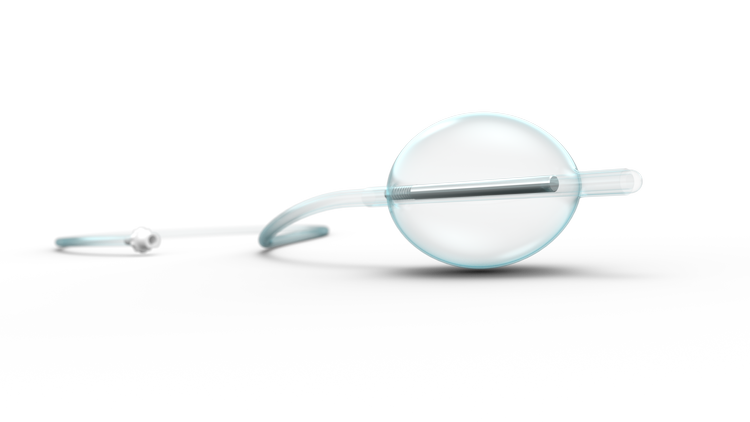
The PUMA-G System is an FDA-cleared procedural kit. Its centerpiece is a magnetic balloon catheter that aligns the stomach to the abdominal wall, so the clinician can watch the entire placement under ultrasound and confirm the path before anything is punctured. The procedure - percutaneous ultrasound gastrostomy, or PUG - has been performed in ICUs, step-down units, floor units, IR suites, and long-term acute-care hospitals, by both physicians and advanced practice providers. The company even reshored manufacturing of its second-generation catheter to Baltimore, working with The LaunchPort, instead of outsourcing to California.
PUMA-G System
The flagship FDA-cleared kit. Place a gastrostomy tube using only ultrasound imaging and the magnet-aligned catheter - no endoscope, no fluoroscopy, no operating room.
PUMA-G Pediatric
An FDA-cleared pediatric version, extending the same bedside approach to younger and smaller patients who have the least margin for a risky transport.
Magnetic Balloon Catheter
The second-generation consumable at the heart of the system - now manufactured in Baltimore rather than shipped in from across the country.
PUMA stands for Point-of-care Ultrasound Magnet Aligned. Yes, the breakthrough medical device runs partly on magnets.
The proof
The argument hospitals actually listen to: dollars and days
Clinical elegance is nice. Hospital economics close deals. Independent studies of the PUG procedure have pointed in a consistent direction: patients leave the ICU sooner, and the bill comes down. A 2024 Jackson Memorial study reported a $34,778 reduction in per-patient hospital costs. A 2022 University of Maryland study put the figure at $26,621. Length-of-stay reductions ran from several days to as many as ten. When you remove the transport, the suite booking, and the second specialist, the savings are not mysterious - they are arithmetic.
What a bedside tube placement saves
Reported per-patient hospital cost reduction with PUMA-G / PUG
Jackson Memorial study, 2024
$34,778
UM-BWMC study, 2022
$26,621
Days back, per patient
Reported ICU length-of-stay reduction
Houghton et al., 2024
10 days
Marshall et al., 2022
5 days
We're seeing early indications those efficiencies result in patients leaving the ICU sooner, which saves hospitals many thousands of dollars per admission.- Howard Carolan, Co-Founder
Backers have noticed. The company has raised about $25.5 million across rounds, including a 2020 Series B led by Palo Alto's Hunniwell Lake Ventures and a later Series B led by Good Growth Capital, with a deep bench of Maryland-rooted investors: TEDCO, the USM Momentum Fund, the University of Maryland, Baltimore, The Abell Foundation, NuFund and Ecphora Capital.
Steven Tropello, MD
Co-Founder · Critical-care physician, Univ. of Maryland
Howard Carolan
Co-Founder · Former CEO, now advisor
Brad Kreger
CEO since Nov 2025 · ex-Velo3D, Fluidigm, Thermo Fisher
The mission
Make the minimally invasive procedure actually minimal
CoapTech's stated aim is point-of-care ultrasound magnet-aligned technology that makes gastrostomy easier, faster, and safer. Read between the lines and the ambition is bigger than feeding tubes. If a bedside clinician with an ultrasound probe can safely do what used to require a suite and a specialist, the same logic could travel to other percutaneous procedures - tracheostomy and beyond. The company's keywords already hint at it. Gastrostomy is the wedge, not the ceiling.
Anyone can make a procedure less invasive. CoapTech's harder trick is making it less complicated.
Why it matters tomorrow
Back to that ICU at 2 a.m.
Return to the bed where this started. The patient still needs a feeding tube. But now there is no phone tree, no waiting on a booked suite, no nervous trip down the corridor with a ventilator. The clinician already in the room sees the stomach on screen, lines up the magnet, and places the tube in minutes. The patient never leaves the bed. The hospital saves a five-figure sum and, often, several ICU days. That is the change CoapTech is selling: not a flashier device, but the disappearance of an entire piece of choreography that everyone had simply accepted.
There is real work left - adoption, evidence, scale, and a new CEO charged with all three. Skeptics are right to want more data and wider use before calling it a standard of care. But the direction is clear, and it is a good one: the safest place to treat the patient is wherever the patient already is. CoapTech built the tool that makes that true for one stubborn, common procedure - and it is betting there are more.