The least glamorous object in American healthcare may be the spreadsheet that decides whether a doctor can work. Somewhere inside it is a license expiration, a payer enrollment, a missing signature, or a training deadline. When the cell is wrong, the consequences are not abstract: a provider waits, an administrator hunts, an audit gets tense, and revenue sits outside the door. MedTrainer has spent 13 years turning that anxious spreadsheet into a software company.
Founded in 2013 by Steve Gallion and Jorge Fernandez, MedTrainer bundles three jobs that healthcare organizations often buy separately: staff learning, compliance operations, and provider credentialing. The company says its cloud platform now reaches more than 3,000 client organizations, 32,000 healthcare sites, and 800,000 users. It has raised $54 million in disclosed equity funding - an $11 million Series A from Telescope Partners in 2019 and a $43 million Series B led by Vista Equity Partners in 2022.
That funding did not invent a new medical procedure. It backed a more prosaic proposition: stop asking trained people to retype, refile, recheck, and re-explain the same facts. In vertical software, prosaic can be profitable.
One worker, three administrative lives
MedTrainer Learning assigns healthcare-specific courses, tracks completion, supports custom coursework and continuing education, and gives managers an audit trail. MedTrainer Compliance handles policies, approvals, acknowledgments, safety data sheets, contracts, incident reports, and accreditation preparation. MedTrainer Credentialing stores provider profiles, collects documents, verifies licenses, monitors exclusions, manages payer enrollment, and moves appointments through privileging and board approval.
The differentiation is in the handoffs. A new person arriving from an HR system can trigger the right courses and policy acknowledgments. Provider data can flow from CAQH into a credentialing profile. Expiring credentials produce reminders. Employee and provider attributes can land in the same report. The product is not merely a cabinet with a search bar; it is an attempt to make the cabinet notice when a folder is missing.
HRIS · CAQH · documents
train · verify · approve
alerts · dashboards · audits
Its customers range from physician offices and dental groups to hospitals, health systems, FQHCs, surgery centers, behavioral health providers, laboratories, home-health businesses, tribal health centers, and telehealth companies. The daily users are compliance officers, HR leaders, credentialers, administrators, IT teams, and executives. These buyers do not necessarily want more software. They want fewer places where a critical date can hide.
What did they actually do?
MedTrainer took a consolidation strategy and made it healthcare-specific. Rather than sell a generic learning system, it built a course library around regulatory and professional requirements. Rather than store arbitrary documents, it added policy review, electronic signatures, version histories, and survey-ready reporting. Rather than create another provider database, it connected credentialing records to primary-source verification, exclusions, enrollment, and privileging.
It also built services beside the software. An in-house group of more than 120 credentialing specialists uses the same platform to manage work for more than 10,000 providers, according to the company. Customers can keep the work in-house or pay MedTrainer to handle it. That is both a revenue line and a feedback loop: the people performing the job sit close to the people shipping the product.
“Because a process so critical should not be so cumbersome.”MedTrainer’s blunt and useful company thesis
The recent AI layer follows the same narrow-job logic. The Upload Assistant classifies provider documents and extracts fields. Form Mapping recognizes and fills repetitive forms. The Compliance Coach answers in-platform questions. Policy Guardian watches changing rules and suggests which documents may need attention. Course Expert matches training to state and care setting. MedTrainer says these features are optional and can be disabled at account level. That matters in regulated work, where a confident wrong answer can be costlier than a slow right one.
What did it cost - and what failed first?
The sticker price is opaque. MedTrainer says it charges per license, per month, with modular packaging; public list prices are not disclosed. Buyers request a quote. That makes the total dependent on headcount, products selected, integrations, and whether the organization adds managed credentialing.
The more revealing cost appears before the recurring savings. MedTrainer’s own credentialing guidance asks administrators to budget about eight hours for training, then configure entities and locations, activate providers, upload documents, map forms, add payers, define enrollments, set verifications, and build reports. Existing data remains the customer’s responsibility unless managed services are part of the deal. G2’s review data has put typical implementation around two months.
The demo promise
Automatic assignments, cleaner dashboards, fewer duplicate entries, faster audit evidence.
The first reality
Inconsistent spreadsheets, missing files, unclear ownership, configuration decisions, and people learning a new routine.
So what fails first? Usually the source material. A platform cannot import a credential that nobody has collected. It cannot map two names that staff use inconsistently without rules. A direct CAQH connection brings data fields but not every document or custom field. The company advises cleaning spreadsheets, gathering CAQH access, reviewing documents, and piloting five to ten providers before a bulk migration. That advice is not a footnote. It is the difference between automation and faster confusion.
User reviews reflect the bargain. Customers often praise centralized tracking, easy assignments, and responsive support. Recurring criticisms include slow pages, course freezes, login trouble, navigation friction, and admin learning curves. The unified suite wins when fewer systems matter more than perfection in every screen. It loses when an organization needs a deeply specialized point tool or has no owner willing to standardize the work.
The moment the argument changes
Compliance software is easy to postpone when the incumbent is “free” Excel. The argument changes when delay acquires a price. A provider waiting for payer enrollment cannot bill. A missing training record consumes hours before a survey. An outdated policy can become a finding. A fast-growing group repeats those costs at every location.
MedTrainer publishes customer-reported outcomes: three weeks faster credentialing on average; Rocky Mountain Surgical Center cutting turnaround time by half and retrieving CMS survey information in 60 seconds; Mountain Comprehensive saving 198 training hours; Rural Health Care reducing training-management time by 35 percent. These are company case studies, not controlled experiments, but they explain what changes a buyer’s mind. The product stops being “software for compliance” and becomes capacity for an understaffed team.
The market around it is crowded. symplr and VerityStream compete in credentialing and provider operations. HealthStream and Relias are familiar names in healthcare learning. PowerDMS addresses policy and compliance workflows. The stubborn competitor is still the improvised stack: an LMS here, a shared drive there, a spreadsheet everywhere, plus a consultant who knows where the bodies are buried.
MedTrainer’s answer is breadth with a common healthcare data model. Its 2026 public API expands that argument by letting larger customers connect practitioner, division, and location data to their own systems. Its Surglogs partnership extends the same-login concept into clinical rounding, digital logs, and policy crosswalking. The bet is that a connected ecosystem can beat a pile of individually capable tools because administrative labor lives between applications.
The part worth stealing
Founders do not need to copy healthcare compliance. They can copy the construction method. Find a recurring job whose failure is expensive. Start with the system of record that operators already maintain badly. Connect the adjacent handoffs. Integrate authoritative external data. Add services when the customer wants an outcome more than a tool. Use AI on bounded, reviewable tasks instead of asking it to play executive.
- Sell recovered time. The feature is an automated reminder; the value is the credentialer who no longer spends Friday chasing it.
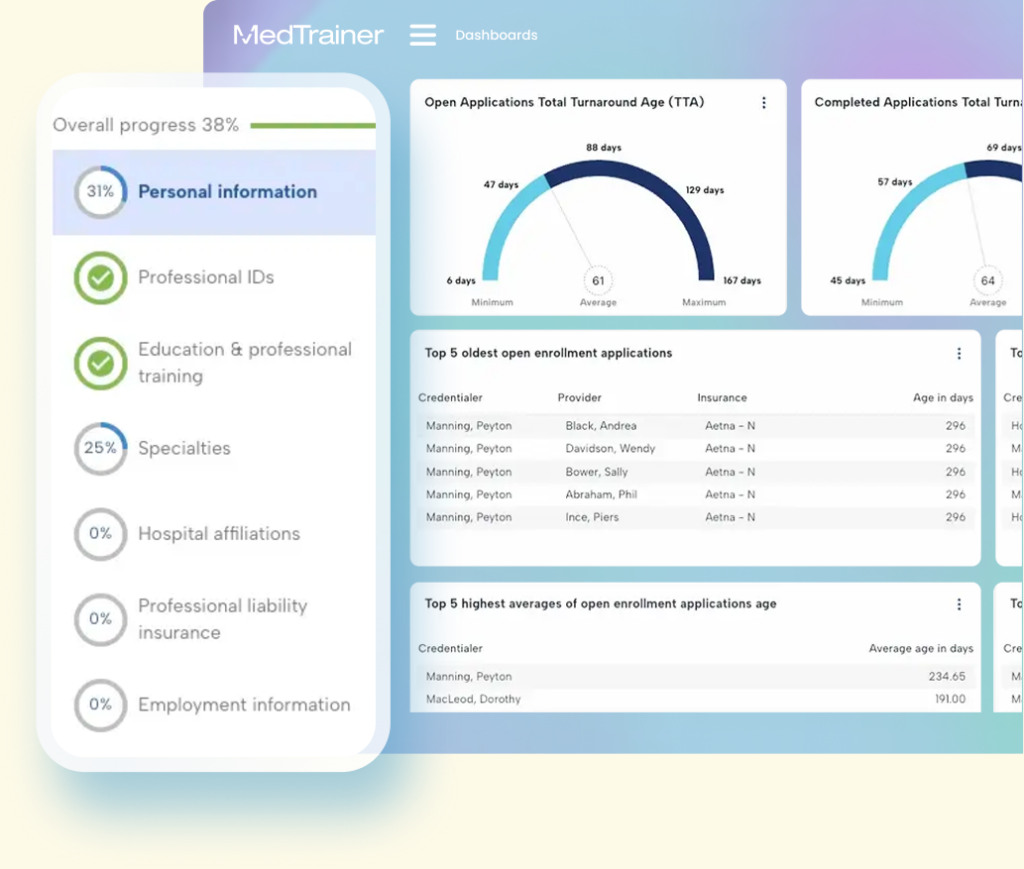
- Make the old mess visible. Completion percentages and dashboards turn invisible risk into a queue someone can own.
- Win a workflow before the platform. Configure one enrollment or onboarding process, prove it, then expand.
- Put services beside software. Experts can deliver the outcome, expose edge cases, and teach the roadmap what matters.
- Keep AI narrow and optional. Classification, extraction, matching, and suggestions are easier to inspect than autonomous decisions.
The model does not work everywhere. A tiny clinic with stable staff, few providers, and simple accreditation may not recover enough time to justify a broad platform. A large organization that refuses to name a data owner will automate disagreements. A team that expects an instant migration will resent the setup. And a buyer optimizing one sophisticated function may prefer a specialist vendor.
But under the right conditions - repeated workflows, multiple locations, enough providers, meaningful audit exposure, and a leader willing to clean the inputs - MedTrainer’s logic is sturdy. The company did not make regulation disappear. It made the evidence easier to find, the next action harder to miss, and the same fact less likely to be typed for the sixth time. In healthcare administration, that is a real product.