Company File / Ophthalmic Imaging
Intalight
The company trying to photograph the entire eye in a single pass of light - and quietly succeeding.
The company trying to photograph the entire eye in a single pass of light - and quietly succeeding.
A patient sits down in a clinic in Vienna, or Miami, or Luoyang. A technician dims the lights, asks them to look at a small target, and presses a button. In the time it takes to exhale, a machine has mapped the retina, the choroid beneath it, the vitreous in front of it, and the blood vessels threading through all of it - across 130 degrees of the eye, in one scan. The patient sees a flash. The clinician sees almost everything.
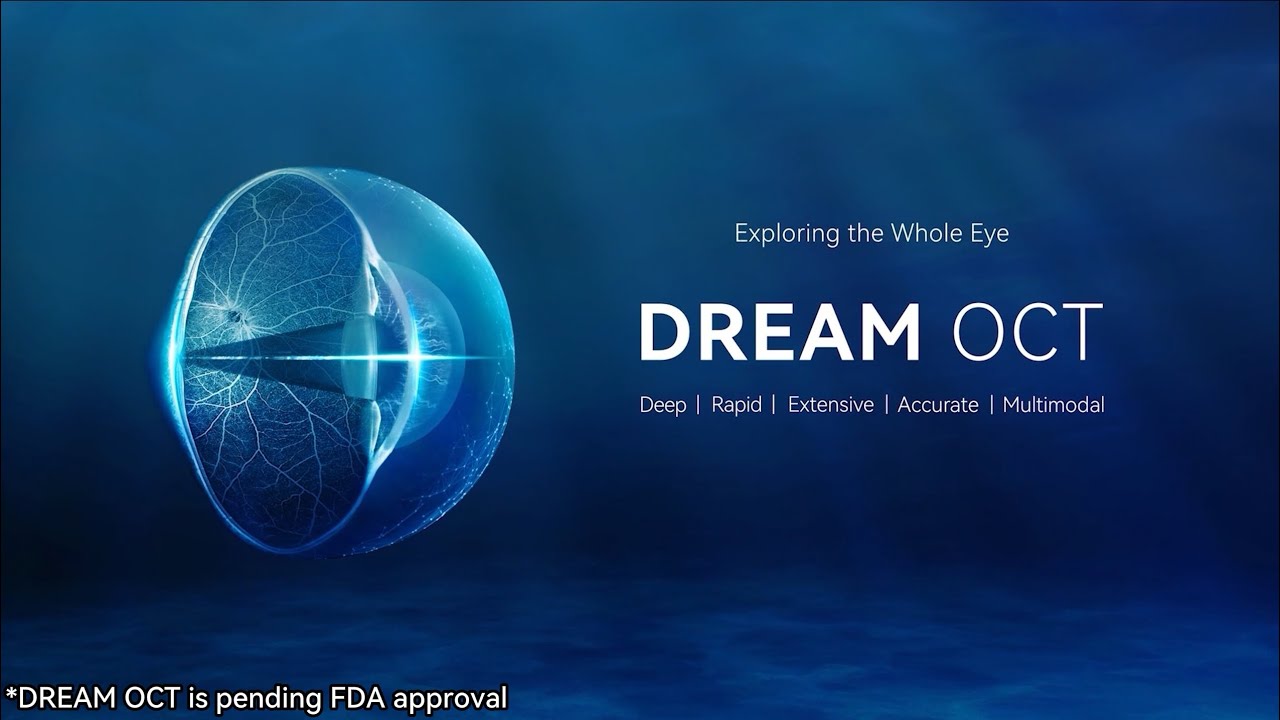
That machine is DREAM OCT. The company behind it is Intalight. And the quiet revolution it represents is this: the eye, for most of medical history, has been examined one keyhole at a time.
Optical coherence tomography - OCT - is the workhorse of modern eye care. It uses light the way ultrasound uses sound, building cross-sections of living tissue without a single incision. It is genuinely one of medicine's great instruments. It also, for years, came with a catch.
Conventional OCT tends to image a small central patch and struggles when something is in the way: a cataract, a hemorrhage, a cloudy vitreous. It is fast, but not fast enough to comfortably scan a wide field before the eye drifts. It sees the retina well and the choroid beneath it poorly. Which is a little like buying a panoramic camera that only photographs the middle of the view, and only on clear days.
The gap was obvious to anyone holding the probe. Closing it required rebuilding the light source itself.
Intalight began in 2014 in Silicon Valley, founded by Shawn Peng, who still serves as chairman and president. The wager was on a different kind of OCT: swept-source, driven by a tunable laser at a longer wavelength than the usual systems. Longer light penetrates deeper and pushes through the cloudy media that defeat shorter wavelengths. A faster sweep captures a wider field before the eye can move.
In 2015 the core engineering and manufacturing moved to China, under the name SVision Imaging. For several years the company perfected the optics largely out of public view, earning its first regulatory clearance in China in 2019. Then, in November 2022, it adopted a single global brand - Intalight - and set out to sell the same instrument to the rest of the world. CEO and co-founder Bing Li, an engineer by training, took the technology to market.
The bet was not just on better physics. It was that a high-end scan, the kind reserved for elite research hospitals, could be made affordable enough for an ordinary practice. Chief Commercial Officer Joe Garibaldi - a veteran of the OCT industry - framed the whole project plainly: make ultra-widefield swept-source OCT financially accessible to academic and private practitioners worldwide.
Deep · Rapid · Extensive · Accurate · Multimodal
Marketing acronyms are usually where good ideas go to die. DREAM is the rare exception, because each letter maps to a real specification. The flagship, sold as the VG200 family, runs its swept-source laser at roughly 200 kHz, reaches up to about 12 mm of imaging depth into the posterior eye, and covers around 130 degrees of retina - close to 26 by 21 millimeters - in a single ultra-widefield capture.
It does not stop at the back of the eye. The same platform images the anterior segment, capturing cornea through anterior vitreous in one scan, and performs visualized biometry. Then software takes over: OCT-angiography algorithms and AI segmentation turn raw light into numbers a clinician can act on - vessel density, the foveal avascular zone, choroidal vessel volume and index. One device, the whole eye, front to back.
Ultra-widefield OCT and OCTA with deep choroidal penetration, plus quantitative angiography metrics in a single capture.
AS-OCT and AS-OCTA up to ~16.2 mm scan depth in air, cornea to anterior vitreous, with visualized biometry.
Automated deep-layer segmentation and True-Angiography algorithms convert scans into clinical and research data.
A longer-wavelength laser sees through cataracts and vitreous opacities that block many conventional scanners.
Translation for the non-ophthalmologist: it photographs the parts of your eye your optometrist usually has to imagine.
Hardware companies do not get viral moments. They get certifications. Here is the trail.
Claims are cheap in medical imaging. Evidence is the currency. So in 2025, a study in Scientific Reports put DREAM's angiography head-to-head against three established commercial systems. On the metric that matters most for a fidgeting patient - how long the wide-field scan takes - DREAM finished in roughly nine seconds where a comparator needed more than twenty. It also showed strong visualization of the deep capillary plexus, the fine vascular layer that is notoriously hard to resolve.
A scan that is two-thirds faster is not a spec-sheet flex. It is the difference between a clean image and a blurred one, for the patient who cannot hold still.
The other proof is adoption. Data from DREAM OCT now appears in more than 170 peer-reviewed publications, with users and collaborators including Bascom Palmer Eye Institute, Oregon Health & Science University's Casey Eye Institute, the University of Washington and the University of Vienna. Medical Tech Outlook named Intalight to its Top 10 Retinal Imaging Solutions list back in 2023, before most of the world had heard the name.
The company's tagline - “Light Every Sight” - sounds like a slogan until you remember what swept-source actually does. It sees through the haze. Cataracts, hemorrhages, cloudy vitreous: the very conditions that obscure the eye are most common in the patients who most need it imaged. A scanner that works on a perfect eye is convenient. A scanner that works on a damaged one is the point.
Intalight backs that mission with an unusual structure: a Silicon Valley commercial presence stitched to deep R&D and manufacturing in China, where it operates as SVision Imaging. A medical advisory panel stacked with retina names helps steer the product. The funding - roughly $75 million across rounds through a 2025 Series D+, with investors including Co-Stone Capital, Addor Capital, CDBI Partners and the Huaxia Eye Hospital Group - is aimed squarely at one thing: getting the instrument into more rooms, in more countries, at a price more of them can afford.
It is worth noting what Intalight is not. It is not, despite a common mix-up, a subsidiary of fellow Chinese maker TowardPi. That is a rival, not a parent. The competitive field is crowded and serious - Zeiss, Heidelberg, Topcon, Nidek, Visionix - which is precisely why a faster, deeper, cheaper scan is worth building.
Go back to the exam room. The patient looks at the target. The technician presses the button. There is a flash - the same flash there has always been. But in those nine seconds, the machine has done something a generation of OCT could not: it has seen the eye whole, front to back, edge to edge, even through the cloud.
That is the change Intalight is selling. Not a new kind of light - light is old - but a new kind of completeness. Earlier detection of diabetic retinopathy, of macular degeneration, of the choroidal and tumor vessels that hide in the deep layers. Fewer follow-up visits because the first scan caught it. More research, because the data is richer. And, if the affordability bet pays off, all of it reaching practices that could never justify a research-grade machine before.
The eye has been examined one keyhole at a time for most of medical history. Intalight is betting that era is ending - nine seconds at a time.
Official & Social
Watch: demos & talks
Read more
Figures (funding, scan specs, study results, employee count) are drawn from public sources and third-party data, and are approximate where noted.