The ambition is wonderfully unglamorous: a knee you stop thinking about. No daily mental inventory of how it feels on the stairs. No fascination with the engineering inside your leg. Corin, the British orthopaedic company, calls this the “forgotten knee.” For a business selling sophisticated hardware, it is an unusually good description of success. The customer should eventually have more interesting things to discuss.
Getting there involves more than a replacement joint that looks neatly positioned on an X-ray. Corin’s pitch centers on the relationship between the implant, the surrounding soft tissues and the way a particular patient moves. It makes the components, but increasingly also sells the means to plan their placement, measure the operation and review what happened afterward. The ambition reaches from the machine shop to the surgeon’s screen.
The measurement before the cut
ApolloKnee is the clearest expression of that strategy. Its BalanceBot assesses the knee’s balance through its range of motion before bone resection. The surgeon can use those measurements to plan implant position within chosen alignment preferences. Robotic cutting assistance then helps implement the plan. Corin is putting a number on something surgeons have traditionally also assessed through experience and feel.
The sequence matters. A measurement taken before a bone cut can inform that cut; a measurement taken afterward may reveal a problem that now needs correcting. Corin’s April 2024 European approval announcement describes support for both tibia-first and femur-first workflows. That flexibility is commercially important: a new system must fit into a surgeon’s working method closely enough to earn a place in the room.
The robot has some less solemn features, too. Gesture controls let surgeons advance the workflow, alongside a draped touchscreen tablet. These are practical concessions to an environment where hands, sterility and attention are already occupied. A clever interface earns its keep when it removes a small interruption from a complicated procedure.
“What you plan is what you get.”Dr Simon Coffey, in Corin’s published ApolloKnee testimonials
That is an enthusiastic user’s assessment, rather than a guarantee. Still, it captures the sales proposition neatly: reduce the distance between intention and execution. The physician remains responsible for the operation. The software and robot provide measurements, planning assistance and guidance within that clinical work.
- 01MeasureAssess balance before bone cuts.
- 02Plan & implementApply surgeon preferences and robotic cutting guidance.
- 03ReviewConnect surgical data with reported outcomes.
A hip plan meets the operating room
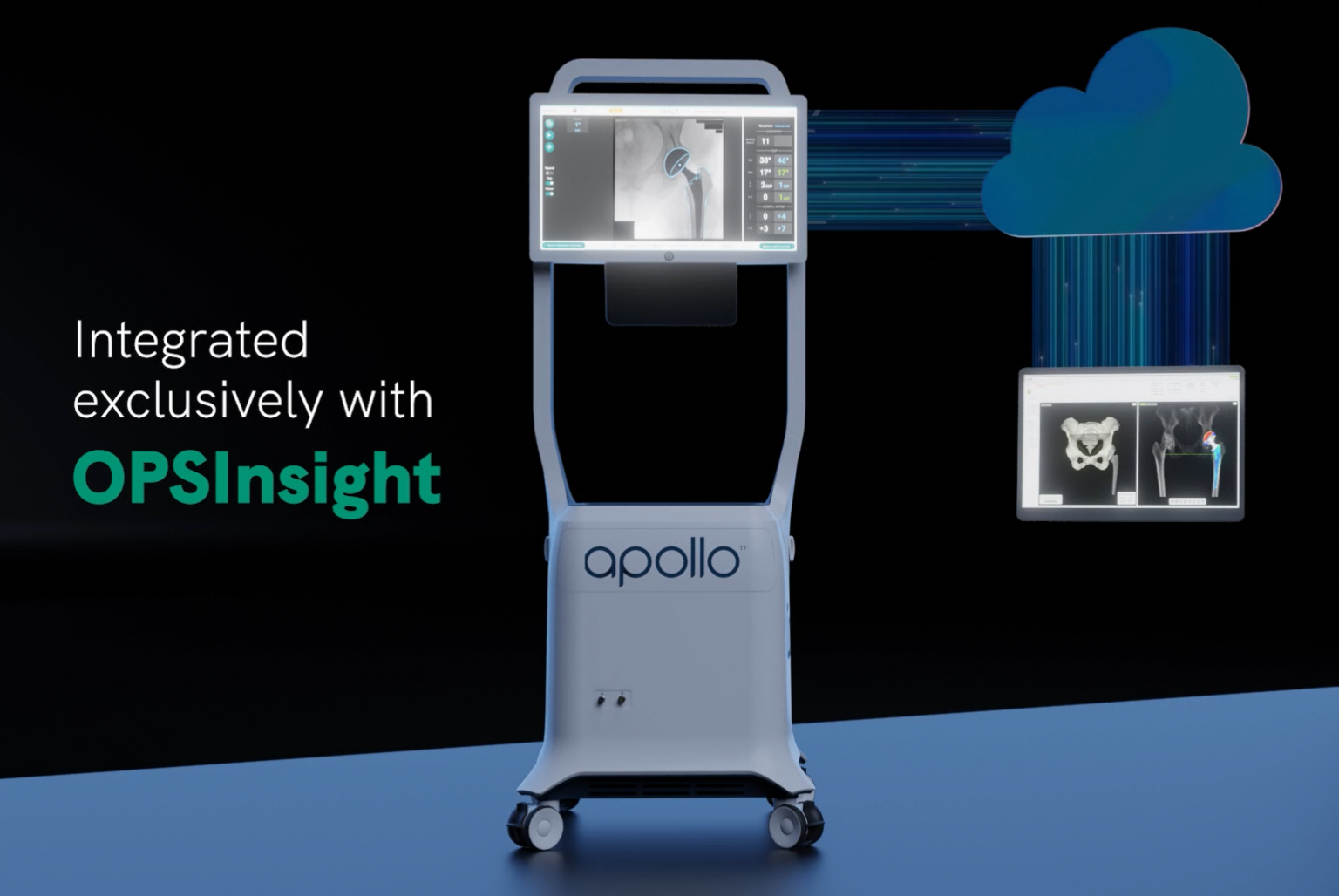
Corin approaches the hip through a related problem: translating a personalized plan into the joint actually implanted. OPSInsight uses preoperative imaging and biomechanical analysis to help surgeons consider how a patient moves. Specialized engineers prepare the analysis; surgeons can adjust the plan through a cloud-based interface. The idea is to consider life off the operating table while deciding what happens on it.
ApolloHipX extends that work into surgery. It links CT-based three-dimensional planning with two-dimensional fluoroscopy, the X-ray imaging used during an operation. Automated registration lets the software assess implant positioning against the plan. This is image-processing technology; describing it simply as a hip robot would obscure what the application actually does.
Corin announced US FDA clearance in January 2025 and the first clinical cases that June. Dr. Stefan Kreuzer performed those procedures at INOV8 Surgical at Memorial City in Houston. The launch announcement described a limited market release. By June 29, 2026, according to a subsequent Corin LinkedIn post, the Kommedico team had performed three navigated hip replacements in Germany with ApolloHipX.
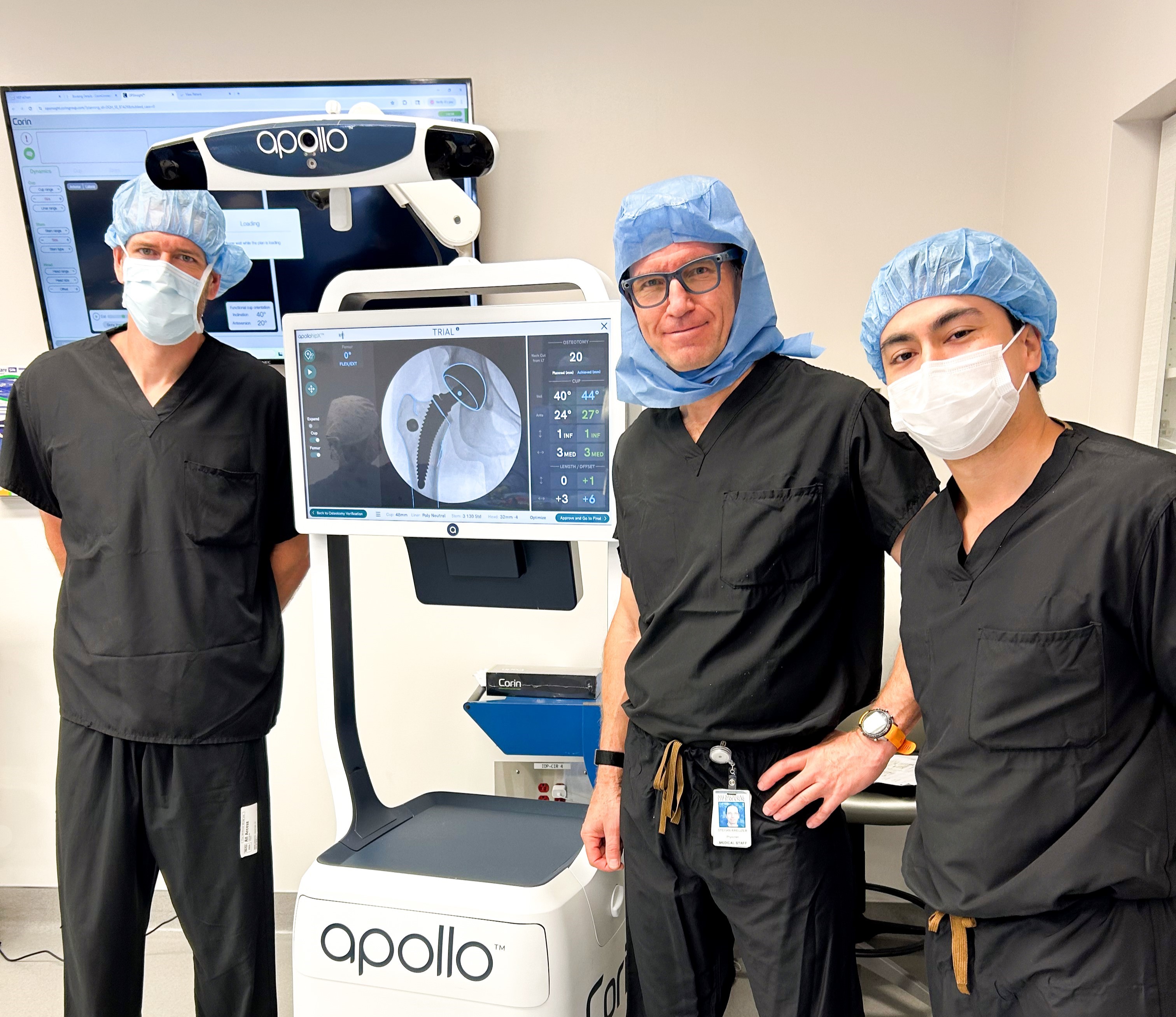
There is a specific job for AI here. Corin says its OPSInsight hip-spine X-ray analysis model was trained on more than 50,000 images from its registry. The claim concerns analysis of functional imaging, rather than an all-purpose artificial surgeon. That narrower description makes the technology easier to evaluate: what information does it extract, and does that information help a clinician make a better decision?
The metal still matters
Software attracts attention, but the implant remains in the patient. Corin’s portfolio includes hip components and knee systems such as Unity and Apex. Its expertise spans component design, materials, manufacturing and instruments, alongside biomechanics and software. Those capabilities have to work together. A beautifully planned procedure still needs an appropriate physical implant and a team able to supply it.
Icona makes the connection tangible. Corin announced the first use of this triple-taper, fully coated cementless femoral stem in December 2024, at Ortho Rhode Island and Saint Francis Hospital in Tulsa. Its design includes a reduced proximal lateral shoulder, a swept distal tip and an angled insertion feature intended to help muscle-sparing approaches. These are small geometric choices with an operating-room purpose.
The company also says registry CT data helped inform Icona’s geometry. Here, information gathered around clinical work travels back toward product design. It is an appealing industrial loop: make the implant, observe anatomy and use those observations in the next design. The quality of that loop depends on the quality and representativeness of the information entering it.
How an implant maker bought its way into robotics
Corin began in 1985. Contemporary reporting identifies Peter Gibson as its founder and chairman. The later corporate story is easier to follow in transactions than in a single eureka moment. In 2013, 2IL Orthopaedics took Corin private in a deal reported at £30.5 million. Five years later, a company backed by Permira funds agreed to acquire a majority stake.
Permira’s 2018 announcement described a company that had moved toward software-led implant design since 2012. Management would remain invested, and the acquisition consideration was undisclosed. The financial sponsor’s stated rationale included innovation, customer service and opportunities for further acquisitions. This was a strategy of adding capabilities around an established manufacturing business.
The subsequent deals explain the current offering. Corin announced an agreement to buy Australia’s Global Orthopaedic Technology in 2018. In March 2019, it announced the acquisition of US-based OMNI Orthopedics, bringing OMNIBotics and ligament-balancing technology into the group. Apollo’s robotic heritage therefore includes an acquired business and its engineering experience. It did not materialize as a standalone software launch.
Reported value of Corin’s take-private transaction. The 2018 Permira deal price was undisclosed.
The hospital buys a working system
The customers are hospitals, ambulatory surgical centers and orthopaedic practices; surgeons are the principal clinical users, and patients are the ultimate beneficiaries. Corin sells implants and enabling technologies through a business that also includes field sales, clinical support, training and service. Its careers material describes staff supporting maintenance and repairs as well as product adoption. The service around the device is part of the proposition.
For a buyer, the relevant cost extends beyond equipment. A useful assessment would count imaging, instruments, staff training, technical support and operating-room time against expected case volume. That is an analytical buying framework, not a quoted Corin price list. The decision is whether the complete arrangement improves the provider’s work enough to justify its total cost.
Corin competes in a crowded neighborhood. Stryker’s Mako combines planning with robotic assistance; Zimmer Biomet’s ROSA supports personalized knee planning; Smith+Nephew’s CORI offers handheld robotics, mapping and balancing capabilities. Conventional surgery remains an alternative. Corin’s particular emphasis is the combination of pre-resection robotic balancing, its implant portfolio and connected planning and review. The word “robotic” alone does little to distinguish anyone.
ApolloHipX presents a different workflow choice from Mako’s hip offering. Corin emphasizes matching plans with standard intraoperative fluoroscopy, while Stryker describes haptically guided bone preparation. Hospitals comparing them need to examine the actual tasks performed, compatible implants and surgical requirements. Two products can occupy the same budget conversation while doing different jobs.
The less photogenic part of progress
Corin’s public record includes a regulatory setback. In February 2017, the FDA issued a closeout letter after evaluating corrective actions related to a September 2015 warning letter. The agency said the violations appeared adequately addressed and emphasized the continuing responsibility to maintain compliance. Both halves matter: there was a problem, and there was a documented regulatory response to the corrections.
This history belongs beside the launch announcements because manufacturing discipline is essential to the business. Corin’s workforce spans inspection, quality, regulatory affairs, engineering and delivery. Its careers page encourages employees to speak up and take ownership of improvements. Those are the company’s stated cultural expectations; their practical value would be in catching problems and making dependable products.
Newer regulatory milestones tell a different, narrower story. ApolloKnee’s US clearance was announced in November 2023, followed by EU MDR approval in April 2024. ApolloHipX has its own clearance and intended use. Permission to market an application is a meaningful step, but it does not by itself establish superiority over another technique or guarantee a patient’s recovery.
The useful lesson is earlier measurement
CorinConnect ties plans and surgical information to patient outcomes for review. The business logic is straightforward: clinicians can learn more when the intended procedure and the resulting experience can be examined together. Collecting data is only the first part. Useful comparisons also require consistent follow-up and care in interpreting differences between patients and procedures.
For readers outside orthopaedics, there is a copyable idea here. Identify a consequential variable that people currently judge imperfectly. Measure it before a difficult-to-reverse decision. Preserve enough information to compare the plan with the result. Corin applies that sequence to surgical balance and positioning; the broader lesson is about moving feedback to where it can still change the work.
The approach depends on trained teams, suitable imaging, compatible tools and clinical judgment. Availability also varies by market. A provider unable to support the workflow will not gain its full value simply by acquiring a station. Corin’s opportunity is to make those pieces work together so reliably that the patient can concentrate on something else. For this particular manufacturer, being forgotten is an exacting product brief.