In 1888, the Johnson brothers had a problem that ought to sound familiar to anyone who has ever shipped a clever product: their customers needed instructions. They were manufacturing sterile surgical supplies. But making something germ-free in New Brunswick did little good if a doctor contaminated it before treating a wound. So Johnson & Johnson published a guide to antiseptic wound treatment. The product needed a practice around it.
That little booklet offers a useful way into a company whose familiar name can obscure its current work. Think of Johnson & Johnson and you may picture a bathroom shelf. In August 2023, however, it finalized the separation of Kenvue, the consumer business associated with Tylenol, Listerine and Band-Aid. The surviving J&J is built around Innovative Medicine and MedTech. The bathroom is a misleading place to look.
- The familiar brands moved. Kenvue separated in 2023.
- The focus narrowed. Medicines and medical technology now define J&J.
- The work got complicated. Evidence, manufacturing and adoption decide what succeeds.
01The business behind the familiar name
The split followed an announcement in 2021. Management argued that separate companies would gain operational focus and flexibility. That distinction makes practical sense: selling mouthwash and developing a cell therapy demand different experiments, different expertise and different ways of spending money. J&J chose to concentrate its remaining business on patients and the professionals treating them.
Its medicines address cancer, immune disorders, neurological conditions and cardiopulmonary disease. Its devices reach into operating rooms, catheterization laboratories and eye care. Hospitals buy equipment and supplies; clinicians choose and use them; patients receive treatment; insurers and public health systems help determine what gets paid for. ACUVUE contact lenses remain a recognizable consumer-facing exception, available by prescription.
J&J reported $94.193 billion in 2025 sales. This is a commercial operation built around medicines, medical equipment and the supplies used with them. Its expertise includes clinical development, regulated manufacturing and getting products into healthcare systems. A discovery earns little merely by being interesting. Someone must demonstrate that it works, manufacture it consistently and make its use feasible.

02A heart problem. A $29.7 billion answer.
Consider the cardiovascular business. In December 2022, J&J completed its Abiomed acquisition at an upfront enterprise value of about $16.6 billion, with possible additional milestone payments. Abiomed brought Impella heart pumps, devices used to support the heart in specified clinical settings. In May 2024, J&J completed its purchase of Shockwave Medical, announced at an enterprise value of approximately $13.1 billion.
Shockwave uses acoustic pressure waves to fracture calcium in diseased arteries. The idea has an almost household intelligibility: hard deposits make a vessel difficult to treat, so change the deposits. The procedure itself belongs with trained specialists. Together, the two deals expanded J&J across distinct cardiovascular problems, alongside its existing electrophysiology business.
The acquisition prices explain the ambition more clearly than a slogan could. J&J was paying for technologies, teams and opportunities to reach patients. Those prices are enterprise values from different transactions, including acquired cash; adding them illustrates the scale of the commitments, rather than a complete accounting of acquisition spending. Whether the purchases earn their keep depends on clinical adoption, execution and future sales.
03The invention can come from somewhere else
Ownership is only one route. In 2017, Janssen, J&J’s pharmaceutical business, signed a worldwide collaboration with Legend Biotech to develop, manufacture and commercialize an experimental CAR-T therapy. The treatment became CARVYKTI, first approved by the FDA in 2022 for certain previously treated adults with multiple myeloma.
Here the patient’s own immune cells become the starting material. They are collected, modified to recognize a target on myeloma cells, and returned. That sequence makes the old antiseptic booklet feel surprisingly contemporary: the surrounding process matters enormously. Treatment requires specialized care, manufacturing coordination and careful management of serious risks. An approved therapy and an accessible therapy are different milestones.
J&J also licensed daratumumab from Genmab in 2012; the medicine became DARZALEX. These arrangements show a repeatable organizational choice: combine outside research with development and commercialization capabilities. For a smaller company, the useful lesson is to identify the missing capability and find a partner who actually has it. Buying an entire business is an expensive way to answer a narrow question.
“Our Credo challenges us to put the needs and well-being of the people we serve first.”Johnson & Johnson / Our Credo and our purpose
- 01 Collect cells
- 02 Engineer cells
- 03 Return to patient
Simplified. Specialized care surrounds each step.
04The operating room becomes the next test
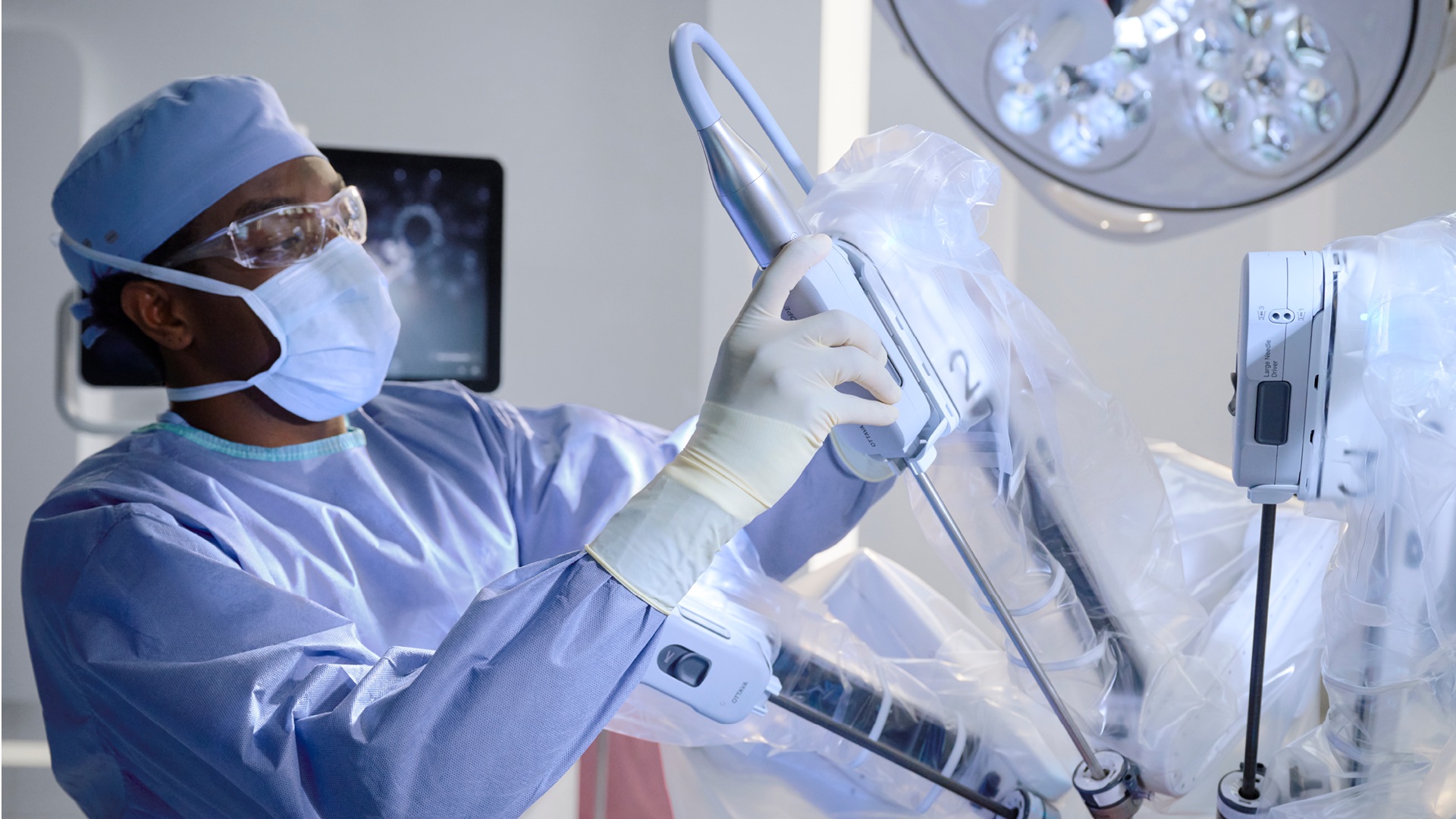
In July 2026, J&J announced U.S. FDA market authorization for OTTAVA, its table-integrated soft tissue robotic surgical system. The integration is a specific design choice: robotic arms and the operating table work together. J&J is entering a field already associated with Intuitive Surgical, where hospitals must consider equipment, staff training and how a system fits the room.
This helps locate J&J in its market. It competes with pharmaceutical companies such as Merck and Roche in particular treatment areas, and device businesses such as Medtronic, Abbott and Boston Scientific in particular procedures. Its distinguishing feature is the combination of drug development and medical technology under one corporate roof. Breadth gives it several routes into care; each product still has to justify its own place.
05The part a familiar name cannot fix
The first thing to fail, in the founding story, was the assumption that supplies alone could change surgical practice. Today the weak points can be biological, commercial or mechanical. Biosimilar competition has cut into STELARA sales. In September 2026, the FDA classified a recall involving Automated Impella Controllers as Class I, its most serious category. Scale brings responsibilities that continue after a sale.
Then there is the unfinished past. A bankruptcy judge rejected a J&J subsidiary’s proposed talc settlement plan in 2025, the third bankruptcy case connected with the issue. J&J disputes the cancer allegations. Its October 2026 earnings release reported a special charge for a proposed talc litigation resolution. Separating the consumer business did not simply erase those liabilities.
The company’s Credo, written in 1943, places the people using its products first. Treat that as a standard against which to judge decisions. The lesson a reader can borrow is concrete: build the instructions, partnerships and operating process alongside the product. That approach needs evidence, trained people and enough money to endure delays. It cannot rescue an ineffective treatment or make an unaffordable one accessible by itself. J&J’s earliest booklet understood the distance between making a useful thing and getting it used well. The distance remains. That puts the unglamorous details of delivery near the center of strategy.
Explore further
Explore Johnson & Johnson, its medical technologies, newsroom and investor updates.
Follow LinkedIn, X, Instagram and Facebook.
Watch: Introducing OTTAVA J&J videos