The easiest way to misunderstand Novartis is to call it a pharmaceutical giant and stop there. Size is obvious: $54.5 billion in 2025 net sales, roughly 75,000 employees, products sold in 118 countries. The revealing part is what the Basel company no longer owns. Over a decade it peeled away animal health, consumer products, vaccines, eye care and, finally, generic drugs. When Sandoz became independent in October 2023, Novartis finished turning a crowded healthcare conglomerate into a company with one job: make patented medicines for serious disease.
That subtraction left a surprisingly legible machine. Four disease territories - cardiovascular, renal and metabolic conditions; immunology; neuroscience; and oncology - sit across five ways of making drugs. Two are familiar: synthetic chemistry and engineered biological molecules. Three are newer and fussier: RNA-based medicines, radioligand therapy, and gene and cell therapy. Those five platforms are not branding garnish. Each asks for different science, factories, clinical trials, supply chains and economics.
A conglomerate discovers the pleasure of saying no
Novartis was born large. The 1996 union of Ciba-Geigy and Sandoz combined businesses whose Basel roots stretched from an eighteenth-century trading house to synthetic dyes, chemicals and medicine. The new name came from novae artes, Latin for “new arts” or “new skills.” The merger also created an organization with many unrelated ways to earn a franc.
The modern strategy reverses that instinct. Alcon, the eye-care division, was spun off in 2019. Sandoz took generics and biosimilars with it in 2023. What remained could direct capital toward higher-value prescription drugs, especially treatments protected by patents and supported by clinical evidence that payers cannot easily ignore. Focus does not remove risk. It concentrates risk in research results, regulatory decisions, manufacturing execution and the commercial life of a smaller group of brands. But it also makes the company easier to steer.
Reimagine medicine to improve and extend people's lives.Novartis corporate purpose
There is a practical lesson hiding inside the corporate slogan. A drug company cannot merely invent. It must shepherd an idea through toxicology, years of trials, regulatory review, specialized production, reimbursement negotiations and a clinician's decision to use it. Novartis's competitive product is partly the medicine and partly this relay race.
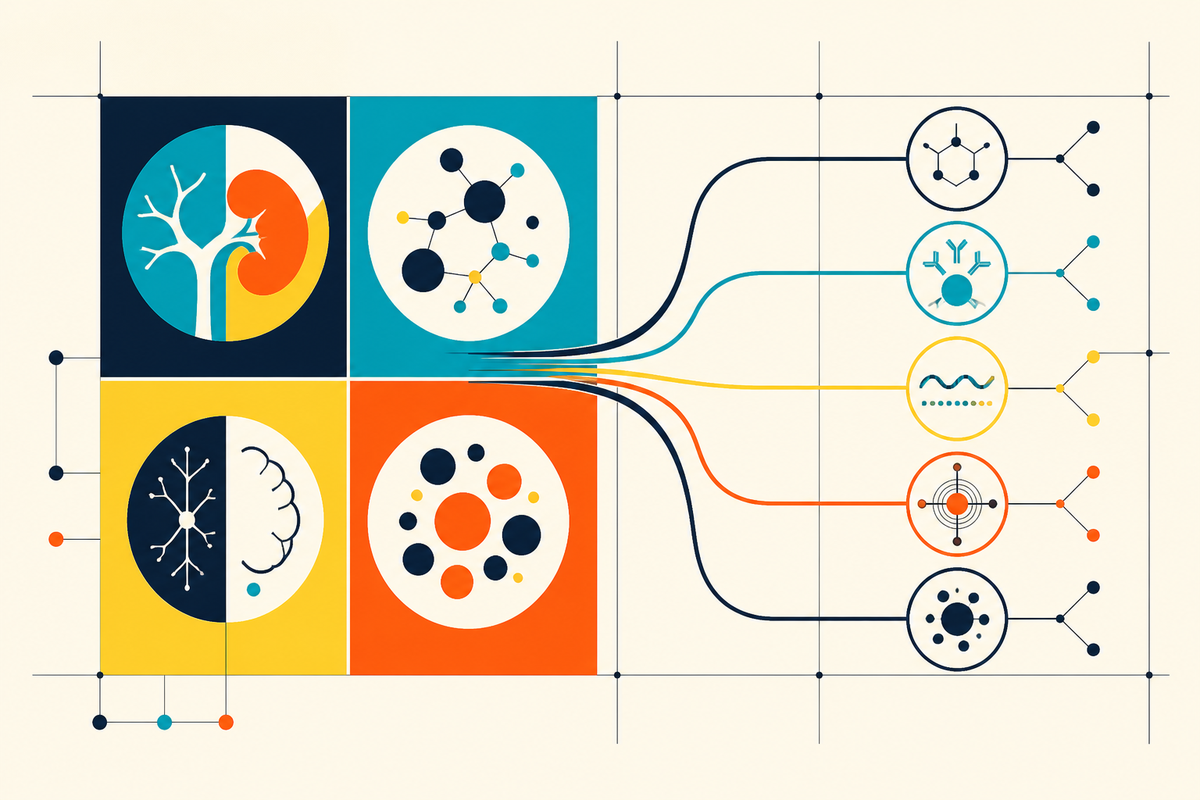
Five toolkits, not one magic hammer
Chemistry still matters. Small synthetic molecules can often be made at scale, formulated as pills and designed to enter cells. Biotherapeutics, including antibodies and other engineered proteins, can bind biological targets with great specificity. These established methods underpin much of today's industry.
The advanced platforms change what can be attempted. xRNA medicines use forms of ribonucleic acid to alter the production or behavior of disease-related proteins. Leqvio, for example, uses small interfering RNA to lower LDL cholesterol, with maintenance dosing twice a year after its starting schedule. Gene therapy can replace or modify faulty genetic instructions; cell therapy changes or deploys living cells. Radioligand therapy attaches a radioactive isotope to a targeting molecule, aiming to carry radiation to cancer cells while limiting damage around them. Pluvicto applies that logic to PSMA-positive prostate cancer.
The breadth matters because diseases do not arrive pre-sorted by corporate capability. A hard-to-reach protein may suit a new small molecule. A cell-surface marker may invite an antibody. A genetic error might be approached upstream through RNA or gene replacement. Novartis can compare several modalities inside one portfolio, then place bigger bets where the biology and its manufacturing skill overlap.
The medicines paying for the next medicines
The portfolio is a mixture of durable incumbents and faster-growing launches. Entresto, used in heart failure, led 2025 product sales at $7.75 billion. Immunology drug Cosentyx followed at $6.67 billion. Breast-cancer medicine Kisqali reached $4.78 billion after 58 percent reported growth. Multiple-sclerosis therapy Kesimpta delivered $4.43 billion, up 37 percent. Pluvicto, the radioligand treatment, approached $2 billion after 43 percent growth.
2025 product sales / USD billions
This is the pharmaceutical flywheel. Cash from marketed products funds laboratory work and clinical trials. Successful trials support approvals and broader labels. New sales finance another turn. Patents make the cycle attractive, but the clock is always audible. Exclusivity ends, competitors improve, payers push back and once-large products shrink. Novartis therefore needs Kisqali, Kesimpta, Scemblix, Pluvicto and Leqvio to grow while it prepares their eventual successors.
Who buys, who chooses, who benefits
“Customer” is an awkward singular in medicine. A national health service, insurer or hospital may pay. A wholesaler or specialty pharmacy may buy and distribute. A physician chooses whether a therapy fits the diagnosis and evidence. A nurse may administer it. The patient lives with the result and, depending on the market, part of the bill. Regulators decide whether the medicine can be sold; health-technology assessors and formulary committees often decide whether it will be used at scale.
Novartis solves different problems for each participant. Patients need slower disease progression, fewer relapses, longer survival or simpler dosing. Clinicians need credible data, manageable safety and a treatment that fits care. Payers need enough benefit to justify the expense. Hospitals need reliable supply and workable administration. A one-time gene therapy, a twice-yearly RNA injection and a radioligand infusion may all be “innovative medicines,” yet they produce radically different service demands.
Serious disease that existing care cannot control well enough, or treatment routines that are difficult to sustain.
Finding the right target, proving meaningful benefit and matching the modality to the patient.
Turning an approval into affordable, reliable access across reimbursement and delivery networks.
A focused R&D engine joined to global trials, regulatory experience, specialized manufacturing and commercialization.
The open laboratory
Novartis is too large to pretend every important idea will originate inside Novartis. Its research network includes more than 300 academic and 100 industry alliances. A collaboration with the University of California, Berkeley hunts for pockets in proteins that small molecules have historically struggled to bind. Work with Orionis Biosciences uses genome-scale tools to identify elusive targets. Its public GitHub organization hosts more than 100 repositories, including tools for clinical statistics, machine learning and gene-therapy analysis.
Buying is another form of research strategy. In 2025 the company acquired Anthos Therapeutics for its late-stage factor XI program, Regulus for a microRNA kidney-disease candidate and Tourmaline Bio for an anti-IL-6 cardiovascular asset. It agreed to pay $12 billion in cash for Avidity Biosciences, whose antibody-oligonucleotide conjugates are designed to deliver RNA into muscle. In July 2026 it proposed acquiring Myricx Bio for a new antibody-drug-conjugate payload. These deals reveal the filter: a technology or medicine should deepen one of the chosen disease areas or platforms.
Where Novartis fits - and where it can trip
Novartis sits among the world's large research-based drugmakers, competing with Roche, AstraZeneca, Merck, Pfizer, Johnson & Johnson, Sanofi, Bristol Myers Squibb, AbbVie and Eli Lilly. The alternatives change molecule by molecule. Doctors compare efficacy, safety, dosing and evidence. Payers add price and budget impact. Biotech companies can outmaneuver a giant in one scientific niche; a giant can outspend and outscale them once a medicine enters global trials and manufacturing.
What distinguishes Novartis is not a monopoly on any one technology. Rivals work in antibodies, RNA, gene therapy and targeted radiation too. Its difference is architectural: four concentrated disease franchises crossed with five in-house modality systems, a commercial network spanning 118 countries and the balance sheet to acquire missing pieces. That combination can move a promising mechanism from an outside laboratory into a late-stage program, then into factories and health systems.
The business is a relay: discover, prove, make, persuade, deliver - then begin again before the patent clock wins.YesPress analysis
The risks are equally architectural. Late-stage trials fail. Regulators can restrict labels. A short-lived isotope does not wait patiently for a delayed delivery. Gene therapies raise difficult questions about durability, safety and upfront cost. Blockbuster patents expire. Access differs dramatically between wealthy and lower-income markets. Reaching 304 million people is substantial, but it does not settle who remains outside the system.
In July 2026, Novartis reported modest second-quarter sales growth and reaffirmed its full-year outlook. The more interesting movement happened underneath: priority brands such as Kisqali, Kesimpta, Scemblix, Pluvicto and Leqvio grew; Europe approved Itvisma for a broad spinal muscular atrophy population; and the United States converted Fabhalta's IgA nephropathy indication to traditional approval after longer-term kidney data. This is how a focused drugmaker advances - not with one theatrical reveal, but with a sequence of evidence, labels and production decisions.
Thirty years after its creation, Novartis is narrower than its founders' conglomerate and technically more varied. It has traded the safety of unrelated divisions for a portfolio in which every major bet must survive biology. The organization looks tidier. The work never will.