The expensive part of a medical device can be everything around it. In a 2024 talk, Duke Rohlen recalled an early business, Lumen, that had roughly $45 million to $50 million invested and sold for roughly the same amount. A sale had happened. An attractive return had not. The company had built the infrastructure of a business around a niche catheter. The supporting cast had swallowed the show.
- Ajax supplies capital and operators to build healthcare businesses.
- Its platforms connect focused development teams with established commercial capabilities.
- Cordis-X, Cortex, Maverix, and FlowMod show different versions of that arrangement.
That recollection helps explain Ajax Health, the firm Rohlen founded in 2017. Its subject is medical technology; its preoccupation is how inventions become businesses. The distinction matters. A device can work beautifully and still leave its makers struggling to finance trials, hire executives, or reach the physician who might use it.
The invention comes with a supporting cast
Ajax invests and takes an operating role. It works with entrepreneurs, investors, and established healthcare companies, bringing expertise across finance, clinical development, engineering, and commercialization. Think of it as a company builder with access to both the laboratory and the boardroom. The device remains essential, but Ajax makes the surrounding organization part of the investment.
There is continuity in the cast. Managing partner Doug Koo has served as CFO across several Rohlen-led businesses, including Cortex, and holds that role at Cordis-X and Maverix. Managing partner Aftab Kherani combines surgical training with investment experience. These are people whose biographies include doing the work inside companies, which is useful when the spreadsheet meets an operating problem.

Rohlen himself began as a restaurant entrepreneur. Later came medical device businesses including CV Ingenuity, Spirox, and EPIX Therapeutics. The restaurant detail is amusing, but also instructive: knowing your craft and running the enterprise that surrounds it are separate talents. A kitchen needs more than a chef. A catheter needs more than an engineer.
Find the sales engine before building the product
Cordis gave Ajax a larger canvas. In 2021, Cardinal Health agreed to sell the vascular device business to Hellman & Friedman for approximately $1 billion, including specified liabilities and working-capital arrangements. Ajax and Zeus Health participated as partners. Beside the operating business sat an independent development engine, subsequently known as Cordis-X.
The useful idea was to begin with a business that already had products and customers, then identify what its portfolio needed. Cordis-X could develop, license, or invest in technologies that filled those gaps. Rohlen described a $300 million development engine in his LSI talk. The commercial route shaped the invention brief.
Conceptual diagram of the approach, not a fixed contract or guaranteed outcome.
That places Ajax between familiar alternatives: corporate research, venture-backed startups, and acquisition shopping. Its proposition is that some valuable products fit awkwardly into those buckets. An addition that strengthens an existing portfolio may be attractive to its owner without being a venture fund’s next blockbuster. Someone still needs to build it.
The numbers need their labels
Ajax’s financing history requires unusually careful reading. In April 2019, Ajax Health II announced more than $85 million, led by HealthQuest Capital with Aisling Capital and Polaris Partners participating. In September, Ajax announced $100 million for Ajax 3; that release also described Ajax 2 as having previously raised $100 million. These are named vehicles and dated announcements, rather than one tidy startup funding ladder.
Cortex offers a clearer pair of milestones. Ajax established the AFib technology business with $90 million in funding commitments in December 2023. Boston Scientific completed its acquisition on January 24, 2025, paying $248 million upfront, net of cash acquired, with up to approximately $50 million in future regulatory milestone payments.
Funding commitments
December 2023
Upfront acquisition cash, net of cash acquired
January 2025
Neither figure establishes an investor return. The acquisition also included contingent regulatory payments.
Cortex developed mapping technology intended to help physicians identify AFib sources. Boston Scientific’s acquisition announcement described a 300-patient global trial evaluating its OptiMap system. The transaction illustrates a commercial destination for an Ajax company; it does not turn a development budget into a published profit calculation.
“Cortex’s vision is to enable more intelligent AFib treatment.”Duke Rohlen, Cortex launch announcement, December 2023
From a platform to a handheld probe
Maverix Medical extends the approach into lung cancer. KKR and Hologic announced the platform in November 2023, managed by Ajax. It was designed to develop and acquire technologies and commercial operations in one disease category. Existing portfolio company Serpex Medical, which developed steerable instruments, was contributed to the platform.
The portfolio became more concrete through acquisitions: Cirrus Bio in 2024 established a diagnostics foundation; Thoracent followed in early 2025. In July 2026, Maverix appointed Carla Jung CEO. Her appointment put an experienced commercial leader in charge as the company expanded its organization and brought products to market.
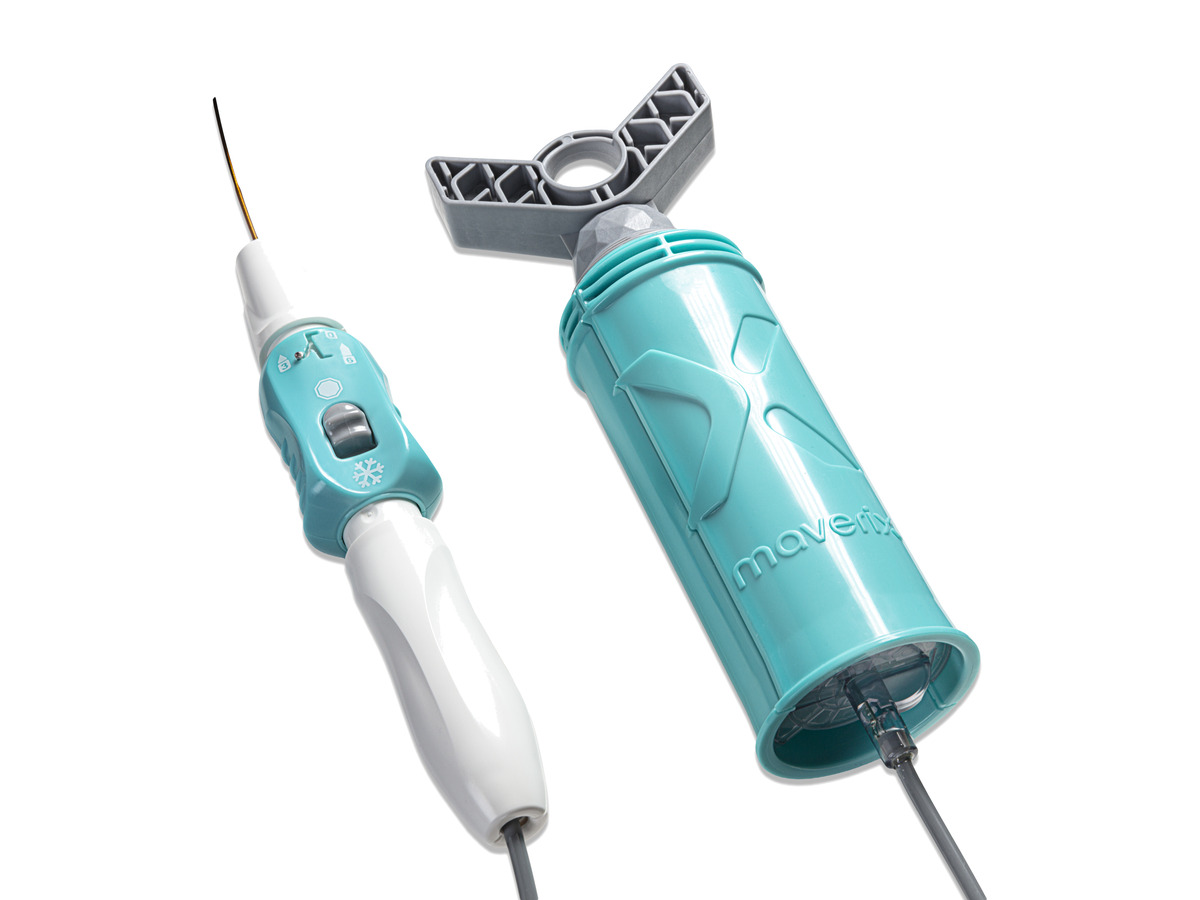
In August 2026, Maverix announced that its Narwhal Cryo System had received FDA 510(k) clearance on June 30. The handheld, single-use cryoprobe requires no dedicated console. Its uses include tissue biopsy and removal of specified obstructive material by extreme cold and cryo-adhesion. This is an affiliate’s product, manufactured by Serpex, rather than something patients purchase from Ajax.
Borrow the question before borrowing the budget
There are two audiences here. A medtech company can look to Ajax for a product development platform and operating partnership. An entrepreneurial team can look for capital, experienced colleagues, and a commercial route. Physicians and hospitals encounter the resulting devices through affiliated businesses. Ajax itself is not a patient-care service.
The transferable lesson is to ask earlier where a product belongs. Which existing portfolio has a gap? Who understands the buyer? Which capabilities should a small team share? These questions can improve a development brief even without Ajax-sized financing. They also expose the limits: an unwilling commercial partner, inadequate capital, or unsuccessful clinical development can undo an elegant arrangement.

In March 2025, Ajax and KKR announced FlowMod, a collaboration using Boston Scientific intellectual property to develop a heart failure system. It is another development effort, with clinical validation and regulatory work ahead. Ajax keeps assembling the people, money, and commercial relationships around the technology. The interesting test is what that arrangement eventually puts in a physician’s hands.