The interesting part of a brain-surgery laser is the thermometer. Delivering enough energy to destroy tissue is one problem. Knowing what that energy is doing, millimeter by millimeter, is another. Inside the brain, the distinction matters enormously. Monteris Medical built its business in the space between those two problems: the ability to act, and the ability to watch.
- NeuroBlate uses laser heat, MRI guidance and surgeon-controlled robotics to ablate targeted brain tissue.
- Hospitals buy the platform; specialist teams decide which patients might benefit.
- Its commercial argument rests on controlled delivery, smaller surgical access and accumulating clinical evidence.
A small opening, a demanding job
Picture the route. A surgeon creates a small opening in the skull and guides a probe toward a target. The patient lies in an MRI scanner. Laser energy heats the tissue, while MRI-based thermal information helps the surgeon monitor the treatment. NeuroBlate’s robotic driver allows adjustments from a workstation. There is a person making the decisions throughout.
The appeal is straightforward. Some lesions lie deep within the brain; reaching them through open surgery can be difficult. For selected patients with tumors, radiation necrosis or drug-resistant epilepsy, laser interstitial thermal therapy, or LITT, offers another surgical approach. Monteris supplies the equipment that makes that approach possible. It is a device company serving hospitals and neurosurgical programs.
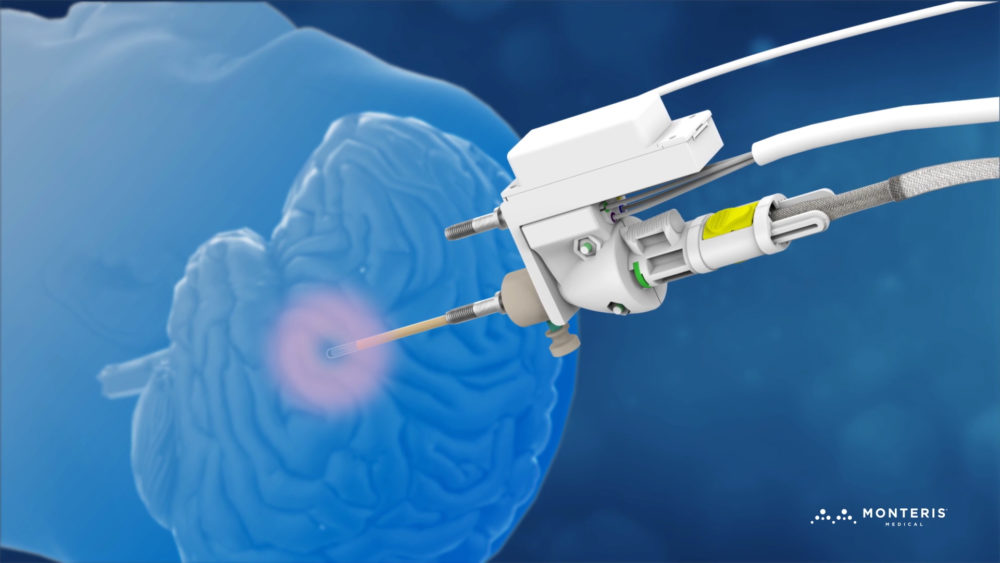
Monteris’s product range reflects the fact that targets have different shapes. FullFire probes diffuse energy; SideFire directs it. The NB3 FullFire probe, commercially released in May 2024, measures 1.6 millimeters in diameter. Cooling is part of the system, too. A device designed to heat tissue must also manage the temperature of its own working tip.
Medtronic’s Visualase offers a competing MRI-guided LITT platform. Monteris emphasizes remote robotic positioning and its choice of directional and diffusing probes. For clinicians, however, the larger comparison concerns the treatment plan: when does ablation fit better than resection or another intervention? A small incision, by itself, cannot answer that question.
The component that had to change
The company’s history provides a particularly concrete reminder. In October 2017, Monteris initiated a recall involving an unexpected interaction with 1.5-tesla MRI systems. The FDA classified it as Class I. The problem concerned unintended heating. For a technology whose purpose depends on controlling heat, this reached directly into the product’s central promise.
The engineering response was specific. A subsequent FDA clearance document describes replacing an internal metallic thermocouple with a nonmetallic fiber-optic temperature sensor. The change addressed MRI energy coupling into the probe assembly. This sensor measured the probe tip’s internal temperature; it was separate from the MRI thermography used to assess brain tissue. The recall record lists termination in January 2021.
“The margin of error in the brain is very small.”Richard Tyc, co-founder, in an interview with SCHOTT
That is the useful detail in this episode: the material used to measure temperature mattered to the safety of temperature control. Medical-device innovation happens at that level. A new component has to work inside an existing environment, with its own physical rules. Here, the environment was an MRI scanner.
The slower part of invention
Monteris dates its founding to 1999, when Mark Torchia and Richard Tyc began the effort in Winnipeg. NeuroBlate received an FDA clearance in April 2013. Those dates suggest the timescale involved. A promising way to deliver energy still needs engineering, clinical use and evidence that other specialists can inspect.
The company’s LAANTERN registry became part of that work. It enrolled more than 1,000 patients and collected outcomes over years. In 2025, a JAMA Neurology analysis examined 145 patients with drug-resistant mesial temporal lobe epilepsy. Among 77 assessed at two years, 45 achieved Engel class I outcomes, meaning freedom from disabling seizures. That is 58.4%.
Engel class I outcomes
58.4% · Freedom from disabling seizures
145 enrolled; 77 assessed at two years. Observational registry analysis.
The distinction between enrollment and follow-up deserves to stay visible. So do the risks: 24 of 145 participants had adverse events. This was an observational cohort, without a randomized open-surgery comparison. It offers useful evidence about outcomes and recovery; it cannot establish that every eligible patient will do better with a laser.
In August 2026, Monteris announced another LAANTERN publication covering 787 brain-tumor patients at 25 centers. The expanding dataset matters because tumors differ, targets differ and treatment goals differ. A larger record can help refine selection. It also makes sweeping claims about a single universal outcome less defensible.
The customer was a roomful of people
In a SCHOTT interview, Tyc described an adjustment in the company’s thinking. Early attention went to the neurosurgeon. Experience showed that neuro-oncologists, radiation oncologists and epilepsy specialists mattered, too. Tumor boards brought several disciplines into the decision. Adoption required a shared understanding of where LITT belonged in the patient’s care.

There is a lesson here for anyone selling complicated equipment. Map the decision around the customer. Understand who recommends, who evaluates, who operates and who follows the outcome. A surgeon can appreciate an instrument while the wider team still needs a reason to include it in care.
The business has a physical rhythm: installed equipment and software, followed by disposable procedural components. That creates an ongoing relationship with a hospital. In October 2022, Monteris reported more than 100 installations across the United States and Canada. Clinical research and workflow support help turn an installed system into a usable option.
Supporting that work takes capital. Monteris’s 2022 financing included $35 million in Series D equity and a $38 million debt facility. In March 2026 it announced $28 million in Series E equity, alongside a separate $35 million credit facility. These are financing amounts, rather than a price tag for developing NeuroBlate or a patient’s operation.
The shape of the next problem
In October 2025, Monteris and Symphony Robotics announced a collaboration aimed at combining laser delivery with micro-robotic guidance. One development goal is curved probe pathways, potentially useful around difficult anatomy. That remains a development proposition; the announcement does not establish a new clinical outcome.
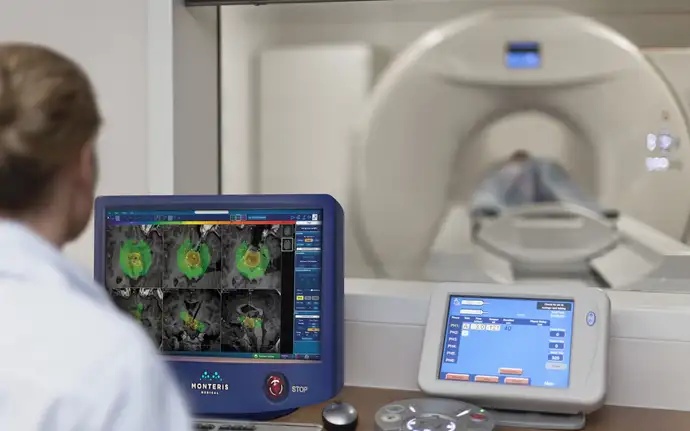
The boundary remains clinical judgment. Patients must be able to undergo MRI, and ablation carries risks including bleeding, swelling and neurological injury. Monteris’s contribution is a more controlled route to selected tissue. Its continuing job is to show which patients should take that route, and to make the evidence as usable as the instrument.