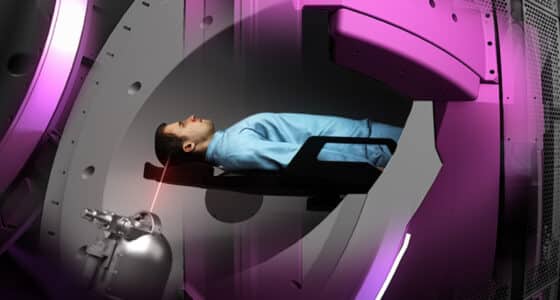
A San Carlos medical-device company arguing that brain radiosurgery shouldn't require a vault, a cobalt source, or a road trip.
Drive south from San Francisco, past the airport, past the strip-mall sushi places, and somewhere near the salt flats of San Carlos there is a building where engineers are calibrating a machine that spins. Inside that machine, two gimbaled rings rotate around a patient's head while a linear accelerator fires beams at a tumor from thousands of non-coplanar angles. The patient is awake. The room is not lined with concrete. The cobalt that used to be required is not there.
This is ZAP Surgical Systems. Roughly 120 people. One main product. A second, software-shaped product newly cleared by the FDA. A backlog of brain tumors waiting in places that historically couldn't afford to treat them.
The interesting thing about ZAP isn't what the machine does. It's what the machine doesn't need.- The recurring observation of every hospital administrator who has ever costed out a Gamma Knife vault.
For decades, the standard for non-invasive brain tumor treatment - stereotactic radiosurgery, or SRS - has been technically excellent and economically catastrophic. The dominant systems require radioactive cobalt-60 sources that decay, get replaced, and travel under armed guard. They live inside multi-million-dollar concrete vaults engineered to stop a stray gamma ray cold. They demand a specialized facility, a specialized team, and a specialized referral pattern.
The net result: in most of the world, if you have a small brain metastasis and you do not live near a quaternary academic medical center, you do not get SRS. You get something else. You travel. You wait. Or you go without.
The problem, in other words, was never really a clinical one. It was a real-estate one. Which is the kind of problem an engineer notices.
Radiosurgery's biggest barrier was never the radiation. It was the parking lot.- A summary of the founding thesis, expressed less politely in pitch decks.
John R. Adler is a Stanford professor of neurosurgery. In a previous chapter he invented the CyberKnife - the robotic-arm radiosurgery platform that now sits in hospitals around the world - and founded Accuray to commercialize it. By any reasonable measure, that was enough. Most surgeons who invent a category-defining device do not go back to the well.
Adler went back to the well. In 2014 he founded ZAP Surgical Systems with a thesis that sounds, in retrospect, almost stubbornly obvious: the linear accelerator is small, the gantry can be self-shielded, and the radioactive isotope is a historical accident, not a requirement. If you accept all three of those claims, you can put a brain radiosurgery suite inside a regional hospital without rebuilding the hospital.
It is not every day that the person most qualified to defend the old system shows up with a blueprint for replacing it.- Approximately how the FDA review felt.
The bet attracted capital quickly. Primavera Capital led an $81M round in 2020. Qingdao Baheal Medical led a $78M Series E in late 2024. Total disclosed financing now sits north of $159M.
John R. Adler launches ZAP Surgical in San Carlos, California.
The ZAP-X Gyroscopic Radiosurgery platform receives U.S. FDA 510(k) clearance.
First clinical SRS treatment delivered, with Barrow Brain and Spine among early sites.
$81M round led by Primavera Capital Group to accelerate global rollout.
$78M led by Qingdao Baheal Medical; total funding crosses $159M.
AI-ready treatment planning system cleared by FDA and CE.
The headline machine is the ZAP-X Gyroscopic Radiosurgery platform. The architecture - two intersecting, motorized rings - is the source of the "gyroscopic" name and the source of most of what makes it different. The dual-gimbaled gantry lets a single linear accelerator approach a target from thousands of non-coplanar angles, sculpting a dose distribution that is sharply concentrated on the tumor and conspicuously absent from the rest of the brain.
Because the system is self-shielded, it does not require a concrete vault. Because it uses a linac rather than cobalt-60, it does not require a radioactive source. Because it is dedicated to the cranium, the workflow is fast: a typical session is outpatient, the patient walks in, the patient walks out.
In November 2025, ZAP added ZAP-Axon, its radiosurgery planning system, which received both FDA 510(k) and CE clearance. The planning software is the half of radiosurgery that determines whether the beautiful hardware actually helps anyone; calling it AI-ready is the kind of phrase one usually distrusts, except that in dose planning it is doing real work.
The company has publicly reported more than 5,000 patients treated on ZAP-X platforms globally. That is not a number drawn from a slide deck; it is drawn from the actual clinical install base. The first SRS treatments were delivered at Barrow Brain and Spine, a partner of the Barrow Neurological Institute - the kind of credentialing site that other hospitals quietly check before signing a purchase order.
Strategic capital has followed clinical traction. Qingdao Baheal Medical led the 2024 Series E with $78M, a meaningful signal because Baheal is not a generalist crossover - it is a commercialization partner in China, which is precisely the geography where the bunker-free thesis matters most. Primavera Capital came in earlier, in 2020.
There is a difference between a medical device that works and a medical device that ships. ZAP-X is, increasingly, the second kind.- A reasonable read of the install base.
The company's stated mission is to make non-invasive cranial radiosurgery broadly accessible. In practice that means lowering the cost of entry for a community hospital, the cost of treatment for a payer, and the cost of access for a patient. None of that is glamorous. All of it is the actual lever.
It is also, quietly, an argument about where high-end medicine lives. For a long time, the answer was: in a few places, in big cities, behind large doors. The implication of ZAP's product line is that the answer can change - that the suite can come to the patient, instead of the patient coming to the suite.
Access, it turns out, is mostly an engineering problem dressed up as a policy one.- The polite version of why this company exists.
The brain-metastasis incidence curve is going the wrong direction. As cancer survival in other organs improves, more patients live long enough to develop intracranial disease. SRS demand will not stay flat. Whether the field meets that demand will depend on how many places can deliver it.
A platform that fits in a community hospital, that does not require a radioactive isotope, and whose planning software lands cleared by two major regulators in the same year is - on balance - the kind of platform that gets installed. Slowly, then quickly, the way these things go.
Drive south from San Francisco again. Past the airport, past the strip-mall sushi. The building in San Carlos is still there. The machine inside is still spinning. The patient inside the machine is, this time, from a community hospital that did not have an SRS program a year ago.
That is the whole story. The cobalt is missing. The vault is missing. The road trip is missing. What's there instead is a dedicated little radiosurgery suite running an outpatient list - a list that didn't exist before, in a place that couldn't have offered it before, treating someone who otherwise wouldn't have been treated.
That is what ZAP Surgical is selling. Not a machine. A new geography.