For InApp's silver jubilee, Vijay Kumar P sent an invitation to people who no longer worked there. The virtual gathering was set for August 13, 2025. Former colleagues were invited back to remember the work, the friendships and the company they had helped build. A business anniversary usually offers plenty of opportunities to count things. Kumar chose to count people whose names had already left the payroll.
There is something appealingly impractical about that gesture. Alumni cannot be assigned next week's deliverables. They have other managers, other calendars, other passwords to forget. Yet Kumar's invitation gave them a continuing place in InApp's history. It offered a useful way into the career of a founder who had himself left the company, led another business and returned.
A founder gets a second first day
On September 1, 2017, Kumar returned to InApp as chief executive. He had spent about a decade with the software services business before taking a sabbatical to lead Testhouse India, an IT consultancy working in software quality and risk mitigation. His return rearranged the leadership: co-founder Amarnath Raja moved from CEO to executive chairman.
InApp had begun operating in 2000. Kumar belonged to its founding group alongside Raja, Satish Babu and Rakesh Puri. By the time of his return, the company had more than 250 software engineers and offices in the United States, India and Japan. Its clients extended from startups and smaller businesses to Fortune 500 companies. He was coming back to an established operation, with colleagues and customers already depending on it.
A return like that adds an interesting wrinkle to the familiar founder story. Building something once gives a person history. Coming back means accepting responsibility for what it has become. Kumar's second first day placed him inside both stories: the company's beginnings and the practical business of its next chapter.
Before the software, a basketball
Kumar studied for a Bachelor of Technology at the College of Engineering, Trivandrum, then completed an MBA at Cochin University of Science and Technology. His management studies ran from 1990 to 1992. He received an academic merit scholarship, led the Management Students Forum, chaired the intercollegiate cultural festival Talentime and captained the university basketball team.
That makes for a pleasingly crowded student timetable: books, festival arrangements and a ball that presumably required someone to put it through a hoop. These activities show him taking on responsibilities that brought other students together, years before he would run a software company. They also give the executive biography a little movement. Before the boardroom came the basketball court.
His working life began at Castrol India. Entrepreneurial ventures followed before InApp. An older account of his career describes franchise operations among those early efforts. Software became the business for which he is publicly known, but his route into it included sales, management education and the experience of trying ventures of his own.
A celebration with a flash mob
By 2022, InApp needed more room. Its growing team had become difficult to accommodate in two existing Trivandrum offices. On July 7, the company inaugurated a new workspace at TransAsia Cyber Park in Kochi. Senior leaders and employees gathered for an opening that included a prayer, music and a flash mob.
An office inauguration is a wonderfully reliable test of corporate temperament. It can be made entirely out of speeches and photographs of people standing beside things. This one found space for a musical concert and dancing. Kumar thanked the people who had come to Kochi and described the occasion in the language of a family gathering.
The practical purpose was clear enough: more capacity for more colleagues. The celebration supplied another layer, marking a change in the company's working geography as a shared occasion. For Kumar, the opening joined two recurring parts of his public role: managing expansion and acknowledging the team that would make use of the extra space.
The anniversary speech keeps returning to the room
Four years earlier, InApp's eighteenth anniversary had taken employees to Magic Planet in Thiruvananthapuram. The gathering, held on September 21, 2018, included recognition for employees and performances by team members. Kumar spoke about individual contributions to the company's progress. The entertainment, rather conveniently, came from the same people being thanked.
In July 2023, the Kochi office's first anniversary brought another gathering, this time at Abad Plaza. Dance, music and games accompanied the milestone. Kumar's opening remarks again thanked the local team for its commitment and camaraderie. The location had changed. So had the anniversary being marked. His attention remained on the colleagues gathered around it.
These are modest scenes in a career that includes running an international software business. They are useful scenes, though. A speech at a celebration reveals what a leader chooses to make visible. Across these occasions, Kumar repeatedly brought employees' contributions into the foreground, giving the company's institutional story a cast larger than its founders.
“Nearly 20% of our colleagues have been with us for over a decade.”
Vijay Kumar, InApp's 25th-anniversary video
Ten years is a long time to share a workplace
In a video marking InApp's twenty-fifth year, Kumar offered a particular measure of continuity: almost one colleague in five had been there for more than ten years. He also described newcomers receiving mentoring and support, alongside an introduction to the company's values and expectations. His account put workplace relationships close to the centre of the business.
The number deserves to stay attached to that anniversary moment. It is his description of the team at that time, rather than a permanent employment statistic. Even with that boundary, it is revealing. When invited to talk about what distinguished InApp, Kumar reached for tenure and the way colleagues worked together.
The alumni invitation extended that attention beyond current employees. People could have left and still belong to the history being celebrated. Together, the video and invitation suggest a consistent emphasis in his public communication: remembering who helped build the company, and making room for those relationships as the business moves forward.
On the other side of the judging table
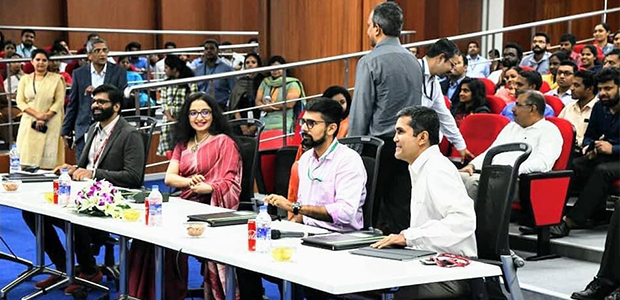
On November 28, 2018, Kumar joined a four-person judging panel at UST Global in Thiruvananthapuram. The occasion was the final round of TrailBlazer, a programme designed to identify leadership talent among young associates. Six finalists remained. The competition tested participants through tasks and challenges, with skills and presence of mind among the qualities being assessed.
Here, his role was to help recognise leadership inside someone else's organisation. The photograph catches a less ceremonial side of an executive's public life: seated at a table, paying attention, sharing the decision with other judges. A leader can spend a great deal of time being introduced. On this occasion, the interesting people were the contestants.
A second set of responsibilities
His work with leadership groups predates that judging assignment. Kumar served on Round Table India's national board from 2003 to 2005, with responsibility for human resource development and leadership development. In 2009, he became founding chair of the Young Indians chapter in Thiruvananthapuram. The chapter launched on April 7, with Alex C Augustine as co-chair.
In February 2020, he was elected chairman of the Confederation of Indian Industry's Thiruvananthapuram Zonal Council for 2020–21. His subsequent responsibilities included chairing Nasscom's Kerala Regional Council from June 2021 to May 2024. His public profile also records National SME Council membership and, from January 2024, a governing council role with the IT-ITeS Sector Skills Council.
These appointments place him in conversations about the businesses and workforce around his own company. There is a considerable amount of committee work tucked behind an executive title. In Kumar's case, the record runs through youth leadership, regional industry representation and technology skills, connecting the day job to a wider professional community.
Who gets to use the technology?
At the SHEROES Summit in Trivandrum in 2018, Kumar spoke about technology's capacity to enable marginalised groups. His observation widened the subject beyond gender to other forms of exclusion. The setting matters: this was a conversation about participation, with technology considered through the people it could help bring into opportunity.
That is a useful companion to the more commercial discussions in his career. A software executive must consider what customers need and what teams can deliver. Here, Kumar was also considering who gets access to the possibilities technology creates. The question fits alongside his involvement in leadership development and industry skills, without requiring a grand theory to tie every appointment together.
Another office, another set of connections
In 2026, Kumar delivered the keynote at the Nasscom SME Confluence Roadshow in Trivandrum. He then joined ZoomInfo's Vinay Kumar for a fireside conversation about connections, business ecosystems and partnerships. The three-hour gathering at O by Tamara brought technology leaders together to discuss how smaller technology companies could grow through collaboration and trusted relationships.
On June 5 that year, he inaugurated InApp's new workspace in Koramangala, Bengaluru. His response to the opening looked ahead to new relationships, recruitment and greater value for customers. An office gives those ambitions an address. It also creates the everyday work of turning an expansion announcement into a functioning place for colleagues.
The journey continues to acquire new locations. Yet the 2025 alumni invitation remains a particularly telling detail. Kumar's own career contains a departure and a return; his anniversary message made space for other people's departures too. Twenty-five years into InApp's story, he was still interested in getting the old team together. The meeting link, at least, would save everyone a commute.