In March 2017, Asoke K. Laha had a practical objection to a new restriction on flying to America. Certain routes would require him to put his laptop out of reach. He was prepared to change airlines. The computer mattered, of course, but so did the reading. “I need my laptop. I read books on the iPad.” A long flight was useful time. Whoever designed the rule had failed to consult the passenger’s library.
It is a small incident, yet it makes a better introduction than a row of executive titles. Laha’s working life has crossed India, Canada and the United States, passing through electrical engineering, software development, management and company building. Somewhere along the way, the engineer acquired another habit: turning the world around him into material for an argument.
He founded Interra Information Technologies, better known as InterraIT, in 1996. In December 2023, he relinquished management responsibilities, remaining a board advisor. His subsequent public designation, Chairman-Emeritus and Founder, leaves room for a different kind of work. His columns range from artificial intelligence to old radio programmes. The executive office may have changed occupants; the questions have kept coming.
A circuitous education
The educational itinerary begins at Jadavpur University in Kolkata, where Laha earned an honours engineering degree. It continues at the University of Saskatchewan, with a master’s in electrical engineering, and Northwestern University, with a master’s in computer science. Three institutions in three countries: a substantial preparation for a career spent making technical work travel.
Electrical engineering and computer science were complementary foundations for the business he would eventually enter. Software services demand an understanding of systems, but also a willingness to work inside someone else’s problem. A client brings an operation, a deadline and an assortment of expectations. The engineer has to make those expectations behave.
His early career included software development at GTE Communications, where he progressed into management, followed by a senior management role at Digital Equipment Corporation in Boston. He then joined Gateway Automation, a Boston startup subsequently acquired by Cadence Design Systems. At Cadence India, he became managing director and built an engineering team. The sequence matters: by the time he founded his own firm, he had experienced both established employers and the uncertainty of a smaller enterprise.
- Before 1996GTE, Digital, Gateway Automation and Cadence India
- 1996Founds InterraIT
- 2014-2015National President, Indo-American Chamber of Commerce
- December 2023Hands over management; continues as board advisor
The unglamorous art of getting it right
At Cadence, Laha received the Corporate Quality Award and was responsible for the India centre’s ISO 9000 certification. These are achievements with little cinematic potential. No one is likely to make a thriller about a quality audit. Yet they belong near the centre of his story, because software services depend on making competence repeatable.
Hiring capable engineers is one task. Creating conditions in which a team can deliver dependable work is another. A quality system attempts to carry knowledge beyond the individual who happens to possess it. That concern helps explain why his career cannot be told entirely through product announcements or a single invention. Much of the work was organizational.
InterraIT gave him a company of his own in which to pursue that work. Its business involved software services for enterprise customers, including Fortune 1000 companies. Its development presence included Noida and Kolkata, with business extending beyond India. Those details describe a recurring challenge in his career: coordinating people who do technical work with people, often far away, who need it done.
A June 2023 company profile described a workforce exceeding 700 across locations in India, the United States, Canada and Europe. That figure belongs to that moment, rather than serving as a permanent headcount. It does, however, establish the scale the enterprise had reached before his management handover later that year.
Give the engineers a microphone
One of the more revealing dates in the InterraIT story is 2006. That was when the company started its Toastmasters club. The initiative gave employees a place to practise speaking, build confidence and develop leadership skills. Laha also valued the opportunity to meet peers from other companies and exchange ideas.
There is something pleasingly concrete about this. Corporate talk about developing people can become so abstract that the people disappear. A speaking club requires an actual person to stand up, organize a thought and deliver it to a room. The feedback cannot be postponed indefinitely into the next strategic planning cycle.
Communication is particularly consequential in software services. Technical knowledge must survive its journey from engineer to colleague to customer. A brilliant solution can be delayed by an uncertain explanation; an important concern can disappear because its owner hesitates to raise it. The club offers a modest, repeatable way to practise that passage. In Laha’s account of the initiative, professional development included becoming more comfortable with other people.
“We started the club in 2006”
Asoke K. Laha, on InterraIT’s Toastmasters initiative
Colleagues’ public recommendations reinforce that picture. Debashish Bhattacharya describes him as a mentor who combined commercial judgment with ethical conviction. Arun Kumar Gupta remembers learning from his professionalism and conduct in business meetings. These are personal assessments, rather than universal verdicts. Their specificity is useful: they describe leadership as something observed at close quarters.
A smaller business deserves a seat
In 2014, Laha became National President of the Indo-American Chamber of Commerce, serving the 2014-2015 term. The appointment moved his work beyond the boundaries of his own firm. His stated priority was to bring the relationship between India and the United States further into the world of small and medium businesses.
That emphasis fits the experience of a founder operating between countries. A commercial relationship is made real through individual companies trying to hire, sell, invest and collaborate. For a smaller business, the distance between diplomatic goodwill and an executable plan can be considerable. Someone still has to explain the rules and introduce the right people.
Laha proposed teams of entrepreneurs and professionals, linked with educational and skill development organizations in both countries. He identified sectors ranging from information technology and cybersecurity to aviation, hospitality, entertainment and professional services. The aim was practical cooperation across several kinds of business. The chamber offered a larger room in which to work on the connections his own career had required.
The professor keeps his notebook open
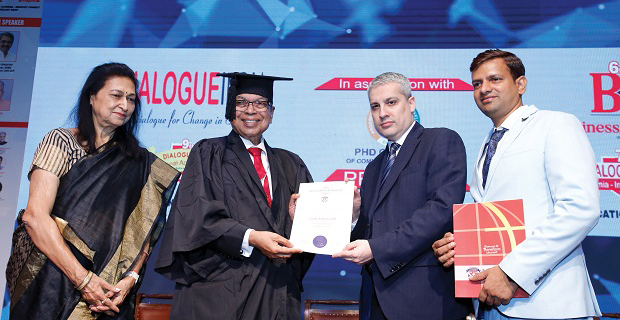
In 2023, Laha received an honorary doctorate in entrepreneurship from National American University in the United States. His academic involvement also included an adjunct visiting professorship at the Indian Institute of Finance. An October 2024 author biography described him as Professor of Practice at IIF Business School.
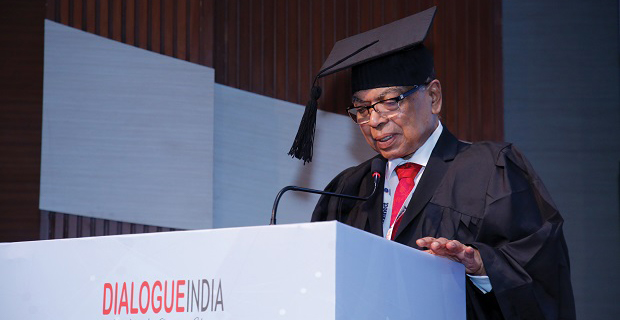
Teaching supplies another setting for the questions he had encountered in management. Experience becomes useful to someone else only when it can be explained. A career full of decisions is raw material; the work of turning it into a lesson still has to be done.
His writing on education makes his priorities more explicit. In October 2024, he argued for AI systems that could adapt learning to individual students and extend support where specialist teaching was scarce. He also wrote about continuous education for professionals. The underlying interest was access: who gets help, when they can get it, and whether instruction can respond to their needs. These were arguments for what technology might enable, rather than claims that every promised benefit had already arrived.
Robots, radio and the awkward question
Laha’s columns are livelier when they wander away from the executive vocabulary. In a 2017 piece on robots, he began with a satirical discussion of taxation and the film Enthiran. A robot’s cinematic troubles became an opening into questions about automation, employment and the uses to which technical knowledge might be put.
He considered the possibility that robotics could generate work as well as displace it, while worrying about people whose skills might no longer match available jobs. The interest lies in the tension he allowed into the discussion. A technology can produce useful new capabilities and leave difficult consequences for the people expected to adjust.
In December 2025, a video of old Radio Ceylon songs prompted another excursion. He recalled the appeal of the music and commentary, then traced changes in listening devices from radios through transistors to newer digital systems. The memory gave him a familiar starting point for a much less comfortable question: how widely have the benefits of technical progress actually spread?
By July 2026, he was writing about the pace of AI’s effect on work. His conclusion allowed uncertainty about where the relationship between people and machines would lead. For someone whose career began well before the current AI boom, that hesitation is instructive. Having watched successive technologies arrive does not oblige a person to pretend the next chapter is already settled.
The passenger who wanted his books within reach is still recognizable here. He has spent years building an enterprise, helping engineers speak and writing his way through new questions. The management handover supplies a date in the story. A closed notebook would be a much harder ending to imagine.
Read, watch, follow
Continue with Laha’s writing, interviews and professional profile.
- Asoke Laha on LinkedIn
- InterraIT website
- The 2024 founder interview and management transition
- The Competitive Edge: Laha on AI and education
- The Coming Saga of Robots
- Radio Ceylon and the priorities of technology
- Laha’s July 2026 AI column
- Watch: Laha explains the IACC roadmap
- Watch: currency devaluation and company planning
- The laptop rule that changed his travel plans
- The Toastmasters club at work
- The 2023 honorary doctorate ceremony