Ramesh Vayyavuru left his IT job in 2012. Years later, when he looked back on the decision, the lessons he chose to describe were accepting failure, persisting, and understanding what clients needed. For someone whose business sells software expertise, that is a revealing list. The difficult subjects had become people, judgement, and carrying on.
He founded Soft Suave with Manohar Vayyavuru. Today, the Chennai-based entrepreneur remains its founder and CEO, leading a business that develops software and supplies engineering teams to clients abroad. There is a company history here, with offices and an acquisition. There is also a more personal history of a specialist learning how many other kinds of work fit inside the word “founder.”
His own public reflections offer a way into that second story. A decision to leave employment can be reduced to a date on a professional profile. Living with the decision takes rather longer. By April 2024, Ramesh was describing entrepreneurship as a period of personal growth, with the customer's needs occupying a prominent place in his account.
The interesting question is what he kept learning after he had given himself a new job. A title arrives quickly. The education attached to it has a habit of extending the course.
A specialist acquires a second syllabus
Ramesh studied at Jawaharlal Nehru Technological University between 2003 and 2007. His later professional identity has stayed close to software: web and mobile applications, cloud services, and the teams that build them. Soft Suave's business places that expertise inside other companies' plans, where a development project has to answer to someone else's commercial priorities.
There is an appealing tension in that kind of career. Technical work rewards depth. Running a services business repeatedly introduces subjects outside a single technical specialism. A developer can understand how an application works while still having plenty to learn about why a customer wants it, how a team will deliver it, and what happens when expectations change.
Ramesh made his interest in continued learning explicit in October 2019. In an essay about weekly working hours, he proposed setting aside substantial time early in a career for developing knowledge and skills. He included learning within his definition of that time, rather than treating every hour as work performed for a company or a client.
His proposed schedule is open to argument. What makes the essay useful as a glimpse of its author is the attention he gives to acquiring expertise. He suggests deepening an existing skill or taking up another relevant one. For people considering entrepreneurship, his advice widens further: learn about the work of different departments.
“Diversify your learning into different departments.”
Ramesh Vayyavuru · advice to aspiring entrepreneurs, 2019
That advice suits the awkward promotion a founder gives himself. The engineer becomes responsible for a business whose problems refuse to remain in the engineering department. There is no requirement for a customer question to arrive wearing the correct departmental badge. The person in charge has to follow it wherever it goes.
Seen this way, his later emphasis on understanding clients fits alongside the earlier essay. Learning can mean mastering a technology. It can also mean hearing a business problem accurately before deciding which technology belongs in the answer. Ramesh's public account gives room to both.
Learn deeply. Learn across departments.
Accept failure. Persist. Understand the client.
The colleagues behind the anniversary
A founder's education also happens in the presence of other people. Ramesh's story has included Manohar Vayyavuru from Soft Suave's founding in 2012. The current leadership team lists Manohar as co-founder and CTO. Their shared business history is a firmer point of interest than any imagined account of a solitary entrepreneur doing everything himself.
The business they established initially served companies in the United States. A Maryland sales office followed in 2013, and a Bengaluru development branch opened in 2019. Those locations give the work a practical geography: development in India, relationships with customers elsewhere, and an organisation built to connect the two.
By August 2022, Soft Suave had an anniversary worth gathering for. Its tenth-year celebration took place at Hilton Chennai on August 20. Employees received awards for their work. The occasion put recognition inside the company alongside the outward-facing business of serving customers.
An anniversary is a useful interruption to the usual vocabulary of software services. A delivery model sounds tidy. A room full of colleagues is considerably less abstract. It brings the work back to the people who have to do it, learn it, explain it, and help the next person along.
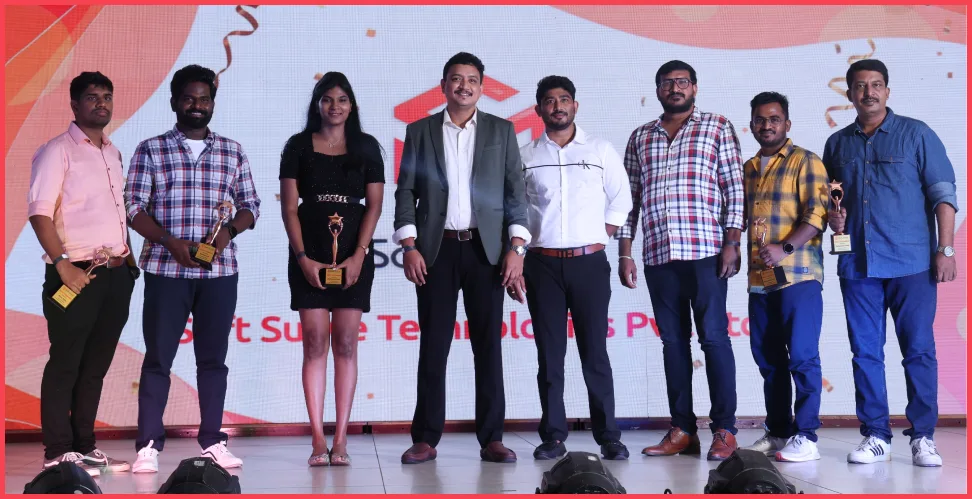
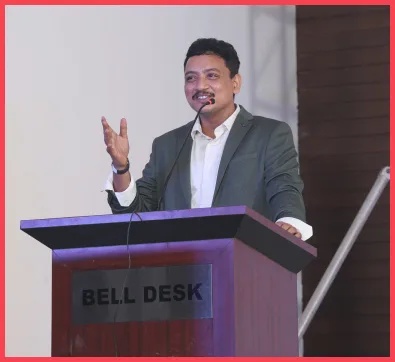
The eleventh anniversary, in 2023, took the company to Ideal Beach Resort in Mahabalipuram. Ramesh addressed the gathering. Dinner and a DJ session were part of the occasion, too. Software may be the reason everyone knows one another; apparently it need not be the evening's entire programme.
In his account of that celebration, he gave attention to the team and its managers. The names included Madhu, then a project manager, and Sudhendra Devi, then an HR manager. The detail matters because it spreads the work of building an organisation beyond its founders.
It also gives the story a scale that a headcount cannot supply. A company can report how many people it employs. An occasion like this shows the way it chooses to gather them. Ramesh's place at the microphone was one part of an evening arranged around the people who had helped the company reach another year.
A client relationship gets a skyline
Another glimpse comes from New York, well away from the anniversary lectern. In October 2024, entrepreneur Tim Maliyil publicly described Ramesh as a business partner who had helped him build AlertBoot. He was pleased that they had finally met in person.
Ramesh replied with thanks for dinner on the 100th floor, the city's views in daylight and after dark, and their productive discussions. It is a pleasingly specific detail in a professional life otherwise liable to be described through services and markets. The relationship had acquired a skyline.
The exchange supports a modest but meaningful observation: a collaboration can precede the meeting that makes it feel personal. Maliyil's acknowledgement concerned work already done. Ramesh's response looked forward to further conversations. Between those two remarks is a recognisable rhythm of international business, in which the people may meet after the project has already given them reasons to know each other.
For this profile, the episode offers something more useful than a polished client slogan. It names a collaborator and a product, and leaves a small human moment beside them. A founder who works across borders eventually appears in a particular room, thanking a particular host for the evening.
A different kind of next chapter
In December 2025, the company's ownership story changed. Soft Suave announced that KiwiTech had acquired a majority stake. Its announcement also said that Ramesh would continue leading the business. The founder's next chapter would take place within a wider organisation.
KiwiTech presented the alliance as a combination of its innovation network and product expertise with Soft Suave's engineering delivery capacity. The intended work included helping clients build, modernise, and expand digital products. For Ramesh, the stated ambition was to extend the reach and contribution of his engineering team.
The practical questions are substantial even when the announcement is brief. A company joining a larger business has relationships already in progress, colleagues with established ways of working, and customers expecting delivery to continue. Keeping the founder involved places someone familiar with that history inside the next stage.
- 2012Leaves an IT job.
Founds Soft Suave. - 2025KiwiTech majority
investment announced. - 2026Explores Maryland's
technology ecosystem.
The international conversations continued. In June 2026, Ramesh visited bwtech at the University of Maryland, Baltimore County, with Ramana Vinjamuri. Marjie Cota described discussions about the technology park's ecosystem, Soft Suave's US expansion plans, and Maryland's Global Gateway Soft Landing Program.
Ramesh thanked her for the welcome and expressed interest in exploring opportunities in Maryland's technology community. This was an exploratory meeting. Its interest lies in the activity itself: a founder learning about another business environment and the people who might help him understand it.
That brings the story back to the education he has written about. The subjects have widened from technical skills to customers, colleagues, partnerships, and places. There is still software to build. There are also more people to listen to before deciding what comes next.
There is a recurring feature in these episodes: other people have a place in them. Manohar appears in the founding story. Colleagues fill the anniversary photographs. Maliyil supplies an acknowledgement of shared work. Cota describes a conversation about possibilities in Maryland. Together, those encounters give the career a human outline. They also keep its ambitions attached to something observable: a business started, a gathering held, a collaboration remembered, a visit made. The next development will have its own practical details. Ramesh has already spent much of his working life moving between the technical problem and the person asking for help with it.
His reflections leave a useful record of that movement. They connect the decision to start a business with the less easily dated process of becoming responsible for one. The company can mark another anniversary while its founder is still finding new questions to ask about the work.
The 2012 decision gave Ramesh a company to lead. The years since have kept adding to the syllabus. For a founder who encourages learning beyond a single department, that seems an appropriately unfinished education.