Karthik Karunakaran helped finance his early entrepreneurial efforts by tutoring students for the Common Admission Test. There is something pleasingly practical about the arrangement: a management graduate teaching other people how to enter management school while finding the money to keep a business going. The future could wait until the bills were paid. It is a small episode, but it gives his career a more useful starting point than a corporate title.
Today, Karunakaran is the CEO and co-founder of Mobius Knowledge Services and the founder of Xtract.io. Friends call him KK. His work sits in a part of the technology economy that rarely supplies a glamorous photograph: making unruly information useful. A business may possess plenty of data and still struggle to get a dependable answer from it. He has spent years working on that gap.
The tutoring belongs to a period when he was bootstrapping. An earlier education venture had fallen short of his expectations for scale. That detail matters because it keeps the story honest. His route into knowledge services involved an education business, financial improvisation and another attempt. The polished job description came later. The practical obligation to make something work was there much earlier.
A return ticket to Chennai
The route began with production engineering at NIT Tiruchirappalli and management studies at XLRI Jamshedpur, with a focus on marketing and finance. He then worked at Tata Steel in Kolkata and Delhi, gaining experience in quality processes and sales. Those are two revealing disciplines to carry into a data business: one asks whether an output is dependable; the other asks whether somebody needs it enough to buy it.
His interest in starting a company had roots in his student reading. He has identified the writing of M. S. Udayamurthy and a biography of J. N. Tata as early influences. Entrepreneurship was already an ambition before it became an occupation. He returned to Chennai, his home city, and began working with old college friends on business ventures.
By 2014, he had a compact phrase for the relationship he wanted with employees: “Grow and Help Grow.” It was a reciprocal proposition, linking the company's development to the skills and careers of the people doing its work. Placed beside his earlier experience in quality and sales, the phrase suggests a practical question that runs through the career: what has to improve around a person for that person to do better work?
Grow and Help Grow.
Karthik Karunakaran · 2014
The internet needed a tidy-up
One of Mobius's earliest projects, around 2002, involved normalizing product data for Epinions, the comparison shopping business. It is an apt beginning. Comparison sounds simple until the things being compared arrive in different formats, with inconsistent descriptions. Before a customer can make an informed choice, somebody has to put the information into a form that allows a sensible comparison.
This was work on the internet's plumbing. The consumer sees a product listing; the service behind it has to make the information coherent. Mobius developed its business around researching, collecting and preparing internet data, eventually serving customers across several industries and countries. Gautam Dalmia is identified alongside Karunakaran as a co-founder.
The company's current portfolio includes data management, digitization, analytics and services for retail and real estate. That range can make a founder's story look sprawling. The early Epinions assignment supplies a clearer thread: information arrives in an inconvenient form, and a business needs to use it. The tools and customers change. The underlying task remains recognizable. In Karunakaran's case, the arrival of AI gives an old commercial problem a new set of instruments.
- CollectFind the information
- PrepareMake it consistent
- UsePut it into a workflow
Four ways to organize a working day
In June 2020, Karunakaran described a company that had grown from five employees to about a thousand, with roughly eighty customers worldwide. Those figures belong to that moment. More revealing than the headcount was the management problem he set himself: how could different kinds of work be distributed without assuming everybody needed the same workplace?
His framework used two axes: established employees versus freelancers, and corporate offices versus remote locations. It made room for core office teams, neighborhood micro offices, partner teams and crowdsourced tasks. Work involving close collaboration or strict security could remain in central offices. Other assignments could move closer to the people equipped to do them.
He described micro offices and franchise arrangements as pilots, with policies still requiring work. That distinction gives the proposal substance. Hiring, training, performance assessment and collaboration all needed reconsideration. A diagram could suggest four tidy boxes; operating them would be messier. For a data company, the organizational chart was becoming another design problem. The practical question was where each task could be done well, and what support would make that possible.
An hour from the nearest city
The idea of moving work closer to talent becomes tangible in MoPower, a joint venture between Mobius and VilPower established in 2022. After a visit, Karunakaran described a team working an hour from the nearest city, with women making up 95 percent of its workforce. The percentage describes that team at the time of his account; it should not be mistaken for a current figure for the entire Mobius group.
His partner, Ezhilvanan Arunachalam, described a relationship that had developed over years of delivering projects before becoming a joint venture. The work included document digitization, web research, ecommerce support and lease processing. It was ordinary business work being performed somewhere that a conventional office-location strategy might overlook.
The appeal of the example is its specificity. Inclusion has a location, a team and customer assignments. Karunakaran has also advocated flexible work and career continuity for women. At MoPower, those concerns meet the operating business. The question becomes whether processes, training and relationships can support a professional career where the employee already lives. That is a more demanding proposition than placing a welcoming sentence on a recruitment page.
Reported by Karunakaran after a 2025 visit. This figure applies to that team at that time.
A new office, an old obligation
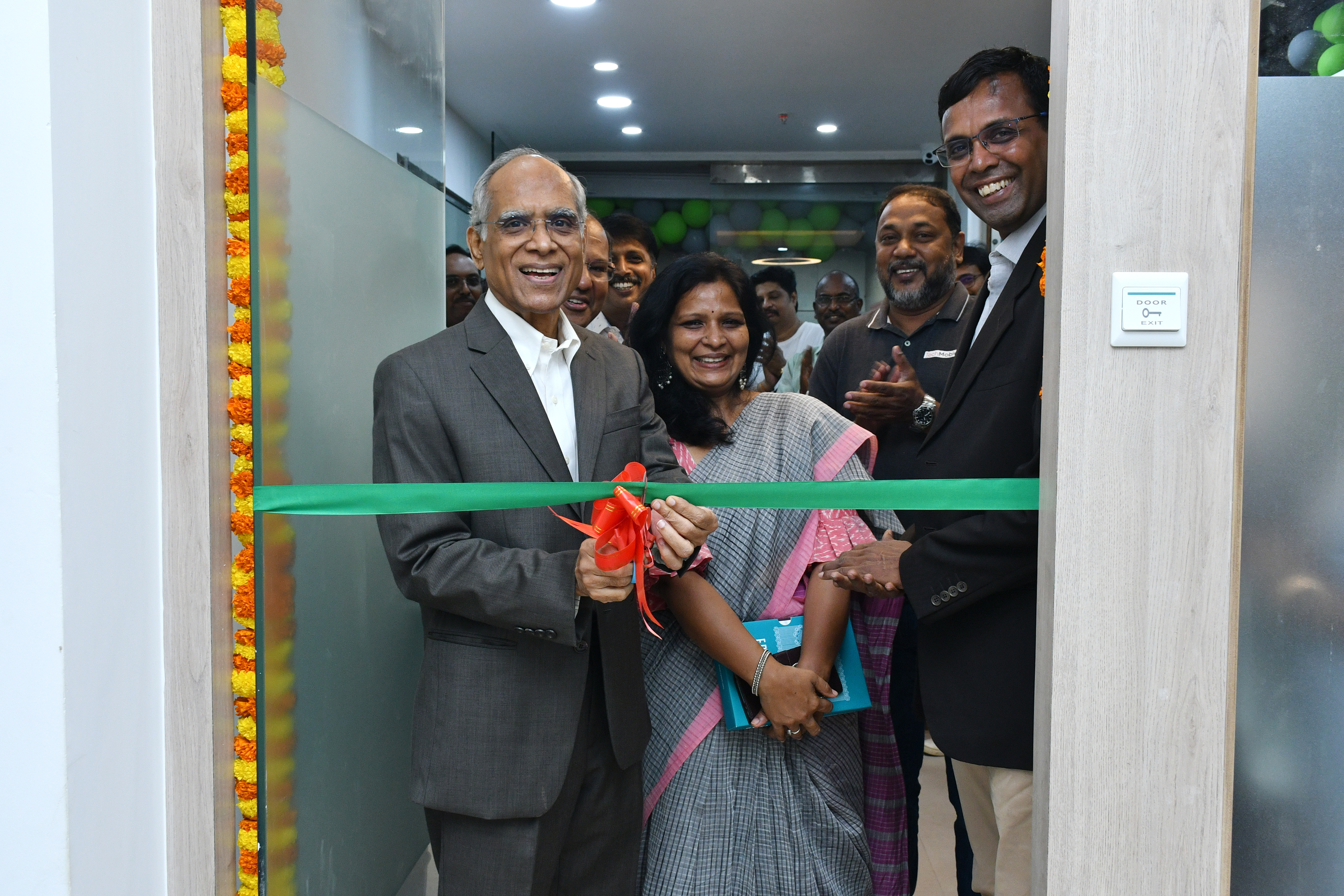
At the opening of Xtract.io's Chennai office in 2024, Karunakaran lit a ceremonial lamp. Cognizant co-founder Lakshmi Narayanan attended as chief guest. The photograph captures a familiar business ritual, flowers and all, surrounding a venture aimed at automating knowledge work. Even a company dealing in the future begins with people gathering in a room.
Xtract.io was presented as a spin-off from Mobius, with an office designed for more than 200 employees. Its flagship offering, the Xtract Data Automation Suite, or XDAS, brings data and workflow automation together. The connection to the older services business matters: a software product can draw on the repeated problems encountered while delivering services.
The product's public description includes generative AI, retrieval augmented generation and integrations with existing systems. The language can become dense rather quickly. In everyday terms, the ambition is to help organizations put their information to work inside an operating process. The office opening marked a new setting for that effort. It also put a human scene around software usually explained with architecture diagrams and acronyms.

Getting AI out of the demonstration room
By June 2025, Karunakaran was describing a change in conversations at a Gartner Data & Analytics conference in Mumbai. Businesses were interested in generative AI, but many were struggling to move experiments into routine use. He treated this as a familiar delivery problem, one he had encountered during years of providing data services.
His emphasis was on preparing information before handing it to a language model, reducing noise, standardizing inputs and keeping expert quality checks in the process. That sequence is less theatrical than a surprising answer generated onstage. It is also closer to what a customer must rely on when an automated process runs repeatedly.
His ambition now includes putting AI into customers' production workflows, with eComNeo forming part of the retail offering. The emphasis on actual use gives the newer work a connection to those early product-data assignments. A demonstration earns attention once. An operating service has to justify itself again the next day. That recurring obligation is where his experience becomes relevant: he has been selling dependable outputs since long before generative AI supplied the fashionable vocabulary.
The next job still needs an owner
His hiring language brings that preference down to earth. In a public search for a commercial leader at Xtract.io, Karunakaran grouped business development, partnerships and marketing under one accountable owner. He wanted someone comfortable doing the work directly, with an understanding of AI products and the ability to build customer and partner relationships. It was a revealing list of expectations from a founder whose own career has crossed technology, sales and operations.
He also returns to the institution where he studied. At NIT Tiruchirappalli's Genesis event in September 2023, he joined an alumni panel hearing students' startup ideas. The encounter places him on the other side of the entrepreneurial question he once faced: how does an ambition become something that can survive outside the classroom?
In October 2025, CII recognized him with an Entrepreneur of the Year award, an achievement Mobius celebrated in its year-end account. Recognition supplies a date for the timeline. The tutoring episode supplies something more personal: a founder finding useful work to support the work he hoped to build. Across education, internet data and AI, Karunakaran's story keeps returning to that practical test. There is an idea. There are people available to help. Then comes the less photogenic business of making the arrangement earn its keep.
Continue the conversation
Writing, conversations and the businesses behind the story.