The insurer wanted a rather ordinary thing. A policyholder should be able to open a portal and see the status of a claim. Instead, that simple answer was stranded among legacy systems. According to an Infoworks case study, the company had spent two years on an on-premises big data strategy and was still fighting manual integration, slow access and a data engineering team spread across multiple tools. An impressive diagram of a future system had become a poor substitute for a current answer.
This is the sort of problem Infoworks was built to solve. Founded by Amar Arsikere in 2014, the Palo Alto company sold automation for the journey from raw enterprise data to something a business could actually use. Its software crawled sources, ingested and synchronized records, assembled transformations, ran workflows and kept track of what happened. The customer could then feed a dashboard, a data science platform or, later, an AI application. By December 2024, Uniphore had announced it was acquiring Infoworks and another data company, ActionIQ, to strengthen the data layer of its enterprise AI platform.
- DataFoundry handled the pipeline from source to usable data.
- Replicator handled the especially awkward move from Hadoop to cloud.
- A published insurer case reports 30% less data onboarding effort.
- Uniphore bought Infoworks for the data work beneath its AI ambitions.
01The claim that could not reach the customer
The insurer's complaint had two faces. For customers, the claims portal could not easily provide the information they wanted, sending more people to the support center. For the engineers, the data lived in separate on-premises environments and had to be combined by hand. A portal team cannot make a good status screen out of data that arrives late, or differently, every time.
Infoworks' answer was an enterprise data hub on Amazon EMR and S3. The software brought on-premises data into AWS, transformed it for analysis, synchronized and cataloged it, then published curated sets to a cloud warehouse and third-party data science tools. The case study says Infoworks was tied to another product to tokenize sensitive personal information before ingestion. Claims 360 and Operations 360 were among the use cases it enabled. These are not household brand names; they are the working labels of people trying to make a policy, a claim and a customer visible in one place.
Figures come from Infoworks' published case study of an unnamed top US insurer, not an independent audit.
The route by which information became available failed first. The company changed course after two years of on-premises work left business users waiting. The reported 30% reduction in onboarding effort describes a narrower benefit than “transformation,” and a more useful one: fewer engineer hours spent getting the next source ready.
02The factory between databases and decisions
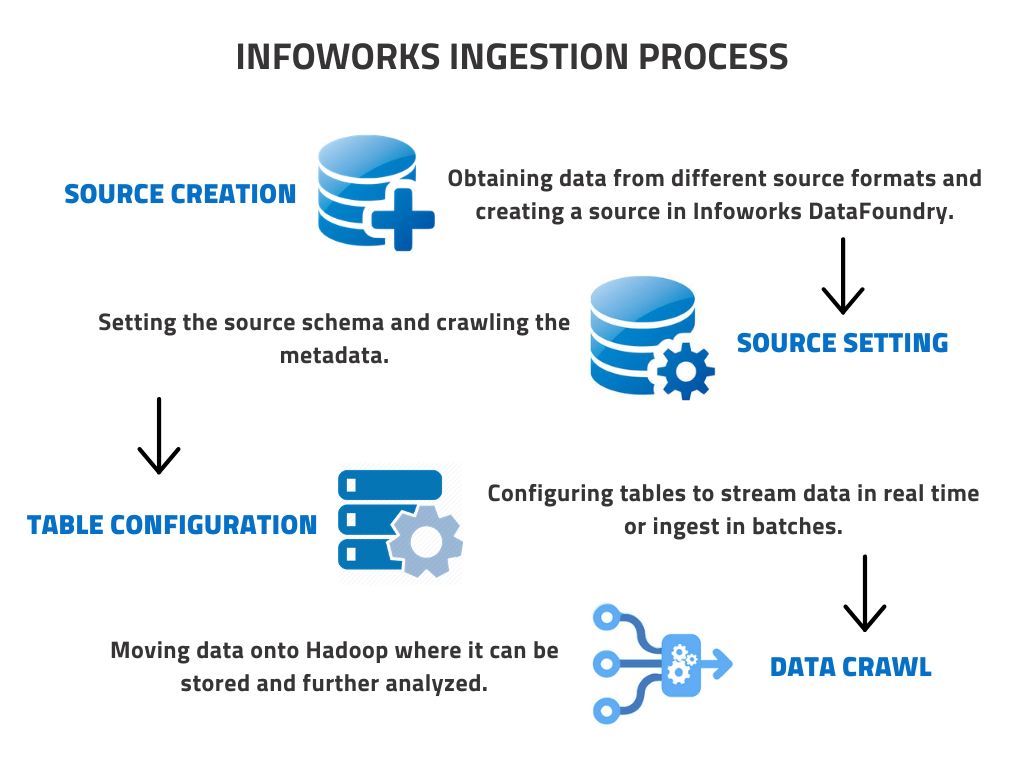
DataFoundry was Infoworks' broad answer. Its product documentation describes automated source crawling, data and metadata synchronization, transformations, orchestration, lineage and production management. It could read files and relational databases, infer relationships, show where a field came from and manage workflows after the original builder had gone home. It made the passage through old and new systems less artisanal.
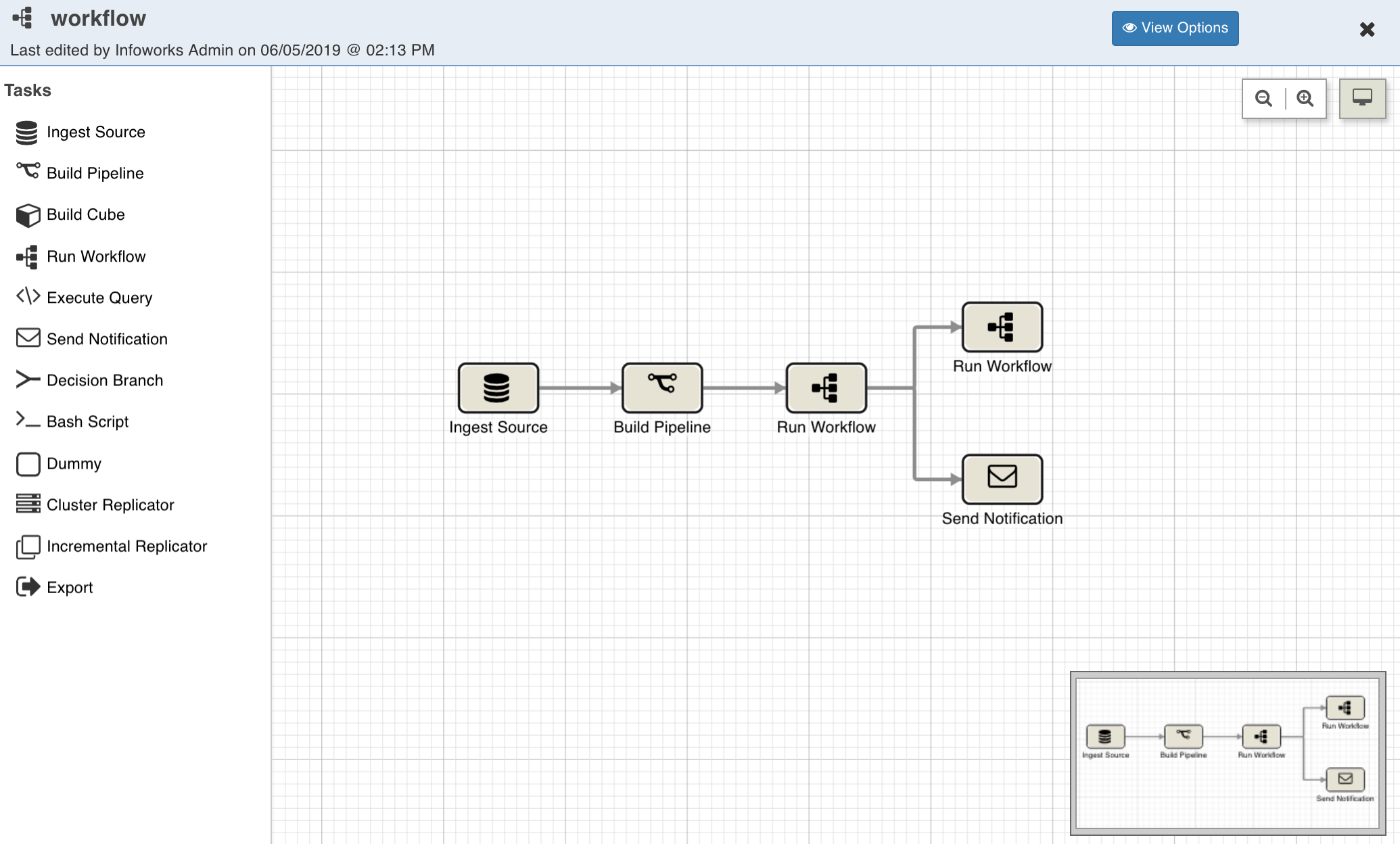
Its workflow editor reveals the company's view of the job. A user could place tasks for ingesting a source, building a pipeline, running another workflow, sending a notification or making a decision on a canvas. That is still engineering; the dependencies, permissions and data quality decisions do not disappear. But the repeated scaffolding is turned into a visible, operable system. A specialist can see a failed stage instead of hunting through a tangle of scripts.
For the organization buying it, the model was enterprise software deployed into its data estate. Its buyers were data teams with serious existing infrastructure. A real budget would include the software, the cloud compute and storage underneath it, security work and the people who know the source systems. In the insurer's case, the clearest cost signal was labor: it reported less effort spent onboarding data.
03The migration has to keep moving
Infoworks also sold a more specialized tool, Replicator. Hadoop migrations are peculiar. A company may move a mountain of historical data, but the mountain keeps growing while the move is under way. Replicator copied data and metadata, kept source and destination in sync, recovered from faults and validated what arrived. In 2022 Infoworks said version 4.0 could move on-premises Hadoop lakes to the cloud three times faster with one-third the resources of traditional approaches. That is a vendor claim, not a universal conversion factor.
The product grew more precise in June 2024, when Infoworks added Databricks Unity Catalog integration. Migration could now include cataloging data and metadata within Databricks in one step. This sounds small until a team finishes moving terabytes and discovers that nobody can tell which tables are trustworthy. A copied file is not, by itself, a usable asset.
“Automation is essential to the success of any large-scale data migration.”Amar Arsikere, Infoworks co-founder and CTO, 2022
A buyer could also assemble specialist products, cloud-native services and custom pipelines maintained by an internal team. Infoworks' differentiation was its attempt to automate the entire route, particularly when the route crossed Hadoop, legacy warehouses, multiple clouds and a production operations team. A company with one tidy source and a small analytics need might find that machinery excessive. A company with hundreds of changing tables, governance obligations and a migration deadline could see the appeal quickly.
04Why an AI company bought the plumbing
Uniphore's December 2024 announcement described Infoworks as bringing an enterprise data platform and intelligent data agents that could discover, identify, organize, catalog and clean business data with little human supervision. ActionIQ brought a composable customer data platform. Together they became part of Uniphore's proposed “Zero Data AI Cloud,” a system meant to let enterprises use existing data landscapes for AI without a giant replacement project. The acquisition was announced in December 2024, despite a later date sometimes attached to summaries of the company.
The chronology explains the market position. Infoworks began in the big data era, when getting Hadoop into a working analytic system was the immediate headache. Its later products addressed moving that estate into cloud platforms. Uniphore's acquisition placed the same capability beneath a newer demand: AI applications that need a reliable map of enterprise data. The slogan changed. The data still had to be found, checked and delivered.
There is a practical lesson here for any team tempted to begin with a clever interface. Pick a question people already ask - “Where is my claim?” works beautifully - and trace every table and workflow required to answer it. Measure onboarding effort and time to a usable answer, not just how quickly a demo can be assembled. If the sources are few and stable, simple tools may suffice. If the data is distributed, changing and regulated, invest in repeatable ingestion, validation and ownership before asking a model to speak for it. The glamorous layer can wait its turn.
05Keep exploring
The product lives under Uniphore now, while older Infoworks documentation remains a useful map of how the platform worked.