In March 2017, a group of Chennai entrepreneurs gathered at the Park Hyatt to discuss artificial intelligence. The programme was called AI 2.0. Its subjects included chatbots, recommendation engines and digital assistants. Vinod Krishnan was then presiding over the Chennai chapter of the Entrepreneurs’ Organization. The chapter’s theme that year was “Escape the Ordinary”. Even the ordinary, it seemed, was about to require a software update.
There is something useful about that date. It places Krishnan’s engagement with AI years before the current rush to put a conversational interface on almost everything. He was already helping create a room where business owners could learn what the technology might mean. Learning, in his professional story, keeps turning up beside the business plan.
Today, as managing director and CEO of TVS Next, he works on a problem with less novelty and considerable staying power: getting people, information and machinery to work together. His career runs through enterprise software, manufacturing customers, entrepreneurial networks and a remarkably practical view of culture. Follow those threads and a pattern appears. Krishnan pays attention to the places where work passes from one pair of hands to another.
A start date before the current vocabulary
The early chronology has a pleasingly unglamorous anchor: 3 November 2005. That is the employment commencement date recorded for Krishnan at TVS Infotech. The company’s later filing lists a master’s degree in business administration and names Maxonic Inc. as his previous employer. It is a business career rooted in the work of serving enterprises, long before AI became the compulsory guest at every technology presentation.
By March 2007, he was speaking as TVS Infotech’s managing director about expanding a team of 250. The ambition was to reach roughly 500 by the end of that year. Those figures describe a plan at the time. They also reveal the scale of the operating challenge: recruiting people, establishing delivery capability and finding customers who would trust a growing team with consequential systems.
The company was a Sundram Fasteners subsidiary, with development operations in Chennai. Enterprise resource planning, including SAP services for smaller businesses, formed part of its offering. Here was software with an industrial address. Orders, inventory and production were everyday concerns. A system’s value depended on the business being able to use it.
In 2010, Krishnan was discussing expansion into Saudi Arabia, Oman, the UAE and South Africa. The customers in view included mid-sized businesses in emerging markets. That chapter matters because it broadens the picture of his work: enterprise problems travelled across borders, while the commercial circumstances changed from market to market. An expansion map could be drawn quickly. Earning a customer’s confidence would take longer.
Joins TVS Infotech on 3 November.
Discusses scaling a 250-person team as managing director.
Presides over EO Chennai during its AI 2.0 learning event.
Publishes an essay on culture and lasting business results.
Explains the manufacturing problem behind NexOps.
The inheritance he talks about
When Krishnan speaks about TVS heritage, his emphasis falls on responsibility. In a filmed conversation about the company’s direction, he describes inheriting a reputation for reliability, integrity and quality. He points to total productive maintenance, total quality management and disciplined execution. These are working habits with a longer history than today’s software vocabulary.
For a technology executive, that is an interesting inheritance to choose to discuss. The exciting part of a new tool is usually what it makes possible. The industrial question arrives immediately afterwards: will it work dependably, inside an operation that must continue tomorrow? Krishnan connects his vision for TVS Next to that older discipline.
His account of the company’s beginnings follows the same route. TVS Next first helped group companies on their digital journeys, then widened its customer base. In one fireside conversation, he put the number of customers served at more than 80. It was a statement made at that point in the company’s development, and an indication of how work inside the group had opened into a broader business.
Who owns the space between two teams?
Krishnan’s 2023 essay, Why Culture Always Trumps Strategy, offers another view of the operator behind the title. He organises his argument around purpose, ownership, learning and appreciation. These are familiar words. The revealing detail is his concern with ownership when a task leaves one team and moves to another. Does the first team hear what happened afterwards? Does responsibility survive the transfer?
He also describes recognition through “Spotlight on Excellence” awards and cash prizes as an approach that has worked in his leadership at TVS Next. His argument makes room for modest, repeatable acts: explain the purpose of the work, keep people informed, help them learn, acknowledge progress. A strategy document can be delivered in an afternoon. These habits need another appointment tomorrow.
That concern with continuity offers a way to read his later product thinking. A handoff can lose context whether it happens between colleagues or computer systems. In both cases, someone may complete an assigned task while the larger outcome remains unresolved. The connection is an editorial reading of his work, but the recurring question is concrete: what happens next?
“The technologies will continue to change. The principles behind how we build never will.”
Vinod Krishnan
The factory has information. Now what?
In August 2026, Krishnan described repeatedly encountering manufacturers whose digital investments had left operational decisions fragmented. The individual systems existed. Their information and knowledge remained separated. His team had addressed the issue through consulting engagements before building NexOps as a repeatable manufacturing intelligence platform. The repetition of the customer problem helped determine the shape of the product.
His diagnosis was concise: manufacturers needed better decisions. NexOps was designed to connect existing systems, add operational context and bring AI into daily work. He described its intended direction as an open platform on which customers and partners could build industry-specific capabilities. That ambition keeps the customer’s existing investments in the picture.
The practical attraction of this approach is easy to understand. An enterprise has accumulated processes, equipment and knowledge over years. Any new platform enters that established world. Krishnan’s proposal asks how the parts can cooperate more effectively. It is a patient question in a business frequently tempted by the pleasure of beginning again.
- 01 / ConnectBring operational and enterprise systems together.
- 02 / ContextualizeCombine data with domain knowledge.
- 03 / DecideDevelop insights for operational decisions.
- 04 / ActCoordinate workflows and actions.
- 05 / ImpactAssess the business outcome.
A process diagram, not a performance forecast.
An ecosystem needs more than introductions
In another filmed discussion, Krishnan names Snowflake and Microsoft when explaining his approach to partnerships. He talks about helping customers unify information, extract insights and scale securely. The emphasis is on a shared job. A partnership announcement is easy to frame for a wall; making the technologies cooperate requires rather more attention.
Microsoft’s account of TVS Next’s NexAA platform shows another application of that thinking. The platform connects with HR systems to support employee interactions and career development. Krishnan describes the collaboration in terms of productivity and talent. It extends his enterprise interests beyond the factory, into the everyday experience of the people inside an organisation.
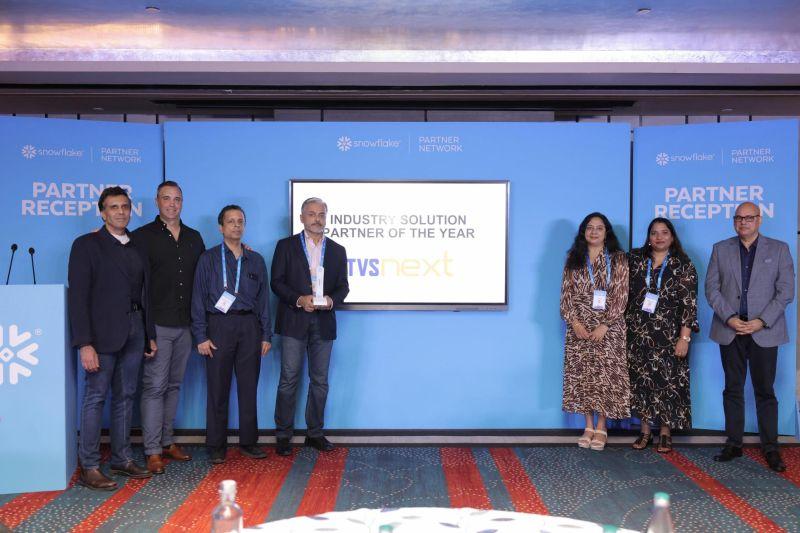
By September 2026, the Snowflake relationship had produced a public occasion for the team. TVS Next announced recognition at Snowflake World Tour Bengaluru with the Industry Solution Partner and Data Driver awards. Krishnan received the recognition alongside Rupa M, who leads Data & AI, and marketing director Asha Hariharan. The photograph supplies a welcome change of scene from architecture diagrams: colleagues standing together, holding something tangible.
The room beyond the office
His entrepreneurial connections provide another setting for the same interests. Krishnan has been a TiE charter member and a member of the Entrepreneurs’ Organization. His public speaker biography describes mentoring and supporting entrepreneurs and startups. These activities put him among people asking how to build a business, as well as those asking how to modernise one.
The 2017 AI evening makes that involvement specific. EO Chennai then had 79 members, and the chapter had held 14 events that year under its chosen theme. Speakers for the AI programme included Microsoft’s Annie Mathew and Haptik’s Ashim Jolly, with entrepreneur Rajesh Nahar moderating. It was a gathering designed to help business owners understand a developing field.
In October 2025, the programme for the Chennai launch of P R Krishnan’s Being Ordinary, Doing Extraordinary listed him on a discussion panel with Lakshmi Narayanan, Ravi Viswanathan and Rajani Seshadri. The setting fits this part of his public life: business leaders meeting around ideas and experience, with time reserved for questions. Even executives occasionally need to sit on the listening side of the table.
The next decision
Looking back on 2025, Krishnan described a year of learning and doing: AI accelerators, new partnerships, a wider client base and additions to the leadership team. TVS Next’s first-half 2026 update carried those interests forward with NexOps.ai and an expanded AI Center of Excellence. His agenda has continued to develop through products, people and outside collaborators.
The thread through these chapters is practical. A young enterprise-services operation needs people who can deliver. An employee needs to know what happened to the work they handed over. A manufacturer needs information that helps someone decide. Krishnan’s story keeps returning to the connections that make those things possible. The next useful question may be waiting in the gap between two boxes on the chart.