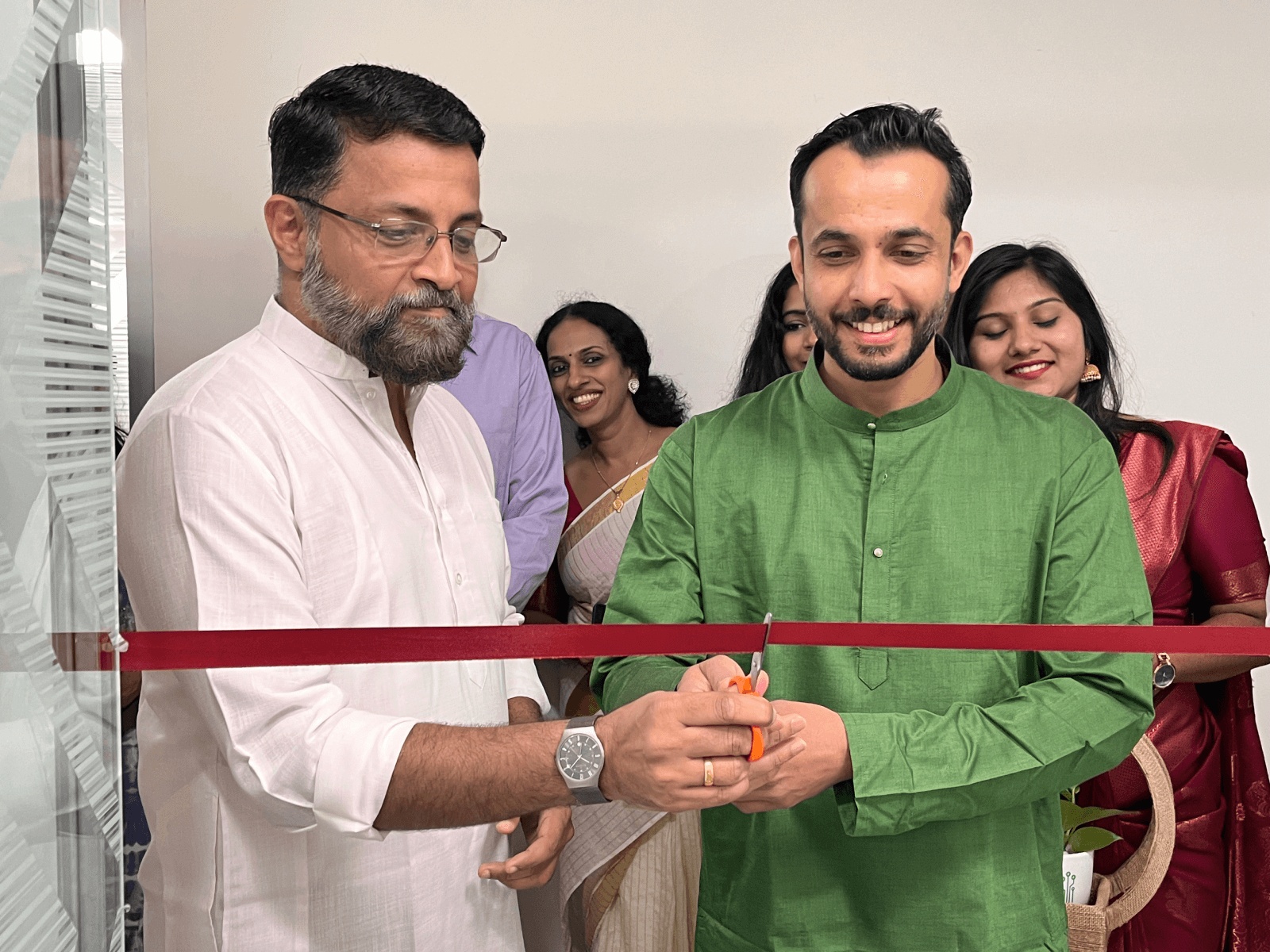
A red ribbon stretches across a doorway in Thiruvananthapuram. On one side stands Col Sanjeev Nair, Technopark’s chief executive. Beside him, smiling in a green kurta, is Sivakumar Thekkenaduvath. Their hands meet around a pair of scissors. Software companies usually announce their ambitions in slides. On September 5, 2024, Gritstone Technologies had a doorway to show for its plans.
The new office was in the Kabani building at Technocity, Technopark’s fourth phase. Gritstone already had operations at Government Cyber Park and UL Tech Park in Kozhikode. Employees and family members attended the opening. That last detail gives the occasion its human scale: a company can describe an expansion in square feet, but the people gathered around the ribbon make a different kind of record.
For Thekkenaduvath, Gritstone’s founder and CEO, the opening brought a business founded in the United States further into Kerala, where he was born. His career crosses engineering, enterprise software, commercial management and education. Follow those interests together and an intriguing question emerges: what happens in the distance between having an idea and being able to put it to work?
The education before the company
His academic training was in electrical engineering: a bachelor’s degree in electrical and electronics engineering from the University of Calicut and a master’s degree in electrical engineering from the University of Kerala. The combination is a useful starting point for a career that would eventually involve both building technology and running the organizations around it.
The early professional chapter began at KRAN Consulting. As a technical team lead, he worked on eGovernance problems during the internet’s earlier years. Government software puts a particular kind of demand on an engineer. A system must make sense beyond the people who wrote it. Procedures, institutions and users all have a vote, even when they have no seat in the development meeting.
At UST Global, his responsibilities moved through engineering leadership and delivery management into strategic account management, including pursuing Fortune 100 clients. The progression matters. Engineering asks whether something can be built. Delivery asks whether a team can get it done. Account management introduces the person who must decide whether any of it is worth buying. A working career can supply a fairly demanding business education.
He later worked at Vanguard on enterprise platform transformation, with strategy and execution responsibilities in its retirement and international businesses. A client partner role at Mphasis also forms part of his career. These were roles inside established organizations, where new software has to coexist with the systems, obligations and expectations already in place. The elegant diagram has to survive contact with Tuesday.
- KRANTechnical team leadership
- UST GlobalEngineering, delivery, accounts
- VanguardEnterprise platform transformation
- MphasisClient partnership
- GritstoneCompany and product building
The awkward life of a good idea
Gritstone dates to 2016. Its business is product engineering: taking proofs of concept into products and platforms ready for the market, then helping those products scale. The distinction sounds technical until you have used something that worked beautifully in a demonstration and less beautifully when you needed it. A demonstration enjoys unusually cooperative circumstances. Customers tend to bring their own.
The company’s stated methods include design thinking, user research, lean and agile development, and checking product-market fit. Its services span product development, cloud and mobile engineering, interface design, DevOps, Kubernetes, artificial intelligence and analytics. These are the disciplines around the central promise. They address how something is designed, released, maintained and changed once people begin depending on it.
That collection of responsibilities suits the range of Thekkenaduvath’s previous work. There is a commercial problem alongside the engineering problem: a product needs an audience and a reason to exist. There is also an organizational problem: the people building it need a way to make decisions together. His role at Gritstone encompasses business strategy, sales, product direction, culture and operations.
A founder’s title can compress a remarkably untidy job. In this case, it covers both deciding where the business should go and helping maintain the systems that keep it moving. Those responsibilities give the profile a more useful shape than the familiar picture of an entrepreneur struck by one excellent idea. There is a substantial amount of coordination between inspiration and the invoice.
“Grateful to be part of purpose-driven organizations and amazing teams.”
Sivakumar Thekkenaduvath, LinkedIn profile
A company vocabulary with room for revision
Gritstone’s public values include accountability, transparency, curiosity and compassion. Under constant learning, it uses the phrase “infinite beta.” It is a small, rather appealing admission for a technology company: learning does not come with a final release date. The phrase also supplies a useful way to read a career that moves between technical, commercial and executive responsibilities.
Values become interesting when they suggest a practical question. Accountability asks who owns a decision. Curiosity asks whether the problem has been understood. Transparency asks whether the people affected can see what is happening. Those are tests a reader can apply to any organization. A list on a website gives the organization a vocabulary; its daily decisions must give the words substance.
Thekkenaduvath’s own short introduction on LinkedIn emphasizes gratitude and teams. It is a modest sentence beside the length of his professional history. Read alongside Gritstone’s stated values, it puts collaboration near the center of his public presentation. The engineering company, the customer relationship and the educational initiative all involve other people doing work that a founder cannot perform alone.
More doors in Kerala
The Technocity opening made the organizational work visible. Gritstone’s chief operating officer, Premjith Alampilly, attended, along with Technopark marketing and customer relationship executive Vasanth Varada. Nair performed the inauguration. Around them were the employees and families whose presence turned an office announcement into a shared occasion. The photograph records a business milestone without requiring a stock image of a handshake.
The location adds another layer. Gritstone’s Indian operations already included two technology parks in Kozhikode. The new office extended that presence to Thiruvananthapuram. For a US-founded company with a founder born in Kerala, the map joins places that can otherwise appear in separate chapters of a professional biography. The engineering business has an American base and a tangible working geography in India.
Expansion is easy to describe as a line climbing upward. This particular moment is better understood as a set of relationships: a park offering space, a company establishing a workplace, colleagues taking responsibility for it, and families coming to see it open. The ribbon is brief ceremony. The useful story begins when the doorway becomes an ordinary entrance to work.
EDUS Foundation co-founded
Gritstone’s US beginning
Technocity office opens
The other distance: learning to earning
The education work precedes Gritstone. In 2009, Thekkenaduvath and his wife co-founded the EDUS Foundation, with a focus on children’s education and employability in India. He also founded the Planck Epoch Institute of Professional Studies. That institution addresses preparation for work as artificial intelligence changes the demands placed on people entering the job market.
Planck Epoch advertises practical training, mentoring, interview preparation and career guidance. Its listed six-month programs include AI and machine learning, Python, data science, game development, blockchain and digital marketing. The emphasis is on doing: projects and experience sit alongside instruction. It places professional preparation close to the work itself, where learners must use what they have been taught.
The program list is broader than programming alone. Digital marketing appears alongside Python and data science; career planning and interview skills appear alongside technical instruction. That range gives the institute’s stated approach a practical shape. Preparing for work can involve explaining what you know, discussing a project and understanding where a skill might be useful. The published offering brings those activities together rather than treating the technical syllabus as the whole preparation.
There is a connection here worth considering. Product engineering concerns the passage from a promising demonstration to something people can use. Professional training concerns the passage from studying a subject to being able to work with it. The two passages have different stakes and methods. Both require attention to the difficult middle, where knowledge meets a task with consequences.
A course title cannot do that work by itself. Neither can a founder’s aspiration. Practice, feedback and access to opportunities matter because employability has an audience: someone needs to trust a person with a job. This is what makes the educational chapter relevant to Thekkenaduvath’s business story. It concerns the people who might eventually help build the products, rather than only the products themselves.
What comes through the next door
His ventures have also included co-founding BrokerQuoter and MonsterQuoter in 2019, connecting employers, brokers and professional employer organizations. His executive experience includes VensureHCM and Vensure Employer Services. Across these roles, software remains connected to the organizations and working relationships around it. The application is one part of a larger arrangement of people, decisions and responsibilities.
In 2024, he received inclusion in Marquis Who’s Who. His stated ambitions that year included expanding access to technology and AI education through ventures in the United States. That aspiration sits comfortably beside the education work in India. It gives the next chapter a concrete question: who gets the opportunity to learn the tools that are changing work?
Return to the doorway in Technocity. The photograph offers no forecast. It gives us a founder, his colleagues, a park chief and a ribbon about to stop being an obstacle. After years spent moving among engineering, customers and company leadership, Thekkenaduvath is opening another place where those activities can meet. For a career concerned with putting things to work, an open door is a fitting image.