A merchant has a perfectly serviceable online store. The photographs are uploaded. The inventory has been counted. Then someone suggests selling through another network. Suddenly, the same products need another vocabulary, another route to the customer, another way of dealing with an order that goes wrong. Wits Innovation Lab has built a product for precisely this awkward moment: an adapter connecting Shopify stores to India’s Open Network for Digital Commerce, or ONDC.
- Wits builds custom software and supplies engineering capacity for business clients.
- Its Shopify adapter connects an existing store to ONDC.
- Its MarbleX collaboration puts that open-commerce interest in a real artisan storefront.
The store stays. The connection changes.
The adapter is a useful place to begin because it gives a sprawling technology company a manageable shape. Wits describes onboarding, inventory synchronization and compatibility with existing customer-management systems. The proposition is understandable: preserve the store a merchant already operates while adding a connection to a wider commerce network. The merchant’s previous investment becomes the starting point.
Read the company’s technical walkthrough and the work becomes less abstract. There are cryptographic keys, additional product fields and a mechanism for passing complaints to sellers with identifiable records. Those details have none of the glamour of a new shopping app. They matter because commerce depends on agreement: what an item is, whether it is available, and who must respond when a customer objects.
and stock records
and connect workflows
connected buyer apps
There is a limit to what a connector can promise. Reaching a network creates an opportunity to be discovered; demand still depends on the merchandise, pricing and service. For a merchant, that distinction should shape the buying decision. Integration is a piece of distribution infrastructure. Treating it as a sales forecast would give the software a job it cannot perform.
The product is also the team
Wits sits in the market for technology consulting and outsourced product engineering. Its company profile describes customers ranging from startups to enterprises, across sectors including finance, healthcare, retail and logistics. Its service mix includes custom applications, experience design, staff augmentation, testing and operations. A buyer can bring a software project, a staffing shortage or a collection of systems that need to cooperate.
That is a services business with a practical commercial proposition: access to several disciplines through one engagement. The comparison is with assembling an internal team, hiring specialists separately, or adapting an existing software package. Each route buys a different balance of control, coordination and continuing responsibility. Wits’s broad menu makes most sense when the problem crosses several of those disciplines.
The company’s published customer testimonials name Earn Alliance, Affinidi, Herbalife, ChapterX and 9Yaps. Their comments emphasize execution, communication and working across teams. These are customer accounts selected by the vendor. Still, the pattern suggests a sensible question for prospective buyers: how will the people doing the work stay connected to the people making product decisions?
“The real power lies in decentralising and not locking the opportunities in one centralised system”
Bhuwan Yadav, co-founder and CTO, in an ONEST concept paper
A storefront with a destination
In January 2025, Wits publicly acknowledged collaborating with MarbleX on Himira. MarbleX described an ONDC-enabled commerce initiative for self-help groups and women artisans in Himachal Pradesh. Its announcement showed the launch of a storefront intended to put their products before a wider audience. Here was a specific destination for the open-network argument: people making things needed more ways to sell them.
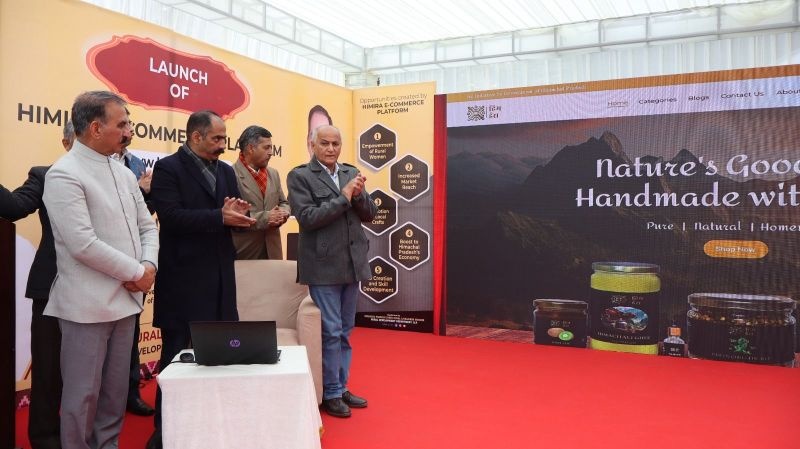
The significance lies in the relationship between the participants. MarbleX called Himira its product; Wits acknowledged collaboration. That distinction keeps the story honest about ownership. It also shows how this market works: a specialist technology company can contribute to a service whose public identity belongs to somebody else. The engineering partner may be largely invisible to the eventual shopper.
Open networks recur elsewhere in Wits’s public footprint. OpenAgriNet lists Amit Garg and Bhuwan Yadav with Wits affiliations among its contributors. Yadav’s ONEST comments argue for distributing access to opportunities across networks. Together, these appearances suggest a recurring area of interest beyond a single commerce adapter. They establish participation and a point of view, rather than proof of any particular commercial outcome.
After the applause, the monitoring
A recent hiring notice provides another revealing detail. On October 12, 2026, an advertised Wits MLOps role called for engineers to build deployment pipelines, monitor models in production and maintain reproducibility and governance. The work included troubleshooting and cost optimization. This is the operational side of artificial intelligence: keeping a model useful after somebody has demonstrated that it can work.
For buyers, the vacancy is a reminder to include operations in the original conversation. Who checks performance? Who investigates a failed deployment? Who maintains the record of what changed? These responsibilities belong in the scope because launch transfers software into daily use, where the exceptions arrive on their own schedule.
Buy a smaller uncertainty
The useful lesson to copy is a purchasing method. Start with one bounded workflow: a catalog reaching another channel, an application reaching its first users, or a model reaching production. Ask for acceptance criteria that can be demonstrated. Then assign ownership of the connection points and the support work. A small, observable result makes a much better opening conversation than a shopping list of technologies.
Wits’s model fits buyers who need implementation capacity and can supply someone empowered to settle product questions. A standard requirement may be cheaper to meet with packaged software; a business unable to define responsibilities will struggle with any outside team. The adapter offers the clearest closing image: keep what works, specify the missing connection, and judge the engineering by whether people can actually use it.