In 2004, Michael Vadini gave his investors more of his company. They had bought into TITAN Technology Partners during the technology boom, at a valuation the subsequent downturn made painful. He first gave them preference over himself if the business failed and money remained. Then he granted two additional shares for every share they held. His own stake fell to about a quarter. The arithmetic was disagreeable. That was rather the point.
Founders are usually celebrated for keeping hold of things: control, equity, the microphone. Here was a decision to surrender something measurable. A comforting sentiment becomes more interesting when it appears on a capitalization table.
“If you do the right thing, good things happen.”
Michael Vadini, on the TITAN investor decision
Vadini’s explanation was plain. The action behind it was specific.
That episode offers a useful opening to a career that spans enterprise consulting, online sign-up sheets, commerce analytics and ServiceNow implementation. The company names change. The recurring work involves getting people, information and obligations to move together. Today, as founder and CEO of Usecase, Vadini is applying that interest to how businesses organize around artificial intelligence.
A business built to keep running
TITAN, founded in 1998, worked in a part of technology that rarely makes a glamorous entrance. It hosted and supported business applications, provided consulting and handled outsourced processes. Its customers included large enterprises and midmarket organizations. By 2014, its offices stretched from Charlotte and Nashville to London, Pune and Singapore.
These were systems with a daily job to do. A company running its operations on SAP or Oracle needs the software available after the demonstration ends. Payroll does not become less urgent because a server has other plans. TITAN’s business brought application knowledge and operational responsibility into the same relationship.
On April 1, 2014, Velocity Technology Solutions announced its acquisition of TITAN. Vadini joined as president of the TITAN division. The combination expanded Velocity’s support for enterprise applications and its international footprint. It also meant that selling the company came with another assignment: taking a leadership role inside the larger organization.
For Vadini, the enterprise software business would remain familiar territory. But another venture had already taken him somewhere a little closer to the school calendar.
The administrative drama of a missing snack
SignUpGenius began with a problem that required no enterprise architecture diagram. Dan Rutledge had seen the failures of informal group organizing, including a youth soccer team left without snacks because a paper sign-up sheet confused parents. He was working with Vadini at the time. Together, they launched the first version of the service in 2008.
Rutledge brought web development experience, using Adobe ColdFusion to get the site running. The product replaced familiar group-organizing machinery: paper lists, scattered messages and the reply-all email chain. Few human inventions can make a simple obligation feel quite as elaborate as reply-all.
The division of credit matters here. Rutledge created the website as a side project; Vadini partnered with him to found the company in October 2008. This was a collaboration, with a specific everyday frustration at its beginning.
Early adoption moved beyond family and friends. SignUpGenius reached 98,000 users in 2009 and more than 900,000 in 2010, when it moved into its first office. Angel Rutledge joined as chief operating officer and chief marketing officer in 2011. The business grew around the decidedly untheatrical act of getting a group to agree who would do what.
A business application. A volunteer roster. A commerce dashboard. Different settings, familiar friction: information and responsibility need somewhere to meet.
Father, son, and a pile of disconnected data
In 2014, Vadini and his son Carmen founded Glew. Their starting point was the difficulty of business intelligence: capable systems could also be expensive, complicated and awkward to implement. They wanted a more accessible way for commerce businesses to use their data.
Glew brings information from areas such as marketing, inventory, finance and ecommerce into one place. Its work includes the less visible plumbing behind a dashboard: moving data, storing it and producing reports. The attraction is practical. A business needs to understand how its different activities connect before it can decide what to change.
This father-and-son company put a family relationship inside a technical problem. It also brought Vadini’s enterprise experience into the world of commerce brands, where software has to earn its place amid advertising costs, product decisions and customer retention.
His appearance on the Ecommerce Fastlane podcast put those concerns in focus. The conversation covered disconnected performance reporting, customer lifetime value, profitability and ways to understand customers. The subject was the decision after the report: how a merchant might use information to change the business.
The episode also addressed product strategy and the different metrics a merchant might watch while trying to grow profitably. That gives the analytics venture a useful place in his career: it moved the conversation from maintaining a business system to interpreting what the business was doing. A report becomes worthwhile when someone can act on it. Otherwise, it is another very well-formatted obligation.
The good news arrived by phone
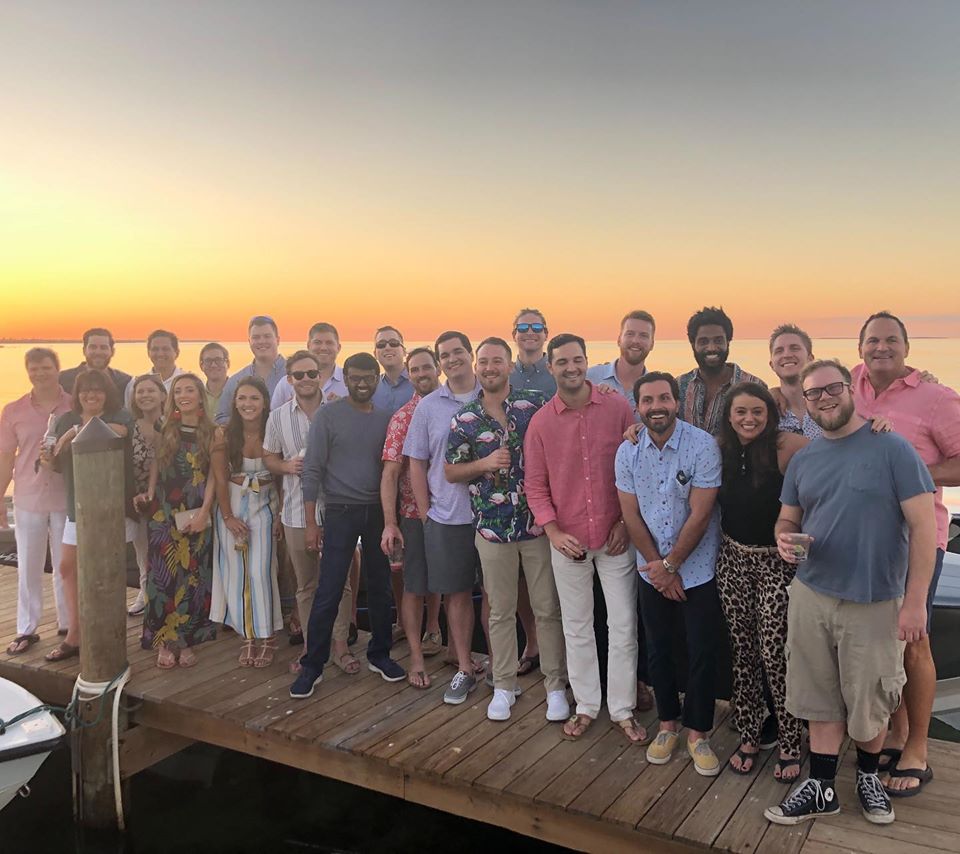
Glew finished first in the Charlotte Business Journal’s 2019 Fast 50 ranking, its first appearance on the list. The measured growth was 381% from 2016 through 2018. At the December awards event, Vadini’s daughter Adeline accepted the honor while the team was away at its annual meeting in Islamorada.
She called her father with the result. His response was an explanation of delayed growth in subscription software: “You don’t grow fast initially.” He described the long stretch of work before acceleration becomes visible. The award supplied a tidy number for a process that had felt much less tidy while it was happening.
The family connection ran further: Adeline’s husband also worked at Glew. When asked what kept the company going, she pointed to its people. Carmen echoed that emphasis at the team’s celebratory dinner.
The growth rate behind its first-place finish in Charlotte’s 2019 Fast 50.
There is something pleasing about a software growth story delivered through a daughter’s phone call. The percentage is exact. The setting is human-sized: someone at an awards ceremony, someone answering a phone, and a team elsewhere finding out that its work has been noticed.
Seven years from founding to acquisition
Infocenter followed in 2017. It focused on ServiceNow, helping organizations plan implementations, build workflows and manage them afterward. The work returned Vadini to enterprise services, with a more concentrated platform focus than the broad application landscape of TITAN.
On May 1, 2024, Insight Enterprises acquired Infocenter. The company had been named ServiceNow’s 2024 Americas Consulting and Implementation Partner of the Year. Insight wanted to add its consulting, implementation and managed services to a portfolio that already included extensive cloud capabilities.
Infocenter brought a sequence to that work. RADIUS analyzed business processes and helped plan solutions; DEVSHOP provided ongoing managed services. A project could begin before implementation and continue after launch. For customers, that structure connected the proposal with the less ceremonial business of keeping improvements coming.
Vadini’s stated mission at the acquisition was to help companies “plan, build and manage ServiceNow.” Those verbs are a useful description of the business he had built. Each represents work that persists after a software license has been purchased.
- 1998TITAN begins
- 2008SignUpGenius launches
- 2014Glew begins; TITAN acquired
- 2017Infocenter begins
- 2024Infocenter joins Insight
Insight’s 2024 annual report records $265 million in cash consideration, net of acquired cash, with additional contingent earn-outs. The contingent component meant the transaction included terms extending beyond the initial payment.
His relationship with Baldwin Wallace University continued beyond his BA in business administration. He served as a trustee from September 2012 to January 2021. He also describes mentoring entrepreneurs and rising executives as part of his work. These connections extend the career beyond the companies that appear in acquisition announcements.
In a public Veterans Day reflection, Vadini identified his father, Mario, as a veteran and credited his service and commitment with influencing his understanding of responsibility and leadership. It is a personal reference within a public record largely concerned with organizations. Alongside the family involvement at Glew, it gives a clearer view of the relationships he chooses to discuss.
A new assignment for the corner office
Usecase is Vadini’s current venture. Its focus is AI-driven business strategy, organizational design and operating models for enterprise and midmarket companies. The offering includes industry-specific playbooks intended to help organizations develop different products, services and ways of delivering them.
His December 2025 essay about the “barbell problem” explains the leadership argument behind that work. At one end, employees experiment with AI tools independently. At the other, executives hand the entire question to IT. He argues that both approaches leave business strategy insufficiently connected to implementation.
His proposed center is senior leadership: CEOs, boards and business leaders deciding the direction, investment and organizational changes together, with IT involved as a partner. That is his prescription, and its emphasis is revealing. After years spent helping businesses run software, he is pressing the people in charge to reconsider how the business itself should run.
In an October 2025 essay, he also emphasized culture, learning and trust alongside technology. A new system, in his argument, has limited value if the organization around it cannot adapt. This brings the discussion back to people with responsibilities, incentives and habits - the ingredients that make any diagram harder to implement than to draw.
There is a line connecting the investor decision at TITAN, the group-organizing tool, the shared family business and the current AI argument. Each asks who carries responsibility when a system changes. Vadini’s career has supplied several answers, some technical and one conspicuously expensive to himself. The next answer is taking shape at Usecase, where the assignment begins with the people who usually commission the software.
Follow the work
- Michael Vadini’s website
- X / @MVadini
- His essays
- TITAN’s investor decision
- TITAN joins Velocity
- SignUpGenius at ten
- The SignUpGenius origin
- Glew’s founding story
- Glew’s Fast 50 celebration
- Listen: Ecommerce Fastlane
- Infocenter joins Insight
- Insight’s 2024 annual report
- The barbell essay
- Transformation beyond buzzwords
- His father’s influence