In August 2021, a proposal went before the commissioners of El Paso County, Colorado. Eight firms had bid. Staff recommended Circular Edge for a $120,000 engagement covering enterprise software administration and on-call support. The initial term was one year. The software was Oracle JD Edwards. The assignment sounded wonderfully uneventful: help keep it running.
There is a useful way to read that document. Enterprise software becomes valuable through continuing attention: the administrator who catches a problem, the consultant who understands an awkward configuration, the person available when a process stalls. Circular Edge sells that attention. It also makes software to reduce how much attention the same problem needs tomorrow.
- Keep it running. Consulting and managed support for Oracle business systems.
- Remove repeat work. Its own tools handle scheduling, signatures and connected workflows.
- Start with one bottleneck. The useful question is what employees repeatedly have to fix.
A business built around the second step
Founded in 2003, Circular Edge works across implementations, upgrades, integrations, cloud moves and continuing support. Its leadership page identifies three co-founders: CEO sAchin cHoudhari, product-management vice president Nitin Choudhari, and chief operating officer Ashim Choudhari Lakhpat. The company reports more than 300 customers worldwide.

Its customer examples include manufacturers, medical-device businesses, property companies and a water utility. These organizations have different outputs, but familiar software chores: moving orders, reconciling information, controlling access and keeping transactions moving. Circular Edge’s technical expertise sits alongside knowledge of finance, manufacturing and supply-chain processes. Knowing how a screen works is only part of knowing why someone needs it.
The commercial model follows those chores. Customers can buy a project, ongoing support or additional people and skills. Smart Help, its managed-services offering, has historically included on-demand and monthly support packages. A Denver Water testimonial published by Circular Edge praises the ability to scale assistance while “only charging us for the time we use.” That is a specific purchasing benefit: flexibility during a transition.
For a buyer, the alternatives include hiring internally, engaging another Oracle specialist or choosing a broader systems integrator. Circular Edge’s combination of support and proprietary tools makes the most sense when the recurring problem matches something it already knows how to solve. The county proposal is a useful reminder to compare actual scopes: response coverage, technical responsibilities and renewal terms matter more than a headline fee. A warehouse application and a year of administration buy different kinds of help.
Put the fix where the work happens
Consultancies often encounter the same problem in different buildings. Circular Edge has turned several into products. Smart Scheduler addresses batch processing in JD Edwards EnterpriseOne: jobs that must run in sequence, wait for other jobs or produce output for someone else. Built within the JD Edwards toolset, it handles dependencies, monitoring and scheduling through a familiar environment.
ERPSign takes on another border crossing: the document that needs a signature. It connects DocuSign workflows to JD Edwards, allowing users to send, track and manage documents within their business application. The proposition is pleasantly concrete. A signed agreement should not become a separate detective assignment.

AtomIQ covers a wider set of connections. Its portfolio includes warehouse management, integration, mobile applications and AI agents. Circular Edge has demonstrated barcode scanning and shop-floor workflows, while its current materials describe actions through collaboration tools such as Microsoft Teams. Together, these products explain the company’s market position: an Oracle-focused services provider that also builds reusable software around recurring operating problems.
- 01The batch queueSmart Scheduler → sequence and monitor jobs
- 02The unsigned documentERPSign → send, sign and track in JDE
- 03The disconnected workflowAtomIQ → connect systems and actions
The handoff is where time disappears
Consider the returns-management example in Circular Edge’s 2024 conference recap. Atrion faced material handoffs, communications across departments and delays creating transactions in JD Edwards. The recap describes using orchestrations to automate steps, including work-order creation, and reduce human error. The troublesome part was the coordination surrounding the record.
A Brookfield Properties Retail testimonial describes another shift. Following a JD Edwards upgrade and migration to Microsoft Azure, the customer reported lower infrastructure and support costs and better oversight. Proactive monitoring helped identify issues sooner. The revealing detail is who used to sound the alarm: customers. Moving detection upstream changes the working day before it changes a dashboard.
“only charging us for the time we use”Jonathan · Denver Water
Customer testimonial published by Circular Edge
These are customer accounts published by the supplier, so they deserve that context. Their transferable lesson is still useful: map the delay before choosing the tool. Count the handoffs, identify who waits and establish what a completed task should look like. That gives an improvement project something more useful than a fashionable name.
A bigger Oracle neighborhood
Circular Edge’s expansion has followed adjacent business needs. It joined the NetSuite Solution Provider Program in June 2022. That December, it announced the acquisition of Innovus Partners to broaden Oracle Cloud EPM implementation and support. EPM adds budgeting, forecasting and connected planning to the operational systems conversation.
Partnerships extend that reach. DocuSign supplies the signature capability behind ERPSign; Medius brings accounts-payable automation. In February 2025, Medius named Circular Edge its 2024 North America Partner of the Year, citing its Oracle-related services for JD Edwards and NetSuite. That recognition gives the partnership a more concrete basis than a logo on a webpage.
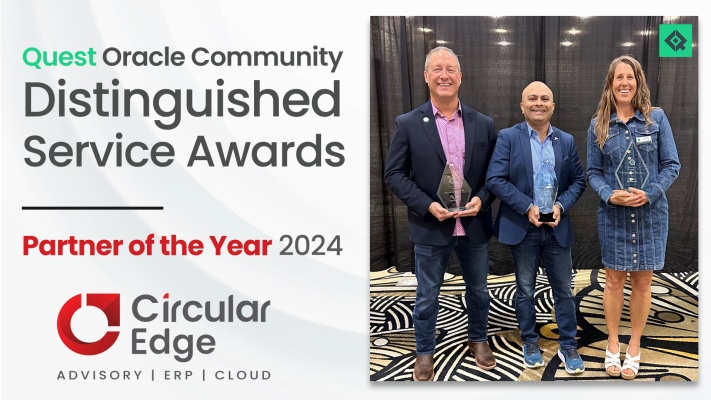
The user community supplies some personality. Circular Edge’s event recaps feature customer breakfasts, a giant LED robot and DJ appearances by its CEO. Its leadership page reports average employee tenure above seven years. Both details fit a business that depends on people remembering how somebody else’s complicated system actually works.
Give the AI a small job
By 2026, the company’s public workshops had become more explicit about AI execution. An August listing offered a 90-minute exercise turning an incoming email into a JD Edwards sales order. An October workshop advertised conversational access through ChatGPT, Copilot, Claude and AtomIQ Sensei using an MCP server.
The sensible buying test remains narrow. Circular Edge’s own agent guidance recommends defined workflows with clear inputs and measurable outcomes, and describes token-cost tracking and optional human approvals. Buyers should test exceptions as carefully as successful transactions. Poor data or unsettled approval rules can turn faster execution into faster rework. Oracle-specific tools also need a compatible environment. For the right organization, the opportunity is practical: make one familiar piece of work require less chasing.