The customer was moving to a bigger building. Its enterprise software, unfortunately, had baggage. In Cyret’s published account, the hardware was aging, the original JD Edwards installation discs were missing, and IT had no budget for the move. An executive decision about property had become a question about whether the business could keep operating.
It is a wonderfully unromantic beginning for a technology story. Nobody needed a manifesto. They needed a workable upgrade and a payment schedule. Cyret’s Xoom proposal offered phases, an initial payment of 10 percent and monthly fees, with three years of support included in that customer’s arrangement.
The story in three points
- The core: Oracle ERP consulting, integration, migration and ongoing support.
- The extension: DocMaven automates document handling and healthcare administration.
- The buying lesson: follow the handoffs, then measure whether the work actually finishes sooner.
01 / THE UPGRADEAn office move with an unwelcome passenger
The episode illustrates Cyret’s position in enterprise technology. It works where an existing system meets a new demand: another location, a newer release, a cloud migration, a process the original configuration never anticipated. Customers already have businesses to run. Any improvement must survive contact with that fact.
Cyret’s practice covers assessment, implementation, integration and post-implementation work. JD Edwards is a particular focus, alongside Oracle E-Business Suite, Oracle ERP Cloud, NetSuite and PeopleSoft. The menu also reaches into Microsoft Dynamics, Primavera project management, data management and business intelligence. That breadth matters when the assignment involves several applications rather than one clean installation.
The useful distinction is between owning software and operating a system. A license does not settle how an order enters the business, how a warehouse records it or who investigates an error after hours. Those are the questions a services company gets paid to answer. Cyret’s work sits inside that often untidy interval.
02 / THE HANDOFFThe work between the applications
Consider a warehouse example from Cyret’s case materials. The customer needed faster vehicle turnaround and better storage handling. Cyret arranged for inbound details to reach JD Edwards through electronic data interchange before the vehicle arrived. The workflow prepared lot and location information so barcode labels and put-away instructions could be available when unloading began.
The same account describes lot numbering for first-in, first-out handling and storage rules based on pack type and ABC classification. It is the sort of detail that makes an ERP specialist useful: the truck, pallet, lot and rack must agree about what is happening. The software has to express the physical operation accurately.
Before the truck meets the rack
Simplified illustration of Cyret’s published warehouse case. Steps, not performance measurements.
Its market is consequently broad but recognizable: manufacturing, distribution, energy, food and beverages, financial services and healthcare. These organizations have transactions, rules and exceptions that must travel through more than one system. Cyret’s competitive argument is its combination of enterprise application knowledge, process consulting and continuing delivery. Buyers comparing Oracle specialists should examine that combination against their own particular problem.
The factory work has an external partner, too. In January 2023, Cyret announced an agreement with Instron Technologies to combine ERP consulting with industrial automation and digital factory expertise. The logic is straightforward: information from operations becomes more useful when business systems can act on it.
03 / THE REFERRALThe referral clock
Healthcare gives the handoff problem a different consequence. A document can arrive while the patient’s next step remains unresolved. Reading a fax, finding the right record, contacting the patient and informing the referring provider are related jobs. Completing the first does not guarantee that the others happen.
“Right now, data is sedentary in healthcare.”
Rahul Chitko, identified as Cyret CEO in a June 2021 county profile
Cyret’s healthcare automation was an early recipient of Prince William County’s IGNITE grant program. Its present DocMaven offering describes document reading, classification, validation and routing into workflows. For healthcare customers, the ambition includes moving incoming information into electronic health records and reducing the administrative steps around care.
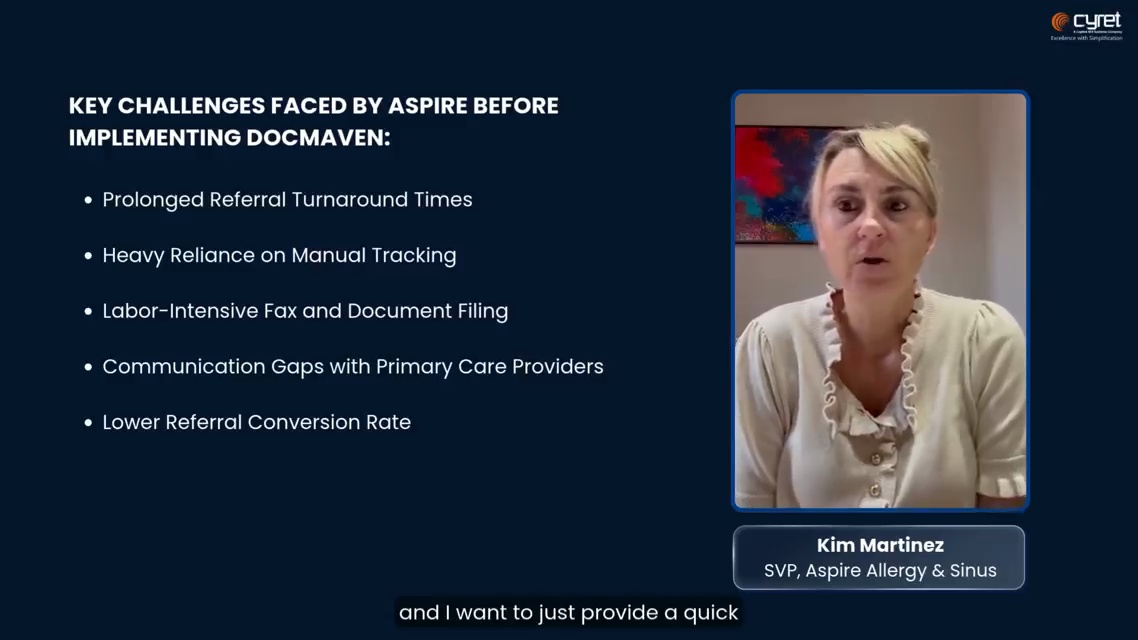
A named example makes the proposal more concrete. In a September 2026 company-published testimonial, Aspire Allergy & Sinus SVP Kim Martinez describes fax reading, NextGen EHR uploads and an automated referral tracker. She says the time to first patient contact fell from roughly three to four days to 24–36 hours. That is a customer’s reported experience, with its own processes and starting conditions.
Aspire / Time to first patient contact
Approximate ranges reported by Kim Martinez; days converted to hours. Bars show upper bounds, hatched ends show the range. Customer testimonial, not a controlled comparison.
For a buyer, the interesting unit is the completed referral. A demonstration can show a document being read correctly. A useful deployment must also send the information to the right place and prompt the next action. Testing the whole journey gives an operations team something firmer to judge than the charm of a screen.
04 / THE COMMERCIAL DESIGNBuying time, buying expertise
Cyret has several ways to package the work. ACE starts with a predefined JD Edwards EnterpriseOne 9.2 configuration and advertises an eight-week go-live approach. Its base-and-add-on model gives the buyer a starting shape. Extra scope adds elapsed time. The attraction is fewer decisions at the beginning, provided the configuration fits the business.
ACE’s advertised go-live target
A preconfigured implementation approach; scope and additional modules affect timing.
Xtend supplies outsourced technical and business work through build, operate and transfer options. Older published examples list full-stack development at $18–25 an hour and RPA work at $18–28. They are indicative historical rates subject to experience and job description. A buyer still needs a scoped proposal covering the actual team, deliverables and ongoing obligations.
Managed support addresses what follows delivery. Cyret describes documented issue repositories, selectable coverage and a follow-the-sun model. Its business model combines project services, recurring support, outsourcing, software resale and automation offerings. The long relationship can be as important commercially as the initial installation.
These approaches offer a useful way to compare providers. How much configuration is reusable? Who owns an unresolved issue? What happens after the upgrade? Can the commercial arrangement accommodate the cash available when the need appears? Each answer changes the value of an apparently similar proposal.

05 / THE BUYER’S MOVEFollow the document before buying the dream
The lesson to copy is modest enough to be useful. Pick one recurring transaction. Trace it from arrival to completion. Count the retyping, the waiting and the people who must intervene. Then choose a result to measure: time to first contact, time to put away stock or hours spent resolving a support incident.
There are conditions attached. Preconfiguration saves time when a company can accept the model. Highly unusual processes may require more design. Automation needs agreed rules and a route for exceptions; connecting systems cannot resolve a disagreement about who should act. Shared support needs coverage and responsibilities that match the operation. These are questions to settle in a pilot and contract.
The office-move customer encountered the problem all at once. Other organizations meet it a little every day, in a queue or an inbox. Cyret’s proposition is most intelligible at that scale: find the work trapped between useful systems, and give it somewhere to go.