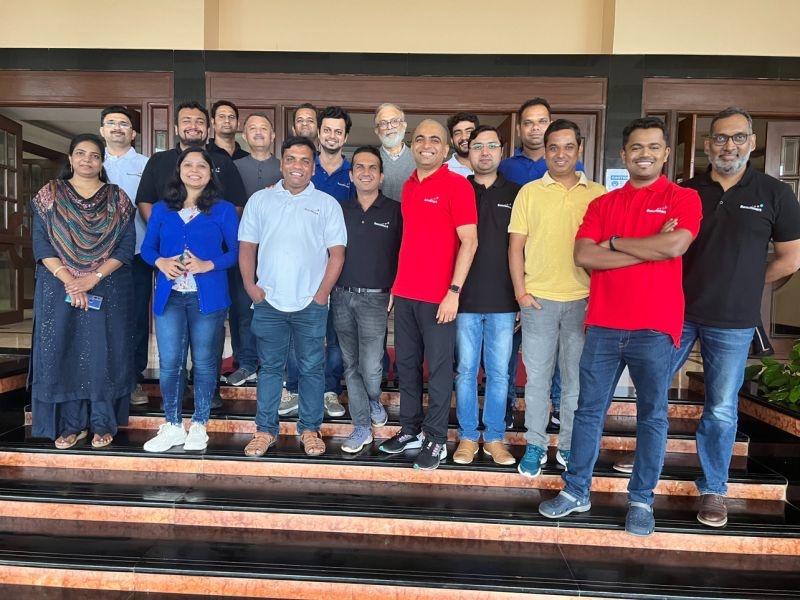
Before Rahul Asanikar could leave for a leadership offsite, his daughter had a question. Who was going? Eighteen people, he explained: fifteen employees and three advisers. What would they do? Work on team bonding and agree on a plan for the future. Rujuta, then fifteen, offered a diagnosis. If the bonding needed attention, surely the leader carried some of the responsibility.
She suggested ten to fifteen percent. Her father claimed the whole hundred. In retelling their exchange, he joked that she had given him a substantial discount on accountability. The founder and CEO of Benchmark IT Solutions had arranged an overnight strategy session, but the first useful intervention had arrived before departure. Family feedback, conveniently, requires no conference room booking.
It is a revealing story for Asanikar to choose to tell. He makes himself the recipient of the lesson. His daughter gets the sharp observation; he gets the bill. That willingness to put responsibility back on the leader offers a way into his working life, which stretches across software development, international client relationships and the everyday difficulty of getting people to understand one another.
A computer science degree, then the work of delivery
Asanikar studied at Shivaji University from 1995 to 1999, earning a bachelor's degree in computer science. His career includes a project management role at Maximize Learning. Those details put software and delivery together early in his professional record: the technical problem, and the work of getting an agreed result into someone else's hands.
Project management is an unromantic entry in a founder's biography. It does, however, put a person close to a business's awkward questions. What exactly has been promised? Who understands the requirement differently? When will somebody discover that two apparently reasonable assumptions cannot both be true? A career concerned with delivery leaves plenty of room for technical curiosity, but little room to ignore consequences.
Benchmark dates its beginnings to 2005. Today, Asanikar is based in the Greater Pittsburgh region, while the company maintains offices in Pittsburgh and Pune. That geography is central to the work: software teams serving businesses across borders, with all the practical coordination that entails. A time difference is easy to print on a slide. Agreement about what a product should do takes rather more effort.
The shopping app chapter
His entrepreneurial record also includes Ocatalog, a mobile shopping platform he founded with Ganesh Patil and Shereeza Khan. It launched in the final quarter of 2012 and appeared in the eSparks 2013 selection of twelve Indian ecommerce companies. At the time of that coverage, the venture had a twenty-person team, fifteen clients and a Pune base, with offices in Florida and New York.
The proposition connected retailers and shoppers through mobile technology. It placed Asanikar on the product side of an experience most people understand immediately: finding something worth buying without making the search a part-time occupation. The venture belongs to a period when a phone was becoming a shopfront as well as a means of calling the shop.
For his biography, the distinction matters. Building a business around a product asks questions that sit alongside the engineering: who will use it, what will make the transaction easier, and how will a retailer fit it into existing work? Ocatalog gives his career a specific entrepreneurial chapter beyond the company whose name now accompanies his own.
Computer science at Shivaji University
Ocatalog launches in the final quarter
Speaks on software outsourcing in Pittsburgh
Joins the Entrepreneurial Fellows class
A road map before an ocean
In July 2015, Asanikar appeared alongside Kevin Jones, founder and president of Ectobox, at a Pittsburgh program about choosing onshore or offshore software development. Asanikar was introduced as Benchmark's co-founder and head of operations. The subject could easily have become an argument about where the cheapest developer lived. The practical recommendations went further.
The session emphasized defining both the product and the project. Vendors should provide a road map, observe software industry guidelines, communicate regularly and offer periodic reviews. Offshore arrangements also required attention to differences in time zones, language and culture. These were recommendations from the session, shared by its speakers, rather than a private formula attributed to one of them.
There is a useful discipline in that list. Geography does not settle whether a requirement makes sense. Neither does a low price settle whether both parties expect the same result. The advice asks a buyer to do some thinking before purchasing development time. An international team can cross an ocean quite efficiently and still arrive at the wrong interpretation of a sentence.
The client inside the client's company
Asanikar's account of working with Ernest Legrand of Webcbg in New York takes the relationship a step further. He described learning from Legrand over a decade. Their work together included helping client teams prepare internal presentations and demonstrations, so those teams could make their case within their own organizations. Delivery included helping the customer explain the delivery.
That is a more particular task than keeping a customer pleased. Someone who commissions software may also have colleagues to persuade, a budget to defend and a demonstration that must make sense to people who were absent from the development meetings. A useful supplier can understand those obligations without mistaking them for someone else's problem.
Asanikar connected the experience to the practice of managing up. His questions were practical: how could he reduce another person's workload, what form of communication suited them, and how could he get feedback? In this telling, attention to the customer starts with asking how that person works. It is a modest conversational habit with a fairly demanding implication: the answer may require changing your own habits.
“What can I do to take work off your plate?”
Rahul Asanikar, reflecting on managing up
Ten years before the first handshake
Another relationship supplies an unusually long interval between beginning work and meeting in person. In December 2019, Asanikar first met Jim Duncan, founder of ResortCleaning, after ten years of building the company's software platform. He later acknowledged that they should have met sooner. Their teams had nevertheless been working together throughout those years.
ResortCleaning builds software for cleaning companies and property managers working with short-term rentals. Its product addresses operational work such as scheduling, communication and inspections. This is software close to a working day: people need to know what is ready, what still needs doing and who is responsible. An overlooked instruction can become somebody's very visible inconvenience.
The decade before that first meeting gives the relationship its distinctive shape. Face-to-face contact came after a considerable body of shared work. For a founder operating between countries, it is an example of how much collaboration can precede a handshake, and a reminder, in his own hindsight, that meeting still has a place.
Building ResortCleaning's platform before Asanikar's first in-person meeting with founder Jim Duncan in December 2019.
Returning to the classroom
In 2025, Asanikar joined the University of Pittsburgh Institute for Entrepreneurial Excellence's Entrepreneurial Fellows Class. The thirty-four-member cohort began its first session on January 15. The yearlong program combined sessions led by experts, learning among peers and individually matched mentorship, with topics including strategic growth, financial management and leadership development.
The participant list placed him alongside business owners and leaders from a range of organizations. For somebody who had already been a speaker at an institute program a decade earlier, the return as a fellow makes a pleasing change of seats. A person can have experience worth sharing and still have good reasons to bring a notebook.
The program's format also gives substance to the idea of continuing education. Other participants bring businesses with different customers, staffing needs and financial questions. Peer learning creates the possibility of hearing a familiar management problem described without the vocabulary of your own industry. Sometimes that is enough to make the problem newly visible.
New tools, familiar questions
The company Asanikar leads now offers an AI Lab built around workshops, identifying uses for generative AI and machine learning, and assessing whether proposed applications fit a business's needs. Its published process includes gathering requirements, defining a proof of concept, testing and collecting feedback before rollout. The subject has changed; the requirement to understand the job remains familiar.
Benchmark's product work includes Vruuum, designed to manage validation workflows for systems and equipment in regulated settings. It brings together requirements, vendor specifications, qualification evidence and approvals. Those are functions the company describes, rather than a claim that Asanikar personally designed each component. They show the kinds of detailed business work his organization is pursuing.
There is a recognizable thread through these chapters: a shopping platform, software for property operations, customer presentations, a leadership classroom. Each involves people trying to make a complicated activity manageable. Reading his career through that thread gives more weight to the questions he asks than to any particular technology label.
Back at the offsite, the plan was to bring people together and decide what came next. His daughter's arithmetic had already supplied a starting point. Asanikar could joke about the generous discount she offered him, but he chose the larger share of responsibility. Eighteen people would join the trip. Accountability had arrived early.