At the thirty-year mark, Igor Epshteyn performed a small act of entrepreneurial accounting. He had started Coherent Solutions in his late twenties. Three decades later, he explained, he was still in his late twenties, with three decades added. Some founders announce a new era. Epshteyn made a joke about the arithmetic.
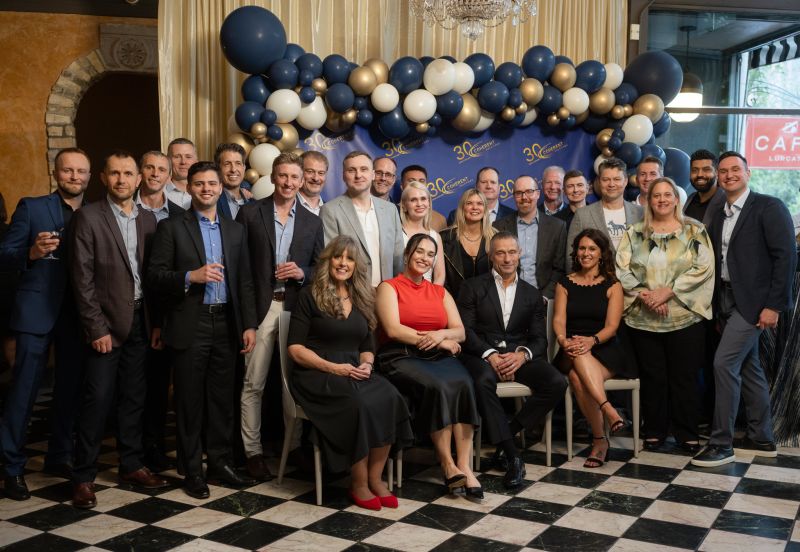
The occasion was Coherent’s 2025 anniversary, and the numbers behind the joke were substantial: more than 5,000 people employed over its lifetime and more than 25 million hours invested in clients’ work, by his count. He had gathered with colleagues, clients, friends and families to celebrate. His explanation for the company’s endurance gave trust and the habit of showing up a place alongside strategy.
That is a useful entrance into Epshteyn’s story. Software companies live among machines, but a software services founder spends much of his life negotiating human dependencies. Someone has to understand the assignment. Someone has to deliver it. Someone has to keep the relationship intact when the assignment, or the economy, changes.
A business before the American business
Epshteyn’s entrepreneurial life began in Belarus, where he established his first company in 1990. He grew up in Minsk. The American chapter followed in 1992, when he immigrated to the United States and began working as a software engineer. Coherent would come three years later, in Minneapolis. The founding date is 1995, well before a mobile app became the default answer to almost any commercial question.
His route through the United States took him through New York and San Francisco before Minnesota. He worked at companies of different sizes, eventually developing sales software, moving from programming into management and gaining a view of the whole project. Seeing the work from several positions gave him an idea for improving how software products were made.
His education also crossed disciplines: electrical engineering at the Minsk Institute of Radio Technology and an MBA from the University of Minnesota’s Carlson School of Management. In his own account, he never practised as an electrical engineer. The career he built used software and, increasingly, the business decisions around it. The two educations gave him different ways to approach the same client’s problem.
There is something pleasingly practical about that origin. A product has to survive its journey from a customer’s intention to a working system. The founder had experienced several stops along that route before deciding to run the journey himself.
- 1990First company
Belarus - 1992Moves to
the United States - 1995Coherent begins
Minneapolis - 2003First international
development center - 2025Thirty years;
IceLake investment
The customer who changed the map
The early business grew during the technology boom, reaching roughly 50 consultants. Then the bubble burst. Keeping Coherent alive involved layoffs and the stability supplied by large accounts, among them John Deere and the Minnesota Department of Transportation. Survival had a rather less celebratory vocabulary than the anniversary party would eventually acquire.
John Deere asked whether some engineering work could be outsourced to reduce costs. Epshteyn went to Minsk and bought an IT firm. By 2007, the operation there had about 150 people, while roughly 20 worked in the Minneapolis office, which concentrated on client management. A customer’s cost question had helped redraw the company’s geography.
The sequence matters. Global expansion can sound inevitable when it is presented as a row of dots on a map. Here, a specific customer need helped produce a different operating model. Epshteyn’s earlier life in Belarus became relevant to the American business he had built. The route away from Minsk eventually included a business trip back.
Coherent dates its first international development center to 2003. Bulgaria followed in 2018, with further expansion in 2020. Its published 2023 milestone records more than 2,000 employees across ten countries. Those dates describe an accumulation of teams over years. Every new dot on the map brought another set of relationships to maintain.
A large company with a small-company ambition
Epshteyn has used the phrase “Big Small Company” to describe the organization he wants. In his explanation, teams should have room to act independently, learn from mistakes and work directly with clients. The founder cannot watch every project. His proposed solution is to trust the people doing the work and keep the structure relatively flat.
That ambition creates an interesting management problem. Independence requires information. An engineer who can talk directly to the customer needs to understand what the customer is trying to achieve. A team that can make decisions also needs to know when its decision changes somebody else’s work. A flat organization still has to coordinate.
The company’s leadership includes people whose tenure extends across much of its history. Max Belov joined in 1998 and became chief technology officer in 2001. Alexandre Schneerson helped open the Belarus development center in 2003 and led it as general manager from the beginning. Epshteyn’s global company has been built with colleagues who remember earlier, smaller versions of it.
There is an ordinary pleasure in that detail. Corporate histories tend to turn everyone except the founder into scenery. In this one, the people responsible for the technical work and local operations have their own long-running chapters. The organization’s memory sits in more than one office.
The listening came more easily
In a 2021 conversation about leadership, Epshteyn admitted that communication and public speaking did not come naturally to him. Being alone with his thoughts, sending an email or telling a small group what he had decided could feel easier. His team had pushed him to speak more. Listening, he said, came more naturally.
It is an unusually useful admission from a chief executive. The person responsible for the whole company may prefer the very habits that make the whole company harder to reach. A decision feels complete in the room where it is made. Elsewhere, people are still waiting to hear what happened.
“We’re all together in this adventure.”
Igor Epshteyn, on communicating through uncertainty
His account put clients and employees in the same picture: both needed honesty, regular communication and a reason to remain loyal. He also described using the Entrepreneurial Operating System to identify the company’s values by examining what trusted colleagues already had in common. The exercise began with people the organization knew.
That gives his leadership philosophy a more concrete shape. Trust needs routines around it. Values have to influence hiring and promotion. Information has to travel. The founder who would rather think quietly has to take the microphone anyway. Running a global business occasionally requires doing the part of the job that feels least like you.
An empty office in Moldova
One account from Moldova brings those ideas down to the size of a phone call. Max Sandu, the country’s general manager, was building a new Coherent operation. He was inviting former colleagues and friends to join something that existed largely as an idea. Some declined. A few agreed to come along.
Sandu later remembered Epshteyn telling him: “Max, keep going and never stop!” When the first office keys arrived, the rooms were empty. Desks, computers and equipment still had to follow. The anniversary account, published in August 2026, described a Moldovan team of more than 50 colleagues after five years.
The story supplies an antidote to the effortless expansion announcement. Before an international office becomes a capability on a website, somebody must persuade the first people to join it. The founder can provide encouragement; the local manager still has to furnish the rooms. Global ambition has a surprisingly literal relationship with office furniture.
The next chapter has outside capital
Coherent’s thirtieth year brought changes to the executive team. Tom Stallings joined as chief revenue officer, responsible for global business development and delivery management. Shawn Torkelson joined as chief marketing officer. Their arrival added commercial leadership as the company prepared for another period of expansion.
In September 2025, Coherent announced a strategic investment from IceLake. The transaction closed in December after the final regulatory steps. The company described the partnership as support for greater delivery capacity, deeper technical capabilities and applied AI. Epshteyn remained at the center of the company as president and CEO.
His public discussion of AI has included mundane, recognizable tasks: organizing work, preparing reports, brainstorming and drafting communications. He has also described training employees to work with AI. The appeal is practical. A tool that helps a team handle the routine can change how much attention remains for the difficult parts.
That is a consequential test for a business founded to improve software delivery. New tools can make individual activities faster. The client still needs a working product, and the team still needs to agree on what it is building. Epshteyn’s company is meeting another technological change with thirty years of organizational habits already in place.
Still willing to start the clock
Away from the executive role, Epshteyn’s interests include endurance sports and adventure travel. A company profile published for Coherent’s twenty-fifth anniversary described participation in marathons, bicycle races and Ironman triathlons, as well as mountain climbing on five continents. These are activities with an inconvenient amount of preparation attached.
He has linked his approach to training with his approach to business, emphasizing consistency and discipline over quick gains. The comparison suits a founder whose anniversary arithmetic measures decades. It also leaves room for the dry joke: there are certainly easier ways to remain in your late twenties than running a company for another thirty years.
The more revealing image, though, may be Sandu’s empty office. Epshteyn had already spent years building a global organization when another colleague was beginning again with bare rooms and a few willing recruits. That is how a long business acquires a new beginning. Somebody takes the keys. Somebody makes the call. Then the work starts.
Continue the conversation
- Igor Epshteyn on LinkedIn
- Coherent Solutions website
- The Coherent Solutions company profile
- Watch: leadership and transparent communication
- The “Big Small Company” interview
- Epshteyn on using AI at work
- Five voices from Coherent’s Moldova office
- The IceLake investment closes
- Going Home, Sort Of - the 2007 profile (PDF)