On April 24, 2026, Ted Hanson bought roughly $1 million of shares in the company he runs. The company had a new name, Everforth, and a new stock symbol, EFOR. His average purchase price was $19.24. Corporate reinvention usually arrives dressed in adjectives. This one also came with a receipt.
The purchase on the first day of trading under the new symbol supplies a useful opening to Hanson's story. He had been with the business through an acquisition, several promotions and a gradual change in what it sold. Now he was putting more of his own money behind the next version. The gesture established his financial commitment; customers would still have to supply the verdict.
To understand how an accountant ended up making that wager, go back to Virginia, a young staffing company and a professional relationship that became a career. Hanson’s route to the executive suite began close enough to the books to know how much a good story costs.
The client who became the employer
Hanson graduated from Virginia Tech in 1991 with a degree in accounting. He also earned an MBA at Virginia Commonwealth University. From 1991 to 1998, he worked at the independent accounting firm Keiter, Stephens, Hurst, Gary and Shreaves. Apex Systems was one of his clients. In November 1998, he crossed the table and joined it as corporate controller; he became chief financial officer in January 2001.
That sequence matters. Apex had been founded in 1995 by three other Virginia Tech alumni: Brian Callaghan, Win Sheridan and Jeffrey Veatch. Hanson arrived afterward. His part in the enterprise was to help build an existing business, an occupation with fewer origin myths and quite a lot of work.
The scale changed quickly. Apex’s revenue rose from just under $1 million in 1996 to more than $46 million in 2001. By the time a 2002 account of the company’s early growth appeared, it had locations in 17 American cities and more than 1,000 employees. Hanson was its CFO. The numbers describe the company around him, rather than a personal claim to every dollar of its expansion.
There is something pleasingly uncinematic about this beginning. An accountant gets to know a client, joins the team and stays as the problems grow larger. Technology careers can be built through that door, too. Someone has to make the ambitious plan add up.
When the acquired company changes the buyer
In May 2012, On Assignment, the public company later called ASGN and now Everforth, acquired Apex. Hanson entered the parent organization as Apex’s CFO. The transaction gave the combined business a substantial position in IT staffing. It also provided the starting point for a longer shift toward technology services.
His responsibilities widened. He became president of Lab Support in January 2014 and an executive vice president of On Assignment in January 2016. In December 2016, he became president of the parent company. The earlier promotions trace a progression from finance into operating responsibility; by May 2019, he was CEO. He joined the board the following month.
The interesting part is what he thought the business already possessed. In discussing the company's evolution, Hanson singled out the value of its account portfolio. A staffing relationship put the company inside a customer’s organization, close to its technology needs. The next opportunity was to take on more of the technical work those customers needed done.
“The gold nugget of ASGN is our account portfolio.”
Ted Hanson, 2023
By the first quarter of 2023, commercial and government IT consulting had passed half of consolidated revenue. That change in the revenue mix made the strategy tangible. An established customer could buy a broader service from a familiar supplier. The attraction was understandable; delivering it required capabilities beyond the original staffing brief.
- 1998Joins Apex
Corporate controller - 2001Apex Systems
Chief financial officer - 2016Parent company
President, December - 2019Parent company
CEO, May - 2026Everforth
New name, April
Four alumni, one $5 million return trip
Alongside that corporate progression ran another relationship: Virginia Tech. In November 2014, Hanson, Callaghan, Sheridan and Veatch committed a combined $5 million to support the university’s entrepreneurship center. The amount belonged to the four together. The center had launched that July, with a remit extending beyond its home in the Pamplin College of Business.
At the April 2015 naming celebration, the group helped recognize student entrepreneurs. One was Joe Acanfora, a computer science student who had developed an app to explain where people could park on campus, depending on their permits and the time of day. It was a satisfyingly specific problem. A university may contain a thousand promising ideas; it can still be difficult to find somewhere to leave the car.
The gift and the student awards put a human scale on Hanson’s university involvement. Here were businesspeople backing students who were trying to turn an observed nuisance into something useful. The center offered programs, connections and practical experience, giving an idea somewhere to go after its first enthusiastic conversation.
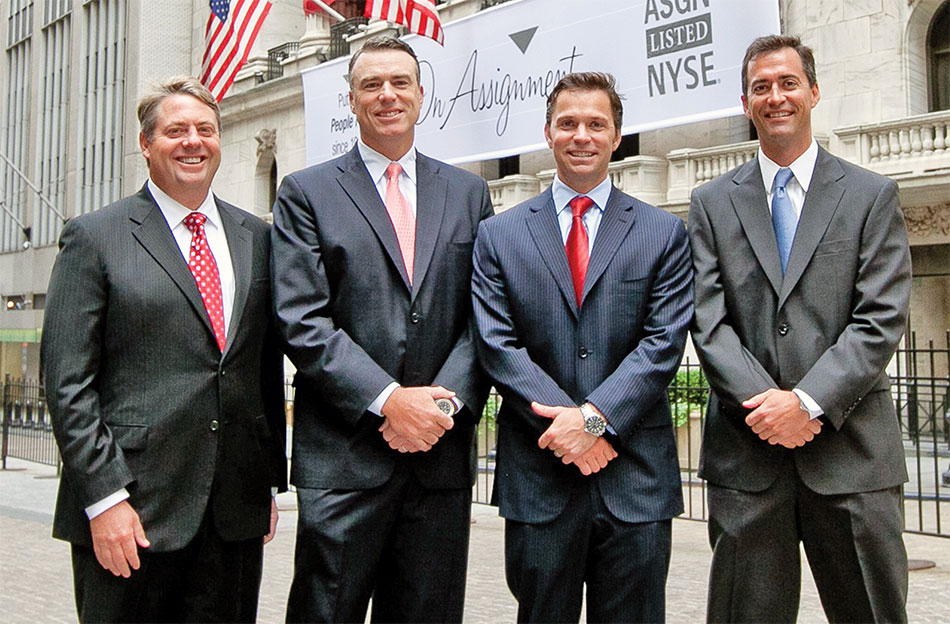
In April 2016, university representatives and alumni rang the New York Stock Exchange’s closing bell. Students joined a New York trip that included company visits and networking. The bell-ringing celebrated the entrepreneurship effort, taking an educational project into the setting where several of its supporters did business. For students, the value extended past the ceremony: they could meet people whose careers had once been as undecided as their own.
The familiar face inside a new name
Hanson became CEO in 2019, then moved the company’s headquarters from California to Henrico County, Virginia, in 2020. His working life remained connected to the region where Apex had grown. In 2023, he was inducted into the Greater Richmond Business Hall of Fame. Recognition had caught up with a career spent largely within the same extended business.
Everforth was announced in November 2025 and became the company’s name in April 2026. The original announcement brought six brands under a new parent identity, including Apex Systems, ECS, GlideFast and TopBloc. Their differing specialties gave the rebranding plan an operational question to answer: how easily could those teams work together for the same customer?
A transaction just before the change sharpened that question. In March 2026, the company completed its acquisition of Quinnox for $290 million in cash. Quinnox brought digital engineering capabilities and delivery centers in India, complementing existing operations in Mexico. The acquisition expanded the delivery network behind the new identity.
A name is comparatively easy to unify. Work arrives with different systems, customers and habits attached. Hanson’s challenge was to make the combined expertise accessible across the organization. A client asking for help should be able to get the right team without first learning the supplier’s family tree.
The accountant’s view of the AI rush
Hanson’s public explanation of AI has focused on what happens inside the customer’s business. In a November 2025 television interview, he described the difficulty created by older systems and scattered data. His argument was that AI could raise productivity, while the infrastructure accumulated over decades made implementation harder than the demonstration suggested.
By July 2026, he was making the same operational case as Everforth’s CEO: customers moving into production needed to integrate AI with their workflows, data and operating models. “We believe that the last mile of the AI valuation equation will be IT services,” he said. That is his commercial thesis, with a clear beneficiary if it proves correct: the company he leads.
The second-quarter figures offered a mixed test of progress. Revenue was $1.007 billion, above the company’s guidance, compared with $1.0206 billion a year earlier. Net income was $14.2 million, down from $29.3 million. A quarter can beat expectations while remaining below last year. An accountant should be comfortable holding both facts at once.
Bars start at zero. Revenue change calculated from reported quarterly totals.
In September, Everforth announced an expanded Microsoft partnership, aligning commercial and federal capabilities through a common approach to customers. It reported more than 1,500 active Microsoft certifications. The partnership announcement supplied another practical measure of the strategy: specialist skills, organized so they could be used across a larger business.
Back to campus, with another set of books
Virginia Tech remains part of the current chapter. Hanson joined its Board of Visitors in July 2025, following a gubernatorial appointment. A year later, his involvement extended into the changing economics of college sports. In June 2026, he and Brad Hobbs were named the initial directors charged with forming the board of Hokie Ventures.
The university-affiliated nonprofit was established to pursue revenue opportunities, investments and donor relationships for athletics. By August, its ten-member board had been announced, with Hobbs as chair and Hanson as vice chair. Fellow Apex alumnus Brian Callaghan was among its members. The connections in Hanson’s career keep acquiring new responsibilities.
College athletics and enterprise technology make an unusual pairing, but the business questions overlap: where will resources come from, who will organize the work, and how will an institution adapt while continuing to serve the people already depending on it?
Hanson’s career offers a long view of those questions. A client became an employer. An acquired business helped redirect its buyer. University relationships became a center for students and then another board assignment. The Everforth name is new. The habit behind it has had nearly three decades to develop: stay close enough to the work to see what the next responsibility might be.