A prescription benefit system does not get to take the afternoon off. Neither does the software an insurer uses to underwrite a policy. These are the kinds of applications Prime Technology Group developed and maintained: systems tucked inside businesses whose customers generally notice the technology only when something goes wrong. There is a peculiar commercial advantage in doing work that attracts very little applause. Once it becomes part of daily operations, it has to keep working.
- The work: custom software, data systems, cloud services and continued application support.
- The niche: healthcare, insurance and finance, where business rules shape the engineering.
- The turning point: a 2020 merger with Synerzip produced Excellarate; Encora bought it in 2023.
- The latest chapter: Coforge completed its acquisition of Encora in April 2026.
Prime’s story is useful precisely because it makes software sound less like magic. An application can be handsome, modern and entirely wrong for the people who must use it. Prime occupied the space between the code and the job: understanding what a client needed to accomplish, building the system around that work, and staying involved after installation. The invoices continued because the responsibilities did, too.
The job hidden inside the application
Start with an unglamorous example. In a published 2020 case study, Prime described its work for an unnamed private, for-profit college based in Bloomington, Minnesota. The college used Salesforce and Marketing Cloud during admissions. Staff needed to track applicants, record interactions and move people through enrollment. Email, documents and follow-ups all belonged to the same process, even when the software treated them as separate activities.
Prime integrated Outlook email and calendars with Salesforce and added SMS and chat with the college’s own routing rules. Its engineering work connected multiple platforms, including Sales Cloud, Marketing Cloud and third-party tools through Dell Boomi. The promised benefit was a staff workflow that could stay inside Salesforce more of the time. Picture fewer excursions between applications, rather than a miraculous new way to run a college.
The example makes the service tangible. A customer bought help joining tools it already used. The project also illustrates why a developer needs to understand the organization: a message is valuable only if it reaches the right person at the right stage. An integration can be technically correct and operationally useless. Prime’s stated approach began with listening to the client, then selecting the framework and infrastructure.
- 01UnderstandBusiness rules and work
- 02Build + integrateApplications and data
- 03Keep it runningMaintenance and support
Development creates the system. Support carries the relationship forward.
A specialist with a maintenance habit
Prime’s historical service portfolio covered outsourced application development, agile engineering, interface design, data management, enterprise content management and cloud services. Its company profile also described mobility, analytics and quality assurance practices. The market was primarily other businesses: healthcare organizations, insurers and financial-services companies, with work also extending into life sciences and e-commerce.
That makes Prime a services business with technical assets, rather than a single application sold to everyone. Clients could use its teams to create software, adapt existing systems, organize data or keep an application supported. Its reusable frameworks and industry expertise were part of the proposition. The practical distinction was familiarity with a client’s operating environment. Plenty of firms can supply programmers; the buying question is how quickly those programmers can understand the rules that matter.
For a buyer, the alternative might be hiring an internal team, commissioning another specialist consultancy or using a larger technology-services provider. Prime’s appeal was the combination of domain knowledge and continuing engineering responsibility. Custom development makes sense when integrations and business requirements justify it. For a straightforward task already served by a suitable packaged application, the same depth can become an unnecessary expense. That is a purchasing judgment, not a defect in the craft.
The phone that became an insurance product
Prime also had a more visible experiment. Research into smartphone motion patterns began in 2015 and led to Xemplar Auto and Xemplar Fleet, commercially available from early 2017. The idea was to turn the device already accompanying a driver into a source of information about driving risk. The products emerged from Prime’s insurance practice, placing industry knowledge inside repeatable software.
In May 2018, Prime announced Xemplar Insights as a separate, wholly owned subsidiary. The announcement explicitly linked the decision to autonomy and the ability to scale. A product serving multiple insurers needed room to develop its own business. That is a meaningful change of direction: the company gave an internal product operation a distinct organizational home.
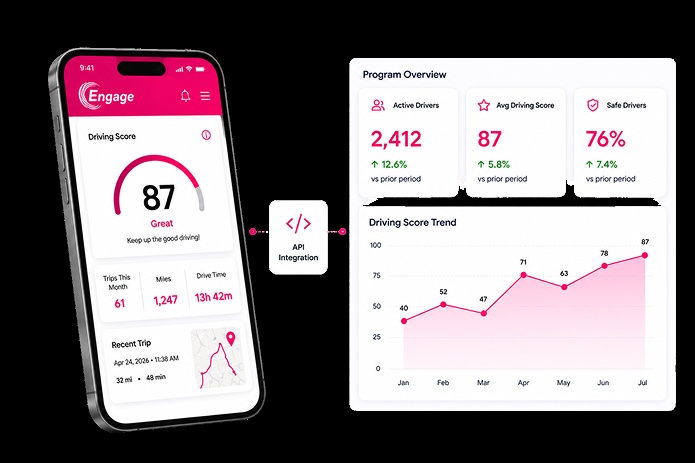
The present-day Xemplar proposition connects smartphone telematics with insurance workflows. Its fleet materials describe GPS and phone sensors recording trips and behaviors such as speeding, hard braking and phone use. Drivers receive feedback; fleet managers can inspect patterns. The attraction is avoiding a separate piece of vehicle hardware. The information still needs a business process around it: someone must decide what to do with the feedback.
Xemplar’s 2022 Auto 3.5 announcement also acknowledged a useful constraint. Smaller insurers and managing general agents could struggle to commit money and staff to a full telematics program at the outset. Its response included turnkey proof-of-concept options, customized apps and an SDK. The lesson is modest and transferable: let the customer test a bounded use case before asking it to finance the grand design.
Buying the skills that fit beside your own
Prime’s corporate development followed a similarly practical logic. Renovus Capital Partners acquired a majority stake in 2014, while the founder retained a significant interest. Frontenac acquired Prime from Renovus in 2019. At that sale, Renovus reported that profitability had doubled over the preceding two years. The figure describes profitability, not revenue, and supplies neither the starting dollars nor a margin.
“Partnering with Frontenac will enable us to fast-track the maturing of our platforms”Sudhakar Goverdhanam, founder, December 2019
In August 2020, Prime announced the acquisition of Lighthouse Software Solutions. Lighthouse brought financial-services application support, modernization and integration expertise. Its founder and staff were to continue with Prime. The fit was unusually legible: if you already build important business software, adding people who understand older applications expands what you can take responsibility for. Older code has an inconvenient habit of continuing to earn its keep.
Then came Synerzip in December 2020. Its strengths included agile product development, full-stack engineering, DevOps and advanced analytics. The companies described the combination as more than doubling the team, with professionals in the United States and India. An advisor to Synerzip framed the benefit as wider industry expertise and a broader US presence. This was a combination of adjacent capabilities, rather than a departure into an unrelated market.
Three names later, the expertise still counts
The combined business launched as Excellarate in May 2021 under CEO Nick Sharma. It reported more than 1,000 engineers, over 100 domain experts and more than 250 clients. Named customers included Change Healthcare, Ad Giants, Alchemy Systems and Centric Software. AWS, Azure, Google Cloud, Appian and Salesforce appeared among its strategic technology and solution partners. Those are Excellarate’s combined-company figures and relationships.
engineers across North America and India
Combined Prime + Synerzip business
- 2020Prime + Synerzip
Merger - 2021Excellarate
Combined brand launches - 2023Encora
Acquires Excellarate - 2026Coforge
Acquires Encora
Encora acquired Excellarate in January 2023, describing the purchase as a way to strengthen its healthtech, fintech and insurtech capabilities, alongside AI, analytics and automation. Excellarate then had more than 1,300 engineers. The rationale preserved the original theme: specialist knowledge could make a larger engineering organization more useful to customers in particular industries.
On April 23, 2026, Coforge announced the completed acquisition of Encora, with financial consolidation effective May 1. The agreed enterprise value was $2.35 billion for Encora as a whole. That amount is not a valuation of Prime. Frontenac’s 2019 purchase terms were undisclosed, and the succession of corporate names does not turn the largest transaction into a price tag for the smallest ancestor.
Ask about the Tuesday after launch
Prime’s history offers a useful way to interview a software partner. Bring an actual workflow. Ask which systems must connect, who owns each business rule, how a limited first release will be judged and who handles maintenance afterward. A polished demonstration answers only part of the purchasing question. A support plan tells you something about the years that follow.
The historical Prime proposition suits problems with enough operational complexity to reward specialist attention. It also demands client involvement: outsourced engineering cannot decide every business rule on the customer’s behalf. The attractive part of the model is continuity between understanding, building and maintaining. The demanding part is that continuity requires effort from both sides. A business can buy engineering capacity; it still has to know what work it wants done.
Continue the conversation
Visit Prime’s historical web address or Coforge. Explore the product branch at Xemplar Insights and its YouTube channel.
Prime’s historical social profiles: LinkedIn, X and Facebook. For the company’s next chapters, read the Excellarate launch announcement and Coforge’s acquisition update.