Ajay Tewari had already visited more than 60 countries when he began again. He had spent 11 years in merchant shipping, risen to chief officer and built a career with a clear next rung. Then his elder brother suggested helping establish the Indian operations of a technology business. In 1999, Tewari left the sea for a small software team. His next assignment would require recruiting people whose technical work he had never been trained to do.
It is an unusual entry on a software executive’s CV. Before the customer calls and delivery centres came Training Ship Rajendra, maritime study and years working aboard vessels. The cargo changed. The questions about people, responsibility and how to conduct business across borders proved rather more portable.
Today he is smartData Enterprises’ co-founder, managing director and global CEO. The company describes a workforce of more than 1,000 across its international operations. Yet the interesting part of Tewari’s career is the gap between the preparation he had and the job he chose. A shipping qualification offered no handy answer to the question of whom to hire for a software startup.
A different sort of training ship
His father served in the armed forces. Tewari has described a childhood spent moving between disciplined surroundings, followed by training at T.S. Rajendra. The University of Bombay awarded him a BSc in Nautical Science in 1991. He later studied marine shipping with the Marine Safety Agency in the UK.
His maritime years exposed him to large commercial operations and people from many cultures. That experience helps explain why he talks about his earlier career as preparation for business. The connection is practical: international work means understanding people who do not necessarily share your assumptions, and taking responsibility for an operation with many moving parts.
In his PortToPort conversation, Tewari returns to that passage between industries: what the sea taught him, what he still had to learn, and how to work with people who supplied the expertise he lacked. His account puts people management near the beginning of the story. The first software challenge arrived before there was much software to manage.
The startup had two vacancies: customers and colleagues
Small teams make every absence conspicuous. A startup needs people to do the work and customers willing to give it work in the first place. Tewari has recalled those as the company’s two early problems. The business would have to make a persuasive case on both sides of the interview table.
smartData chose to work with startups in the United States, accepting that some customers would fail while others might grow. That gave the young consultancy a reason to keep learning: its clients wanted current technology, and prospective employees wanted the chance to work with it. Commercial demand and recruitment could reinforce each other.
There is a certain economy to the arrangement. The same interesting assignment that helps win a client can help persuade an engineer to join. It also makes a promise on two fronts. The customer expects delivery; the recruit expects the experience that made the job appealing.
“I always believe that we have two customers: clients and employees.”
Ajay Tewari
That formulation leaves an employer with obligations as well as expectations. Tewari describes employees as people who joined because they trusted the company’s promises. He also talks about giving younger colleagues project management experience and enjoying the teaching himself. In his telling, learning travels in both directions.
He served in operations roles, including vice president of operations and chief operating officer, before taking the helm in 2004. The sequence matters. His eventual title followed years spent inside the business. There was time to discover which parts of his earlier experience travelled well, and which required an entirely new education.
Making room at the top
A growing company eventually presents its founder with a less photogenic task: allowing other people to lead it. In early 2025, smartData announced that Tewari would become global CEO while Rakesh Pant took the India CEO position. The announcement described a formal handover between the two.
For Tewari, the change gave an organisational form to an idea he had already discussed: taking satisfaction in creating leaders around him. It is easy to praise delegation in the abstract. Assigning responsibility to another named executive makes the principle considerably more concrete.
The company’s leadership story also has continuity beneath the new titles. Vinay Tewari has been associated with smartData since 1999. Archana Pandey helped establish its Nagpur operation. Gurdev Singh has been part of its corporate think tank since 2003. Those histories give the company’s growth a more useful scale than a headcount alone: people have built substantial parts of their working lives inside it.
Tewari’s public reflections return to consistency, ownership and staying close to the work. He describes leadership as something that forms before a title arrives. Against his own route through operations, that observation sounds less like a management slogan and more like an account of how the job developed.
Chandigarh gets a place on the map
His work with other founders has a long local history. He was a founding member of TiE Chandigarh in 2003 and served as chapter president in 2015-16. The chapter’s 2024-26 advisory board also lists him. Entrepreneurship, in this part of his life, involves making time for companies other than his own.
In December 2024, TiE Chandigarh and Chandigarh Angels Network signed an agreement to connect startups with mentoring, resources and funding opportunities. Tewari, identified at the time as CAN’s president, helped lead the collaboration. Its programmes included opportunities for school students, university founders and women entrepreneurs.
These are distinct points of entry. A school student learning to pitch an idea needs a different conversation from a founder seeking investment. Putting both within reach of a local network makes entrepreneurship something people can approach before they possess a polished company presentation.
In his own advice on networking, Tewari asks people to decide what they want before choosing an event. A prospective customer, an industry conversation and a mentor are different objectives. That is a useful piece of restraint in a world of conference invitations: attendance alone offers no guarantee of a useful encounter. His advice starts with a purpose and then a choice of room. Seen alongside his TiE involvement, it gives the ceremonial side of entrepreneurship a practical counterpart: work out why you are there.
At TiECON Chandigarh 2026, Tewari received the TiE Chandigarh Ecosystem Catalyst Award from Haryana’s chief minister. His response gave credit to smartData’s developers, managers and client teams, including colleagues who challenged decisions. That last detail is welcome. Agreement is pleasant company; useful disagreement occasionally earns its salary.
His connections to Chandigarh Angels, Indian Angel Network and Inflection Point Ventures place him on the investor side of the table too. The interest runs back to the problem he once faced himself: finding people willing to back a young business before its future had become obvious.
The finish line has colleagues waiting
In January 2025, four smartData colleagues returned to the Mohali office after participating in the Tata Mumbai Marathon. Tewari was among them, alongside Vivek Sharma, Mohinder Singh and Shashi Bhushan. Their welcome back supplied a different group photograph from the usual conference lineup.
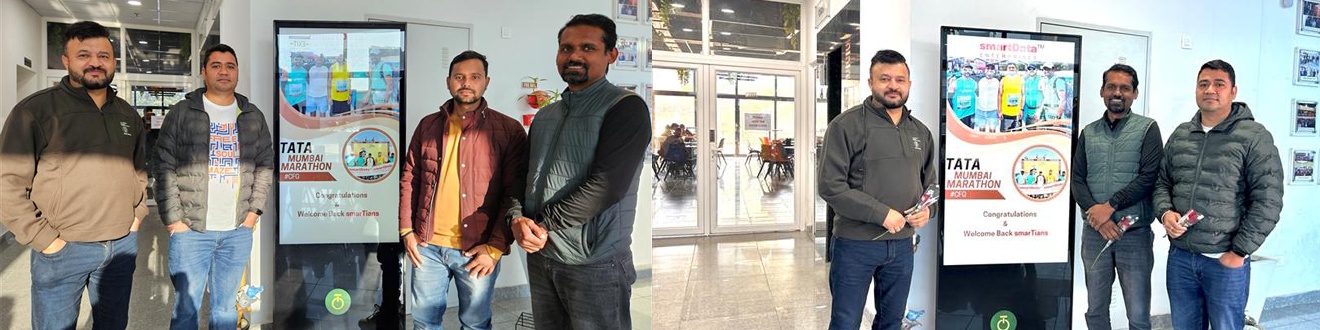
Running is a recurring interest for Tewari, along with high altitude trekking. He has written about completing the Melbourne Marathon in 2024 and about the discipline of returning to a task repeatedly. His running posts make room for doubt and for the need to pace an effort.
One of his Melbourne lessons is particularly serviceable outside a race: “We can’t sprint through everything.” It is an agreeable sentence to hear from a technology executive. Software businesses produce plenty of urgency without anybody having to manufacture extra.
The office welcome also puts colleagues into his sporting life. Here they appear together as participants in the same event, with a shared distance behind them. For a moment, the photograph’s organising principle is a race rather than an organisation chart.
Twenty-seven years in, another change of course
smartData’s 27th Founder’s Day in August 2026 gave Tewari another occasion to describe what should come next. His emphasis was on turning accumulated engineering experience into reusable capabilities and intellectual property. The business is pursuing an AI-first, platform-led model, with enterprise automation among its developing offerings.
The practical ambition is to carry useful knowledge from one engagement into the next. Reusable components and the company’s smartPods are intended to make that possible while leaving room for a client’s particular requirements. Experience becomes more valuable when a team can apply it again without rebuilding everything around it.
In his message for 2026, Tewari also stressed governance, explainability and reliability when applying AI. Those are demands a client can ask awkward questions about. An impressive demonstration lasts a few minutes; an operational system has to keep answering after the presentation has closed.
His international work continues alongside that change. A leadership visit to Dubai with CFO Vinay Tewari focused on relationships and smartData’s Middle East presence. In August 2026, he was also recognised at the Zee Media and SAP Architects of Viksit Bharat forum in Ludhiana.
The destinations have changed since his shipping years, and so has the work waiting when he arrives. The recurring task is familiar: understand the operation, find the people who can do it well, and keep learning enough to make the next decision. Tewari’s career began with a training ship. It has left him with a company that needs to keep learning too.